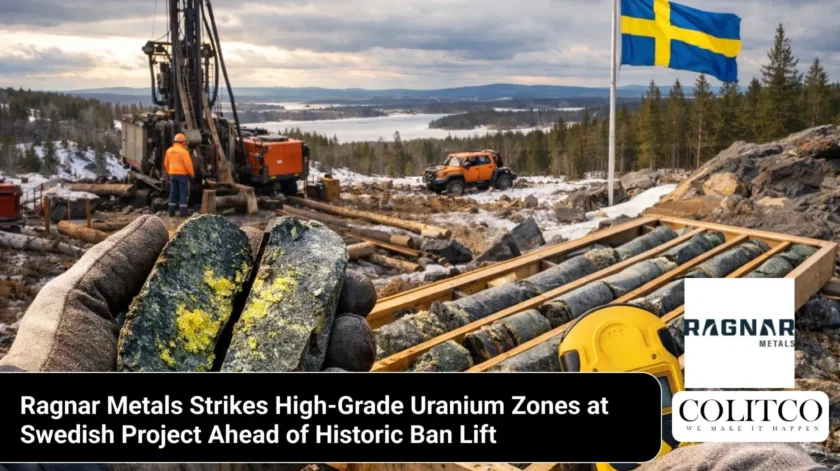
Ragnar Metals Limited (ASX: RAG) has delivered a breakthrough update from its Klockartorpet uranium project in Sweden. Surface rock sampling has confirmed high-grade uranium zones extending over 150 metres of strike length.
The timing could hardly be better. Sweden’s parliament lifted its seven-year uranium mining ban in November 2025, with the regulatory changes taking effect from 1 January 2026.
This positions Ragnar as one of the early movers in a jurisdiction that holds approximately 27% of Europe’s known uranium resources.
Rock Samples Return High-Grade Intercepts
Recent fieldwork at Klockartorpet has identified significant uranium mineralisation associated with sheared and hematite-altered rock. The highlight assay results include:
- Sample GH123: 0.29% U₃O₈, 1.2% ZrO₂ and 205 ppm hafnium
- Sample GH125: 0.15% U₃O₈, 0.9% ZrO₂ and 165 ppm hafnium
- Sample OLSGS012: 0.12% U₃O₈, 1.3% ZrO₂ and 251 ppm hafnium
These grades are exceptional for surface rock samples. The mineralisation was identified over 150 metres of exposed shear zone trending north-south.
Radioactivity was centred around a 5-20 centimetre wide shear zone with strong hematite alteration and possible uraninite veins. Scintillometer readings indicated radioactive zones extending up to 3 metres in width.
Ragnar’s Executive Director Eddie King noted the significance of the discovery. “These results at Klockartorpet demonstrate the prospectivity of Ragnar’s extensive uranium portfolio in Sweden,” he said.
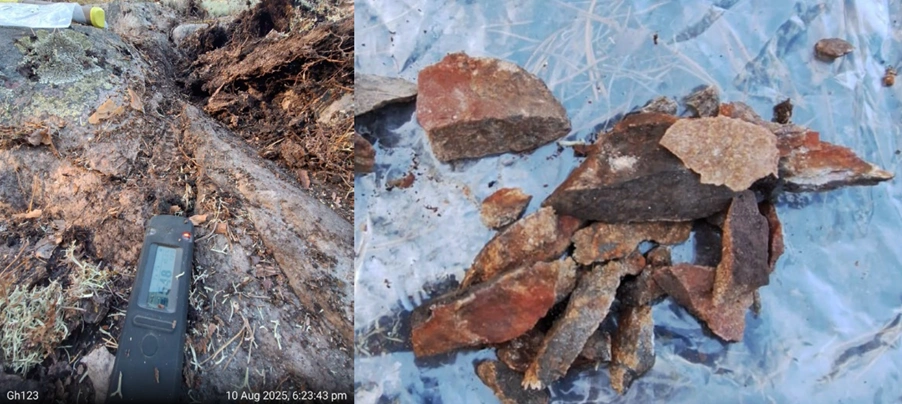
20cm wide zone of shear-hosted uranium mineralisation and hematite alteration at Klockartorpet Project where sample GH123 assayed 0.3% U₃O₈ [Ragnar Metals]
1-Kilometre Anomaly Extends Discovery Potential
Reprocessing of publicly available radiometric data has revealed that the Klockartorpet uranium anomaly extends approximately 1 kilometre in length. The data suggests the shear zone may bend to the southeast.
More significantly, at least four additional uranium anomalies have been identified across the project area. These remain untested and represent priority targets for future fieldwork.
Historical records from the Swedish Geological Survey document uranium occurrences in the area dating back to exploration between 1980 and 1985. This historical context supports the geological interpretation of a regionally extensive mineralised system.
The geochemical signature showing elevated zirconium and hafnium alongside uranium suggests a possible association with alkalic magmatic processes. However, this interpretation requires further mineralogical work to confirm.
Sweden’s Uranium Renaissance Gains Momentum
Sweden’s decision to lift its uranium mining ban marks a strategic shift in European energy policy. The ban, imposed in 2018, had prevented any new uranium exploration or mining permits despite the country’s substantial resources.
The legislative changes reclassify uranium as a “concession mineral” under Sweden’s Minerals Act. This brings uranium exploration and development under the same regulatory framework as other minerals.
Nuclear power currently supplies approximately 30% of Sweden’s electricity through six operating reactors. The government has committed to expanding nuclear capacity equivalent to two reactors by 2035, with massive expansion planned through to 2045.
This domestic uranium development directly supports Sweden’s nuclear expansion plans while enhancing European energy security. The proximity to major European nuclear facilities offers significant advantages over traditional supply chains spanning multiple continents.
Several ASX-listed companies are now positioned to benefit from Sweden’s policy reversal. The uranium sector has attracted renewed investor interest as uranium prices recovered to above US$82 per pound in January 2026.
Ragnar’s Multi-Project Swedish Portfolio
Klockartorpet represents just one element of Ragnar’s broader Swedish exploration portfolio. The company holds multiple uranium projects across the country, positioning it to capitalise on the regulatory changes.
Ragnar’s immediate focus includes:
- Commencing XRD analysis of pulps to define mineralogy
- Further field sampling across the four untested radiometric anomalies
- Permitting for shallow drill sampling and channel sampling
- Developing high-quality drill targets
The company plans to integrate these uranium exploration activities with its flagship Harnäs Gold Project. A maiden drill programme at Harnäs is scheduled for the first quarter of 2026.
This dual-focus strategy allows Ragnar to advance both precious metals and critical minerals projects. The company previously sold its Tullsta nickel project to BHP for A$9.8 million in September 2023, retaining a 1% net smelter royalty.
Ragnar also holds strategic investments in other Australian mining companies. The company owns 14.7% of High-Tech Metals and 16.4% of Kaiser Reef, diversifying its exposure across the resources sector.
Global Uranium Market Fundamentals Strengthen
Uranium prices have demonstrated resilience entering 2026, trading above US$82 per pound in early January. This represents a 12.5% increase compared to the same period in 2025.
Industry experts project uranium demand will surge by 28% by 2030, climbing from approximately 67,000 metric tonnes in 2024 to nearly 87,000 tonnes annually. The World Nuclear Association forecasts demand could exceed 150,000 metric tonnes by 2040.
This growth is being driven by multiple factors:
- Nuclear reactor life extensions and new builds globally
- Rising electricity demand from artificial intelligence and data centres
- Government commitments to carbon-neutral energy targets
- Supply constraints from years of underinvestment
Analysts anticipate uranium prices could reach US$100-120 per pound by late 2026 if supply fails to respond adequately to demand growth. Long-term contract prices have already climbed US$8-10 above spot prices, signalling utility confidence in higher prices ahead.
The strategic importance of uranium was reinforced when it was reinstated to the United States Geological Survey’s 2025 List of Critical Minerals. This designation enables supportive domestic supply chain initiatives and reflects uranium’s status as essential for energy security.
Technical Work Advances Understanding
Ragnar’s fieldwork was guided by handheld scintillometer readings, proving highly effective in identifying radioactive zones. The scintillometer detected radioactivity across zones up to 3 metres wide associated with the shear structure.
All rock samples were analysed by ALS laboratories in Piteå, Sweden. The samples underwent fire assay for gold and multi-element analysis including four-acid digest for base metals by ICP-MS.
The host rock remains uncertain due to strong alteration, with some samples resembling granodiorite. This contrasts with historical Swedish Geological Survey documentation describing the area as quartzite.
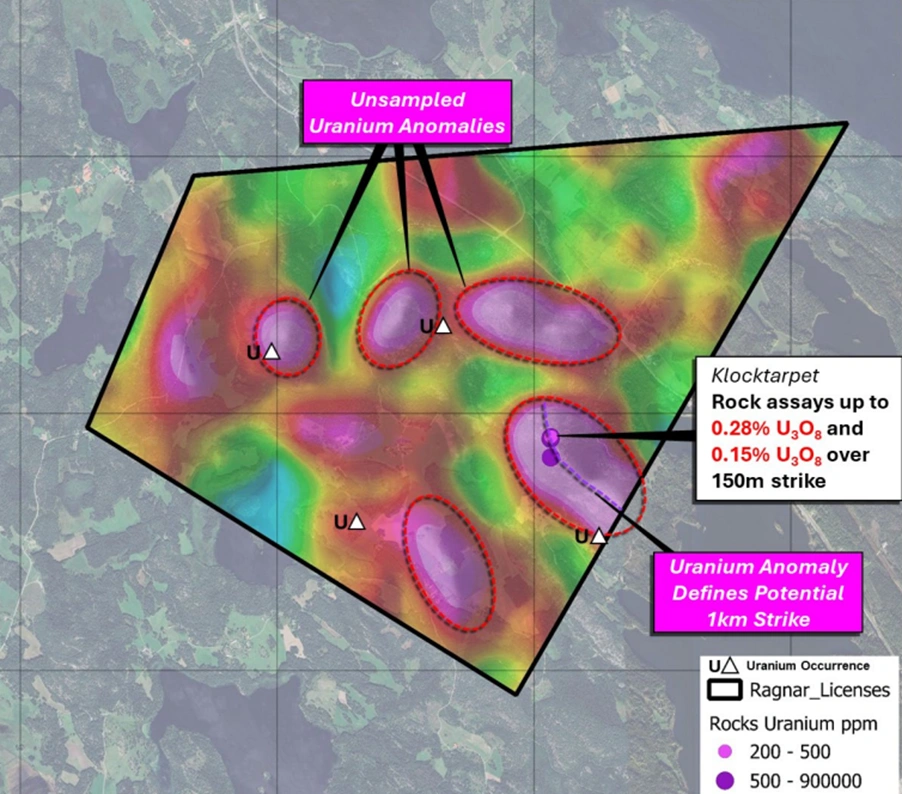
Air photograph image overlayed with radiometric uranium image [Ragnar Metals]
Further mineralogical work including XRD analysis will help clarify the geological setting and mineralisation style. Understanding whether the uranium is related to alkalic intrusive activity could provide important vectoring for future exploration.
The elevated zirconium and hafnium concentrations alongside uranium suggest a hydrothermal system potentially linked to deeper magmatic processes. This geological signature differs from many conventional uranium deposit types.
Also Read: Why Niobium Could Be Australia’s Next Critical Minerals Goldmine
Investor Outlook
Ragnar Metals’ Klockartorpet discovery comes at an opportune moment as Sweden opens to uranium development. The high-grade surface samples and 1-kilometre anomaly provide a compelling foundation for follow-up work.
As of 13 January 2026, Ragnar Metals (ASX: RAG) is trading at A$0.030 per share. The company has a market capitalisation of approximately A$14.2 million with 474 million shares on issue.
The stock’s 52-week range spans A$0.016 to A$0.030, indicating significant volatility typical of early-stage exploration companies. Trading volumes have been relatively modest as the company advances its exploration programmes.
Ragnar’s positioning across multiple Swedish uranium projects provides portfolio diversification within the emerging Scandinavian uranium province. The company’s strategy to develop drill targets at Klockartorpet while advancing its Harnäs Gold Project demonstrates measured capital deployment across commodities.
The lifting of Sweden’s uranium ban from 1 January 2026 creates a window of opportunity for companies with established tenement positions. Ragnar’s 100% ownership of Klockartorpet through its subsidiary Ragnar Exploration AB provides uncomplicated ownership structure.
With uranium markets entering a structural supply deficit and Sweden positioning itself as a domestic European uranium supplier, explorers like Ragnar could benefit from multiple tailwinds. The combination of high-grade surface samples, extensive radiometric anomalies, and favourable regulatory changes positions the company for an active 2026 exploration season.
Investors should note that exploration-stage projects carry inherent risks, and there is no guarantee of economic mineralisation or future production. The uranium sector’s cyclical nature also means prices and investor sentiment can shift rapidly based on geopolitical developments and supply-demand dynamics.