
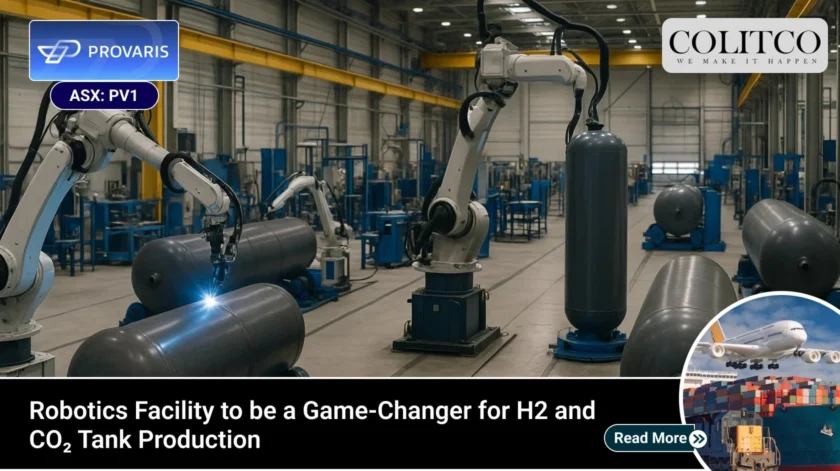
Provaris Energy Ltd (ASX: PV1)(‘Provaris’ or ‘the Company’) has marked a major step forward in its hydrogen and carbon-dioxide tank development program, following the full commissioning of its robotic fabrication cell and ongoing construction of the H2 Prototype Tank at Fiskå, Norway. With strategic partners, such as “K” Line, Yinson Production, Harbour Energy and Clarksons, visiting the site to witness the automated system in action, the Company is positioning itself as a global frontrunner in large-scale compressed gas storage solutions.
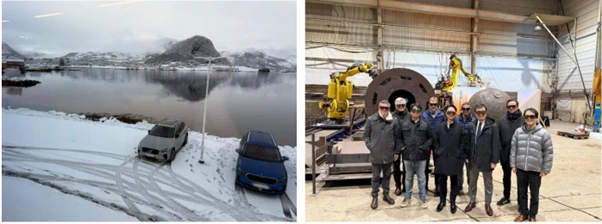
Figure 1: Delegation visit to the Fiskå Innovation Centre in Norway, November 2025.
During a recent onsite update, Provaris’ Managing Director & CEO, Martin Carolan, and Chief Technical Officer, Per Cato Roed, provided an inside look at the prototype, the robotic system, and the objectives of the testing program.
Inside the Prototype: A Closer Look at the Tank and Facility
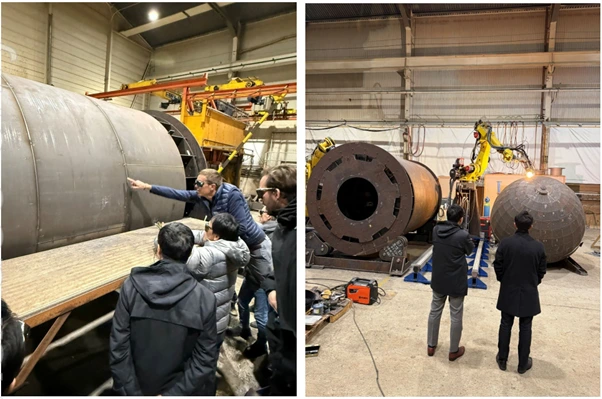
Figure 2: A closer view of the prototype tank during the delegation’s visit.
A short video has been released on YouTube featuring Provaris CEO Martin Carolan and CTO Per Roed onsite, providing an explanation of the Robotic Cell and prototype tank. The YouTube update begins with Martin addressing viewers directly: “Hi everyone. Here I am with our CTO, P Road. We’re on site at Fiska where we are constructing the prototype. As you can see behind me, we’ve got the installed robots and tank sections in progress.”
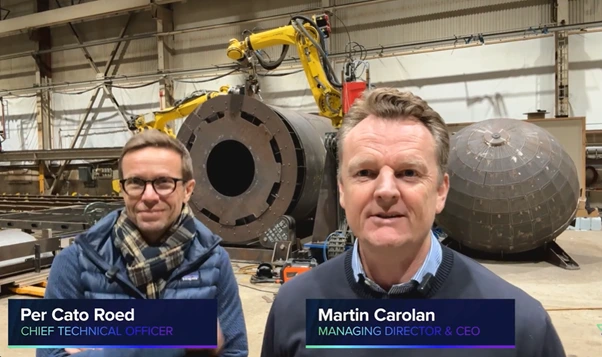
Figure 3: Provaris’ Managing Director & CEO, Martin Carolan, and Chief Technical Officer, Per Cato Roed, in the YouTube video. [YouTube/Provaris Energy]
The prototype tank currently consists of a large cylindrical section and an end cap, both positioned within the robotic welding bay. As Per explains: “The prototype tank is shown in the back here, is currently a cylindrical part and an end cap. When it’s all complete, it will be a tank approximately 2.5 m in diameter and 9 m in length. It’s in total about 34 tons of steel.”
This sizeable steel structure forms the foundation for Provaris’ world-first layered plate tank design, which leverages high-accuracy robotics to ensure precision welding down to the nanometre level.
Commissioning Complete: Robotics Driving New Manufacturing Efficiencies
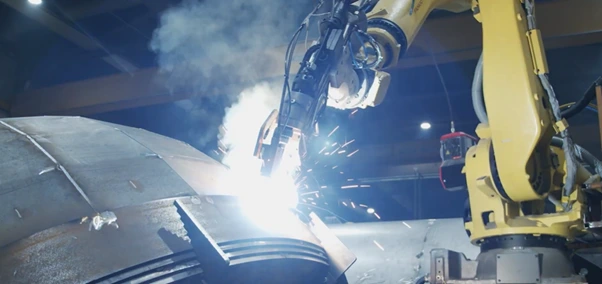
Figure 4: Robotic arm in operation [YouTube/Provaris Energy]
The Company recently announced the completion of commissioning activities for the robotic cell. The sophisticated system integrates industrial robotics for plate handling and laser-welding, creating a scalable production environment suitable for both hydrogen and CO₂ carriers.
Per highlights the rigorous calibration process: “Since we acquired all this, we’ve been setting everything up to make sure that we get everything down to the nano meter accuracy that we need to do the welding and the material handling.”
He adds that early testing is focused on ensuring perfect alignment and avoiding misconfiguration: “As we started up was to commission all the equipment, get all the calibration done. And now then slowly but surely testing to make sure that we don’t set anything wrong up in the first place.”
With calibration complete, welding rates will accelerate through December to meet the target of finishing the prototype fabrication in the first quarter of 2026.
Testing Objectives: Proving Lifetime Performance
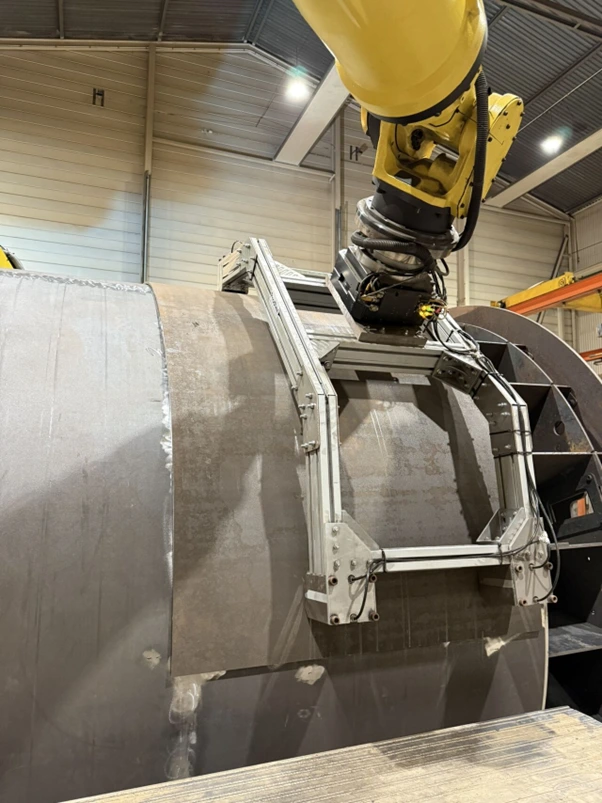
Figure 5: Image showing a close-up of the steel layers or the welding head. [LinkedIn/Provaris Energy]
The prototype tank forms a critical component of the H2Neo carrier approval program. Once complete, the tank will undergo a lifetime-equivalent load-cycle test to prove long-term structural resilience. As Per summarises: “We going to build up the tank and then test that to prove that we can survive the lifetime of the ship. So basically test the load cycles that the tank is going to be exposed to over the lifetime.”
Moreover, the robotic cell functions as a full-scale proof of concept for future industrial production. The aim is to demonstrate how the tank manufacturing system can be scaled for commercial hydrogen and CO₂ carriers.
Strategic Partner Visits: Demonstrating Automation and Quality
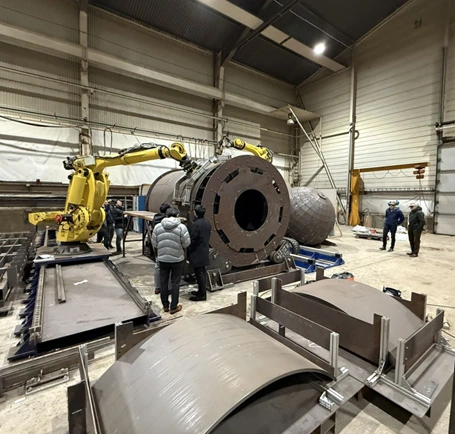
Figure 6: Photo of the delegation visit inside the fabrication facility. [LinkedIn/Provaris Energy]
During November 2025, Provaris welcomed a delegation from “K” Line, Yinson Production, Harbour Energy and Clarksons. Many visitors came from traditional maritime or oil and gas backgrounds, where such advanced robotic fabrication methods are uncommon.
Per describes common reactions: “The maritime and oil and gas industry are not necessarily used to robotics and this level of automation for building something that we’re doing here. So I think for them to see how basically this runs is the number one thing and to see the level of quality assurance that we can get out of this equipment.”
For Yinson, the visit also reinforced synergies between hydrogen and CO₂ tank development: “Everything that we’ve done over the last five to six years on the H2 tank is all leveraged into what we’re doing on the CO2 tank.”
Commercial Collaboration: H2Neo and CO₂ FEED Progress
The Company continues to strengthen its relationship with “K” Line, which is actively engaged in technical and commercial planning for H2 shipping. The robotic facility enables both parties to validate construction pathways for large-scale carbon-steel tanks.
In parallel, the CO₂ FEED program with Yinson is progressing rapidly. Provaris’ multi-layered plate design is being transferred to a 25,000-cbm low-pressure LCO₂ tank intended for storage and offshore injection.
Provaris states that these designs could be a “game-changer” by reducing costs and enabling large-scale decarbonisation value chains.
Looking Ahead
Martin concludes the onsite update by emphasising the forward momentum: “We’ll continue to make updates as we get through and see ramp up of welding through the rest of this year and we look forward to achieving our targets in 2026.”
Investor Outlook
Provaris Energy Ltd (ASX: PV1) saw its stock price increase by 7.14% following the announcement.
- Last Price: $0.015
- Today’s Change: +$0.001 (+7.142%)
- Market Capitalisation: $12.15M
- 52-Week Range: $0.008 – $0.027
Investor sentiment is strengthening as the Company enters a critical phase in its prototype and FEED programs. The successful scaling of robotic fabrication, ongoing strategic partner engagement, and anticipated testing milestones in early 2026 position Provaris to unlock commercial pathways in hydrogen and CO₂ supply chains. With a low market capitalisation relative to development progress, PV1 remains a closely watched emerging-technology stock in Australia’s clean-energy sector.