
Crude oil has smashed through the US$100 per barrel mark, and while energy stocks are celebrating, two of the ASX’s most dependable blue-chip names are sitting firmly in the crosshairs. Before the United States attacked Iran at the end of last month, crude oil was trading at around US$72 per barrel. It has since crossed US$100, at one point approaching US$120 last week.
The trigger was the closure of the Strait of Hormuz, a critical chokepoint that usually hosts about 20% of the world’s oil traffic, following the outbreak of the US-Iran War.
The shockwaves have been severe. The S&P/ASX 200 Index (ASX: XJO) has dropped roughly 6.5% through March alone. But the real damage for everyday investors may be hiding in plain sight, inside the logistics networks of a supermarket giant and the toll roads that millions of Australians drive every day.
What Happened: A Strait Shuts and Oil Explodes
As of mid-March 2026, Brent crude oil was trading at approximately US$102 per barrel, up around USD$30 compared with a year ago. The speed of that climb has caught markets off guard.
On the ground in Australia, the national average petrol price reached 219.5 cents per litre for the week ending March 15, 2026, while diesel hit 245.6 cents per litre. These are not just numbers on a screen. They flow directly into the operating costs of businesses that move goods and manage infrastructure across the country.
Importantly, the oil price is up a striking 69.2% in 2026. That kind of move in such a short window forces CFOs to rewrite their cost assumptions almost overnight.
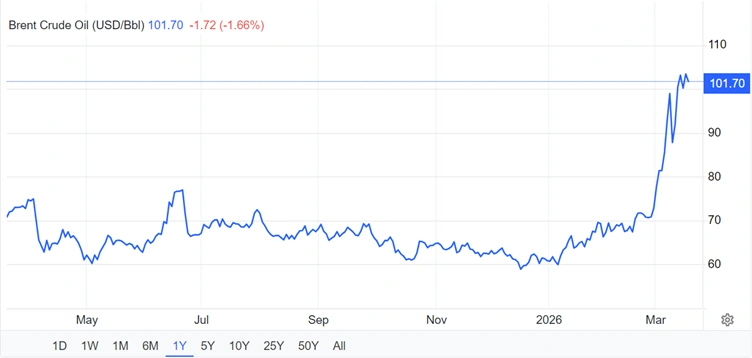
Brent crude oil price movement in 2026 [Trading Economics]
Why It Matters to ASX Investors
Rising oil prices don’t just hurt airlines and energy importers. They eat into the margins of any business that depends on fuel to function. That means freight operators, distribution networks, and any company with a fleet of heavy vehicles rolling across the country daily.
Australia imports roughly 90% of its refined fuel products. There’s no domestic buffer. When global prices spike, Australian businesses absorb the hit almost immediately. For companies that can’t easily pass costs to consumers, that’s a direct drag on earnings.
The broader ASX 200 has already been rattled by Middle East oil tensions before, but the current conflict represents the sharpest supply disruption since Russia’s invasion of Ukraine in 2022.
Who Is in the Firing Line: Woolworths and the Diesel Problem
Woolworths Group Limited (ASX: WOW) looks, at first glance, like a business insulated from oil shocks. It sells groceries, not petrol. But that view misses the engine room of the company’s operation.
Woolworths runs one of Australia’s largest private logistics networks. Goods move from suppliers to distribution centres, then out to more than 1,000 stores nationwide. On top of that, the company’s home delivery service adds another layer of diesel-powered movement across suburban Australia.
This vast logistics network that moves huge volumes of groceries around the country is heavily reliant on diesel-powered trucking. Its fuel bill has probably already ballooned and could continue to do so as long as oil prices remain elevated.
Woolworths faces a difficult choice. It can absorb the higher costs, which hit profit margins. Or it can pass them on to customers already under pressure from fuel costs weighing on Australian households. Neither option is clean.
How Transurban Is Exposed: Traffic May Thin Out
Transurban Group (ASX: TCL) is a different kind of business. It owns and operates toll roads in Sydney, Melbourne, and Brisbane, and collects steady, inflation-linked revenue from the vehicles that use them. Income investors love it for exactly that stability.
But elevated fuel prices introduce a risk that toll road operators don’t face during normal conditions. Many road users can change to using alternative forms of transport, or increase their working-from-home hours, if the cost of driving spikes.
Others might opt for a train, bus, ferry or bicycle if fuel costs remain elevated. If US$100 oil persists through much of 2026, Transurban’s normally stable traffic volumes may take a hit.
Transurban’s toll increase mechanism helps partially offset softer demand. However, if fewer cars are on those roads, the volume side of the revenue equation weakens regardless of what toll rates do.
What the Market Context Says
The Middle East conflict and its impact on ASX market volatility is not a new theme for Australian investors. What’s different now is the scale and speed of the disruption.
There’s no shortage of oil globally, just a shortage of safe shipping routes. That distinction matters because it means prices could correct sharply if the conflict resolves or if the Strait of Hormuz reopens. But until that happens, both Woolworths and Transurban face cost and demand pressures that are likely to show up in their next reporting cycles.
Investors in both companies should watch diesel prices and traffic data closely over the coming months. ASX blue-chip stocks rarely collapse under a single external shock, but margin compression adds up over time.
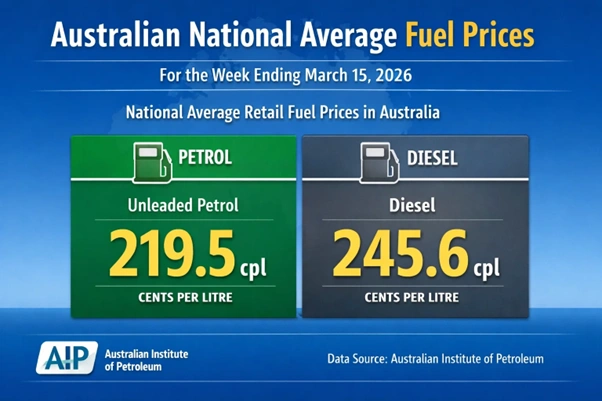
National average retail fuel prices in Australia for the week ending March 15, 2026. [AIP]
Frequently Asked Questions
Q: Why do high oil prices hurt Woolworths?
A: Woolworths relies on diesel-powered trucks to move groceries from suppliers to distribution centres and then to stores across Australia. When diesel prices rise sharply, the company’s freight and logistics costs increase significantly. This either compresses profit margins or gets passed on to consumers through higher prices.
Q: Is Transurban directly exposed to oil prices?
A: Transurban doesn’t consume fuel as a core input, but it depends on motorists using its toll roads. When petrol prices stay high for an extended period, some drivers reduce discretionary travel, switch to public transport, or work from home more often. This can reduce traffic volumes on Transurban’s roads and weigh on revenue.
Q: How much has the ASX 200 fallen due to the oil shock in March 2026?
A: The S&P/ASX 200 Index has fallen approximately 6.5% through March 2026, driven by investor concern over the global economic impact of oil trading above US$100 per barrel following the closure of the Strait of Hormuz.
Q: What is the Strait of Hormuz and why does it matter for oil prices?
A: The Strait of Hormuz is a narrow waterway between Iran and Oman that connects the Persian Gulf to the Arabian Sea. Around 20% of the world’s oil supply passes through it daily. Its closure due to the US-Iran conflict has removed a significant portion of global oil supply from the market, driving prices sharply higher.
Q: Could oil prices come back down?
A: Possibly, and quickly, if the conflict de-escalates. Analysts note there is no fundamental shortage of oil globally, only a disruption to shipping routes. A resolution to the conflict or a reopening of the strait could bring prices back toward pre-conflict levels.
Disclaimer: This article is general in nature and does not constitute financial advice. We accept no responsibility for any claim, loss, or damage arising from the use of this information. Always consult a licensed financial adviser before making investment decisions.
Source:
Motley Fool Australia
Fortune.com
Australian Institute of Petroleum