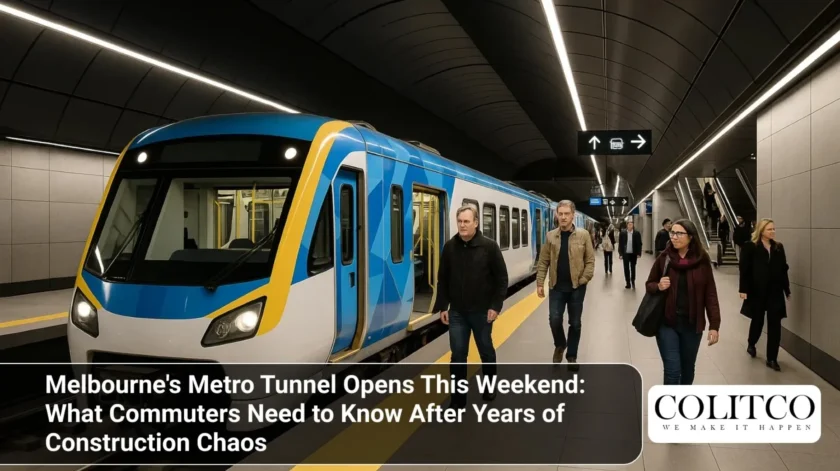
Sunday 30 November 2025 marks a turning point for Melbourne’s transport network. The Metro Tunnel project finally throws open its doors after nearly a decade of planning, construction, and significant disruption across the CBD.
The $12.8 billion infrastructure project represents the biggest overhaul to Melbourne’s rail system in 40 years. Five brand-new underground stations will welcome passengers for the first time, connecting the city’s north-west to south-east suburbs through twin nine-kilometre tunnels.
Victorians won’t pay a cent to try it. The government announced free weekend public transport across the entire state until 1 February 2026 to celebrate the opening.
Ready to catch a train?
Metro Tunnel opens tomorrow, here’s what you need to know: https://t.co/1q5Y3gASmT
We can’t wait to show you what we’ve been building underneath Melbourne. pic.twitter.com/0b0d40Qx05
— Metro Tunnel (@metrotunnelvic) November 29, 2025
Years of Disruption Finally Pay Off
Construction began in early 2017, transforming sections of Melbourne’s CBD into construction zones. City Square and parts of Swanston Street remained closed for years while crews built the tunnel and stations beneath the city’s busiest streets.
The tunnelling work started in 2019 and wrapped up in 2021. The five new stations reached completion in October 2025, bringing an end to the most visible construction impacts.
For businesses and residents in affected areas, the wait has been long. But transport planners say the payoff will be substantial.
Five New Stations Change the Map
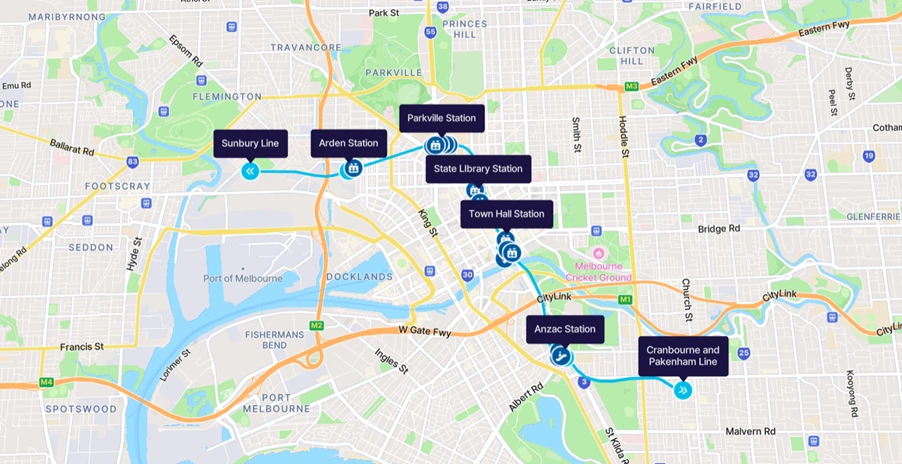
The Metro Tunnel brings these underground stations online:
- Arden Station – connecting the growing urban development precinct in North Melbourne
- Parkville Station – serving Royal Melbourne Hospital, Royal Women’s Hospital, and Peter MacCallum Cancer Centre
- State Library Station – providing direct access to RMIT University and Queen Victoria Market
- Town Hall Station – linking to Melbourne’s arts district, Federation Square, and Southbank
- Anzac Station – Melbourne’s first tram-train interchange on St Kilda Road
Each station sits up to 40 metres below street level and includes lifts, hearing loops, and accessible facilities throughout.
How Services Will Run During Summer Start
Don’t expect full service from day one. The tunnel opens with a cautious “Summer Start” phase to test operations and iron out any issues.
Weekday services (30 November onwards):
- Trains run every 20 minutes between Westall and West Footscray
- Operating hours: 10am to 3pm
- All existing City Loop services continue unchanged
Weekend services:
- Trains run every 20 minutes between Westall and West Footscray
- Operating hours: 10am to 7pm
- Some services extend to East Pakenham (every 40 minutes) and Sunbury (every 60 minutes)
Transport Victoria will add 240 extra services weekly during this period. Passengers on the Cranbourne, Pakenham, and Sunbury lines can choose between existing City Loop services or the new Metro Tunnel route.
The full timetable overhaul arrives on 1 February 2026, when all Cranbourne, Pakenham, and Sunbury line services shift exclusively to the Metro Tunnel.
Free Weekend Travel Sweetens the Deal
All Victorian public transport runs free on Saturdays and Sundays from 30 November 2025 through 1 February 2026. This includes trains, trams, and buses across the state.
Passengers don’t need to tap on or off their Myki cards during this period. Transport gates will stay open at Metro Tunnel stations, with extra staff on hand to help people navigate the new system.
West Gate Tunnel Still Running Behind Schedule
While the Metro Tunnel opens ahead of its original 2026 target, another major Melbourne infrastructure project continues to face delays.
The West Gate Tunnel was originally slated for completion in September 2022. Contaminated soil disposal issues and construction stand-offs pushed the opening into 2025.
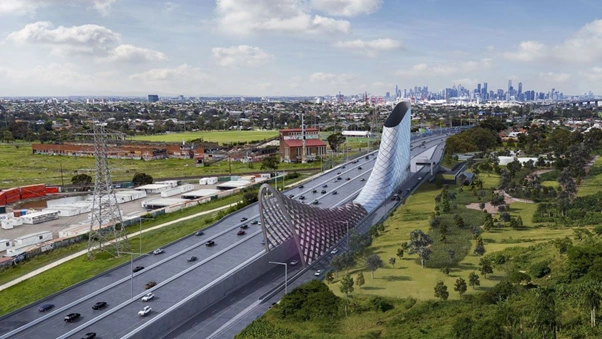
The four-kilometre toll road will connect the West Gate Freeway at Yarraville with the Port of Melbourne and CityLink through twin tunnels. Project costs have ballooned from an initial $5.5 billion to as high as $11.9 billion.
Construction entered its final stages in 2025, with the tunnel now scheduled to open by year’s end. Major asphalting work and final testing continue on the West Gate Freeway, causing ongoing lane closures and delays for motorists.
The project includes widening the West Gate Freeway from eight to 12 lanes between the M80 Ring Road and the West Gate Bridge.
What This Means for Melbourne’s Future
The Metro Tunnel will double the size of Melbourne’s underground rail network. Transport planners project it will carry more than 500,000 passengers daily once fully operational.
High-capacity signalling rolled out across the Cranbourne, Pakenham, and Sunbury lines enables faster, more frequent services. During peak periods, trains could arrive as often as every three to four minutes on some routes.
The project connects two of Melbourne’s biggest housing growth corridors: Cranbourne-Pakenham in the south-east and Sunbury-Diggers Rest in the north-west.
Regional passengers gain new options too. Most can connect to Metro Tunnel services with a single change to the Sunbury or Pakenham lines.
Economic Impact and Job Creation
The project created thousands of construction jobs during its seven-year build. A 2005 Monash University study first conceived the tunnel concept, showing how academic research can shape major infrastructure projects.
The tunnel targets the “80-20 rule” in transport planning. About 80% of Melbourne’s train users travel through the inner city, making a relatively short tunnel highly cost-effective per passenger served.
Construction challenges included managing vibration impacts on nearby buildings. The Victorian Comprehensive Cancer Centre in Parkville and the Manchester Unity Building in the CBD raised concerns during planning. Project managers worked with stakeholders to minimise these impacts.
Testing and Safety Preparations
The first test train ran through the tunnel in July 2023. By August 2023, trains were running at the full tunnel speed of 80 kilometres per hour.
The National Rail Safety Regulator granted full accreditation in November 2025, clearing the path for passenger services.
Metro Trains Melbourne allocated funds to train and employ 300 extra train drivers and station staff for the expanded network operations.
Looking Ahead: Airport Rail Link
The Metro Tunnel forms the foundation for the planned Melbourne Airport Rail link. That project remains in the planning stages, with implementation expected by the end of the decade.
The airport connection will run through the Metro Tunnel, creating a seamless link from the airport through the CBD to Melbourne’s south-east growth corridors.
Also Read: Historic Environmental Law Reforms Pass Parliament After Greens Deal Strikes Conservation Win
What Happens Next
The 30 November opening kicks off a two-month testing period. Transport authorities will monitor passenger flows, system performance, and service reliability before implementing the full timetable on 1 February 2026.
Passengers can plan their journeys at the Transport Victoria website closer to the opening date.
After years of construction noise, road closures, and pedestrian detours, Melbourne commuters can finally see the results. The Metro Tunnel promises faster trips, more frequent services, and better connections across Australia’s second-largest city.
For residents who endured the disruption, Sunday’s opening can’t come soon enough.