

Building wealth does not require a large inheritance or a finance degree. It requires small, consistent actions repeated daily. For Australians navigating the ASX and broader markets, daily investing habits Australia experts recommend are often simpler than most people expect.
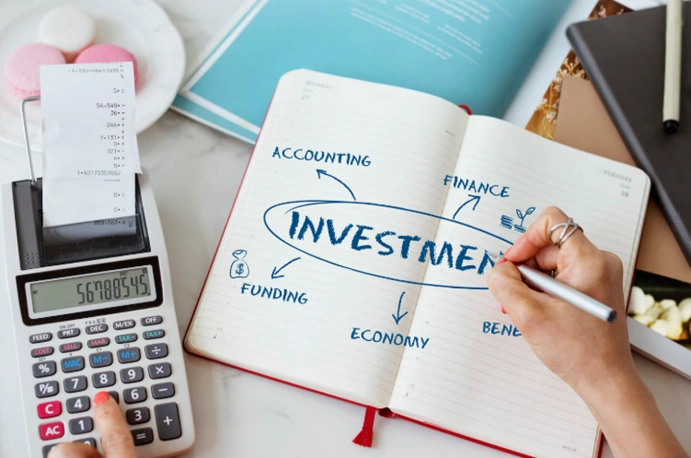
Figure 1: Building a disciplined investment plan through budgeting, financial tracking, and long-term portfolio strategy. [Freepik]
The good news is that starting small is not just acceptable. It is often the smartest move you can make.
Start Small, Stay Consistent
The most powerful daily investing habit is also the most overlooked. Investing a small, fixed amount every day, regardless of market conditions, is the foundation of portfolio growth strategies Australia financial planners swear by. As little as $10 a day, redirected into quality ASX shares or ETFs, can grow to approximately $515,000 over 30 years at an average annual return of 9%.
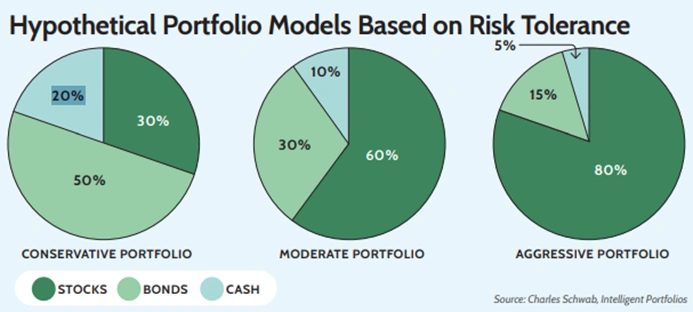
Figure 2: Illustration of how compound interest can significantly grow investments over time with consistent returns. [Harvard Business School]
The driver behind that number is not stock-picking skill. It is time and compounding. A $10,000 investment compounding annually at 5% grows to more than $40,000 after 30 years, accruing over $30,000 in compound interest alone.
Let the Market Work for You
Stop waiting for the perfect moment. Research by Charles Schwab concluded that the cost of waiting for an ideal entry point typically outweighs the benefit of even perfect timing. Australian stock market investing rewards those who participate early and stay consistent.
Dollar-cost averaging is one of the most reliable daily investing habits Australia investors can adopt. By investing a fixed amount regularly, investors automatically buy more units when prices are low and fewer when prices are high, smoothing out volatility over time.
Understanding Your ASX Portfolio
Knowing what is in the portfolio and why it is there separates confident investors from anxious ones. For Australian stock market investing, understanding whether holdings are growth stocks, value stocks, ETFs, or bonds matters. Here is what to check for each holding:
- Whether the Company is growing revenue year over year
- Whether the asset class matches the current risk profile
- Whether the holding still aligns with the long-term financial goal
- Whether future earnings are forecast to grow
Quality and clarity beat complexity every time.
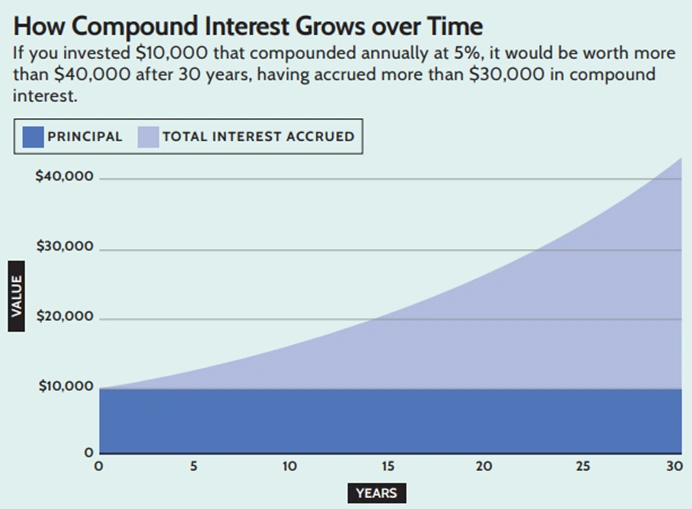
Figure 3: Key metrics investors use to evaluate stocks, including price trends, market capitalisation, dividend yield, and P/E ratio. [Harvard Business School]
Balance Emotion With Discipline
Markets move up and down. One of the most valuable daily investing habits Australia investors can build is staying calm during volatility. Investors who exited markets in March 2020 ended the year with a loss. Those who stayed saw portfolios recover, with some finishing the year up 20%.
The habit is simple. Before reacting to any market move, sleep on it. Review the decision in a day or two. Avoid checking portfolio values daily and set a quarterly schedule for reviewing holdings.
Automate and Rebalance Regularly
Automating contributions removes emotion from investing entirely. Australians with superannuation contributions already experience this through the compulsory employer system, which is dollar-cost averaging in practice. Here is what the annual review should cover:
- Check whether asset allocation still reflects personal goals
- Rebalance if equities or bonds have drifted from the target split
- Confirm automated contributions are directed to the right accounts
- Review whether the current strategy still suits the life stage
Automate, but do not go on autopilot.
Match Risk to Your Stage of Life
Risk tolerance changes as life does. Younger investors can absorb more volatility because they have time to recover. Those approaching retirement should shift toward stable assets such as bonds and income-producing ETFs.
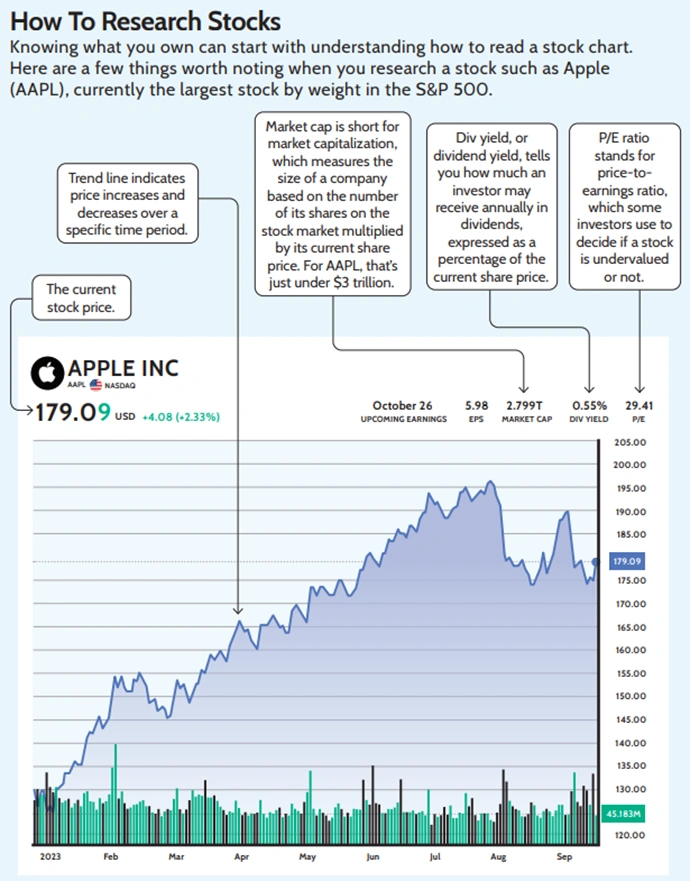
Figure 4: Example portfolio allocations for conservative, moderate, and aggressive investors based on risk tolerance. [Harvard Business School]
The annual habit is to ask honestly whether the current allocation matches the current life stage. If a 45% portfolio drop would affect daily life significantly, the allocation likely carries too much risk.
Stay Tax Aware Every Step
Tax efficiency is one of the most underappreciated daily investing habits Australia investors can develop. Core tax habits worth building include:
- Hold assets for more than 12 months to access the long-term capital gains discount
- Avoid frequent buying and selling, which generates short-term gains taxed at the marginal rate
- Use tax-loss harvesting to offset gains by realising losses on underperforming holdings
- Favour ETFs over managed funds, as ETFs rarely distribute capital gains to unitholders
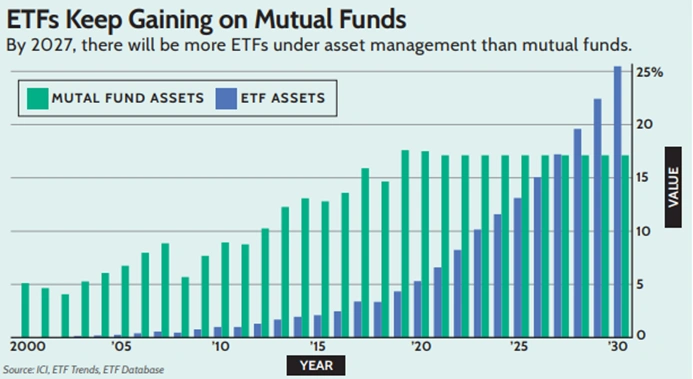
Figure 5: ETF assets under management are projected to surpass mutual funds as investors increasingly favour low-cost index investing. [Harvard Business School]
These behaviours compound into meaningful tax savings, much like portfolio growth strategies Australia investors rely on compound into wealth.
Use Reliable Sources, Not Social Media
Where an investor sources information can strengthen or destroy a portfolio. A 2023 study by the Swiss Finance Institute analysed 29,000 financial influencers and found 56% gave advice leading to negative returns. Only 28% provided genuinely valuable guidance.
For Australian stock market investing, before acting on any tip, ask whether the source holds a regulated qualification or a verifiable track record. Reputable sources include licensed financial advisers, ASX Company announcements, and established financial publications.
Diversify Across Asset Classes
Diversification is a daily investing habit built through consistent, varied contributions over time. Spreading investment across equities, bonds, ETFs, and global markets reduces the damage from any single underperforming asset.
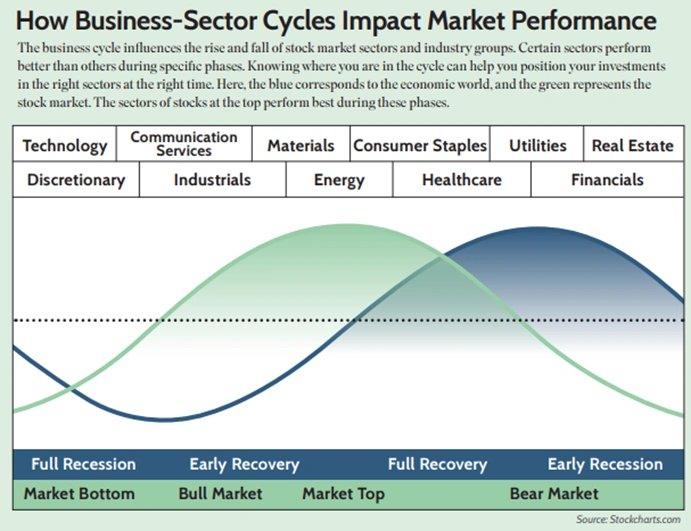
Figure 6: Stock market sectors tend to outperform at different stages of the economic cycle, influencing investment strategies. [Harvard Business School]
A conventional starting point is 60% equities and 40% bonds, adjusted for age and risk profile. Adding a small allocation to global ETFs can provide growth potential when the Australian market is flat. The rule is simple. Do not put all investment capital in one place.
Review Goals, Not Just Numbers
The final daily investing habit Australia investors often overlook is reconnecting with the reason they are investing. Whether the goal is a home, a college fund, debt freedom, or retirement, that goal should anchor every decision.
Markets will fluctuate. Portfolios will have bad months. Goals remain constant. It takes courage to enter the market, commitment to stay in it, and consistency to build meaningful wealth. Those three qualities are the real foundation of portfolio growth strategies Australia investors can rely on for decades.
Frequently Asked Questions
Q1. What are the most effective daily investing habits Australia investors should follow?
Ans. Small, consistent contributions, portfolio reviews, diversification, and tax awareness are among the most effective daily investing habits Australia investors can adopt to build long-term wealth.
Q2. How do portfolio growth strategies Australia investors use work over time?
Ans. Most portfolio growth strategies Australia investors follow rely on compounding, dollar-cost averaging, and long-term investing to steadily grow portfolios despite market fluctuations.
Q3. Why is consistency important in Australian stock market investing?
Ans. Consistency helps investors benefit from compounding and reduces the risk of poor timing. In Australian stock market investing, regular investing often outperforms trying to predict market highs and lows.
Q4. What is dollar-cost averaging, and why is it popular in Australia?
Ans. Dollar-cost averaging involves investing a fixed amount regularly regardless of market conditions. It is widely used in daily investing habits Australia investors follow because it smooths market volatility over time.