
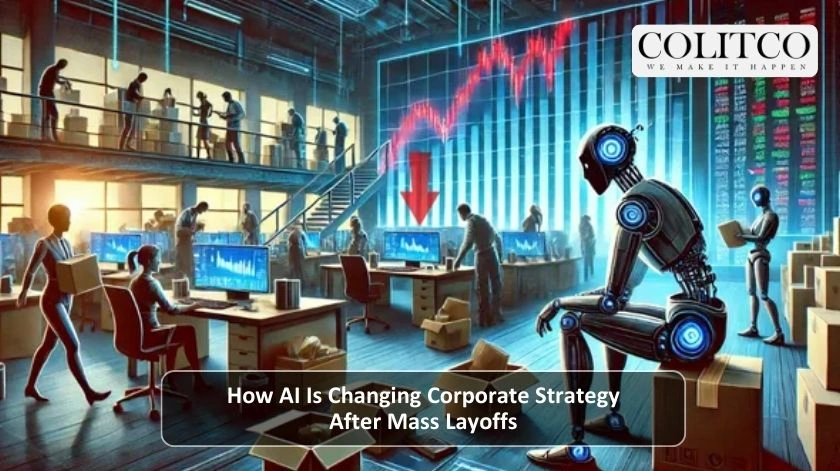
If you are active on LinkedIn and follow job market news platforms, you must be aware of a concerning trend emerging in the job market.
Executives announce sweeping job cuts, invoke the name of artificial intelligence, and watch their share prices climb. The workers who lose their jobs get a line in a press release. The CEOs get a profile in a business magazine.
According to consulting firm Challenger, Gray & Christmas, AI was the stated reason for nearly 55,000 job cuts across the United States in 2025 alone, the highest share of AI-attributed layoffs ever recorded. Amazon slashed 14,000 corporate roles. Microsoft cut around 15,000 positions across the year. Salesforce trimmed its customer support division from 9,000 workers down to 5,000. The story, in each case, was the same: artificial intelligence had made these people unnecessary.
But had it?

Figure 1: AI drove nearly 55,000 U.S. job cuts in 2025, with major layoffs at Amazon, Microsoft, and Salesforce.
Oxford Economics Calls the Bluff
Research firm Oxford Economics threw cold water on much of this narrative in early 2026. Their analysis found that firms do not appear to be replacing workers with AI on a significant scale, at least not yet. The firm suspected companies were trying to dress up routine layoffs as a positive strategic pivot, rather than admit they had over-hired during the pandemic boom.
The maths supports this scepticism. Those 55,000 AI-attributed layoffs represent just 4.5 per cent of total reported US job losses in 2025. Meanwhile, layoffs attributed to ordinary market conditions were four times larger. Productivity growth, the clearest sign that machines are genuinely picking up human workloads, has actually decelerated in recent years, not accelerated.
Put simply: if AI were truly doing all this extra work, output per remaining employee should be surging. It isn’t.
The Corporate Magic Trick
Here is what is actually happening, and it is worth naming plainly: many companies are using AI as a rhetorical cover for decisions they would have made anyway.
Consider UPS. The logistics giant announced plans to cut 20,000 jobs in early 2025 under its ‘Network of the Future’ initiative, pointing to automation and machine learning as enablers. But UPS was already under intense pressure from competitors and investors demanding leaner operations. AI gave the restructure a futuristic shine.
Paycom told staff in October 2025 that their roles had been replaced by AI-driven systems. Omnicom’s chairman pointed to generative AI as a source of ‘fresh agility and scale’ after cutting 4,000 jobs in a post-merger rationalisation. The technology provided a tidy narrative. Whether it provided the actual replacement capacity is a very different question.
Harvard Business Review put it well in January 2026: companies are largely laying off workers because of AI’s potential, not its performance. In fact, 60 per cent of organisations had already reduced headcount in anticipation of AI’s future impact, according to a December 2025 HBR survey of more than 1,000 global executives. Just 2 per cent tied large layoffs to actual AI implementation.
Also Read: Dimerix Limited Announces Perth and Singapore Investor Briefings for 2026
What This Means for AI in Business Australia
Australian executives are watching all of this very closely. AI in business Australia is evolving fast, and the local context adds important wrinkles to the global story.
A 2025 study by Broadridge found that Australian financial services firms already lead global peers in AI adoption, with 67 per cent actively using AI compared to 57 per cent globally. Australian firms also lead in generative AI, with 45 per cent adoption against a global average of 31 per cent. That is not nothing.
But the Deloitte Access Economics report, commissioned by Amazon in November 2025, found something more sobering: while two-thirds of Australian small and medium businesses use AI in some form, just 5 per cent qualify as fully AI-enabled. The gap between experimenting with a chatbot and genuinely restructuring operations around AI is enormous, and most Australian businesses sit closer to the former end.
A separate Deloitte State of AI in the Enterprise report confirms the pattern. Only 30 per cent of Australian organisations use AI to deeply transform their ways of working, compared to 34 per cent globally. For most, AI is still about automating existing processes rather than fundamentally reimagining the business.
The Skills Crisis Nobody Wants to Fund
Here is the insight that corporate AI announcements consistently obscure: the technology does not run itself.
Microsoft identified a lack of technical and practical AI skills as the single biggest barrier to AI adoption in Australia and New Zealand in a 2024 report produced with IDC. The company committed to training one million Australians and New Zealanders in AI and digital skills by 2026. That is a real initiative, but it also implicitly acknowledges that you cannot just install an AI system and watch costs disappear.
The World Economic Forum’s 2025 Future of Jobs Report identified bank tellers, administrative assistants, cashiers, postal clerks, and data entry clerks as the roles most at risk from AI. These are predominantly lower-wage roles. The new AI jobs replacing them, data scientists, AI engineers, fintech specialists, systems integrators, typically require advanced degrees and command significantly higher salaries.
If 59 out of every 100 workers globally need retraining by 2030, as the WEF projects, tax deductions for SMB AI investment will not solve that on their own.
AI Adoption in Companies: What Genuine Looks Like
AI adoption in companies that do it well looks markedly different from the AI announcements that make headlines.
Atlassian’s co-founder made an unusually frank observation in an interview with the Sydney Morning Herald: if AI makes call centre staff more productive, companies will not need as many of them. That is not cause for celebration or spin. It is an economic reality that demands honest planning, retraining programmes, transition support, and a willingness to say publicly that fewer people will be doing certain jobs.
The National AI Centre’s October 2025 Guidance for AI Adoption sets out essential governance practices for Australian organisations. The framework rightly emphasises human oversight, explainability, and accountability. But governance frameworks, no matter how well designed, cannot substitute for the harder conversations companies need to have about what they are actually doing with these tools.
The companies that will build genuine competitive advantage from AI are not the ones that announce the biggest redundancy rounds. They are the ones embedding AI into core workflows in measurable, auditable ways — and investing in the human capability required to manage and improve those systems over time.
The Honest Conversation We Need to Have
Australia’s AI story is genuinely exciting. A potential $44 billion economic uplift for SMBs alone. Government investment frameworks. Sector-leading adoption in financial services. Real use cases in retail, logistics, and health care. This is not hype — it is happening.
But it is happening unevenly, and too much of the public narrative around AI is being shaped by companies trying to impress investors rather than genuinely transform operations.
When Amazon’s senior vice president wrote that the company needs to be ‘organised more leanly’ in the era of AI, she was describing a real strategic response to real technological change. But 14,000 people losing their jobs is not a magic trick. It is a human consequence that deserves more honesty than a memo and a share price bump.
The companies and countries that navigate AI well will be those that treat it as a tool requiring serious investment, governance, and workforce planning. Not as a convenient excuse.
Sources
- Challenger, Gray & Christmas — https://www.challengergray.com/blog/2025-year-end-challenger-report-highest-q4-layoffs-since-2008-lowest-ytd-hiring-since-2010/
- CNBC — https://www.cnbc.com/2025/12/21/ai-job-cuts-amazon-microsoft-and-more-cite-ai-for-2025-layoffs.html
- Fortune — https://fortune.com/2026/01/07/ai-layoffs-convenient-corporate-fiction-true-false-oxford-economics-productivity/
- Workplace Insight — https://workplaceinsight.net/evidence-of-ai-driven-job-losses-remains-limited-says-oxford-economics-report/
- Harvard Business Review — https://hbr.org/2026/01/companies-are-laying-off-workers-because-of-ais-potential-not-its-performance
- Broadridge Financial Solutions — https://www.broadridge.com/press-release/2025/ai-adoption-by-australian-financial-services-firms-outpaces-global-peers
- Broadridge — https://www.broadridge.com/insights/australian-digital-transformation-study
- Deloitte Access Economics / Amazon — https://www.deloitte.com/au/en/services/economics/perspectives/artificial-intelligence-small-medium-businesses.html
- About Amazon Australia — https://www.aboutamazon.com.au/news/small-business/ai-could-add-a-44-billion-to-australian-economy-through-increased-smb-adoption
- Deloitte Australia — https://www.deloitte.com/au/en/issues/generative-ai/state-of-ai-in-enterprise.html
- Microsoft Australia News Centre — https://news.microsoft.com/en-au/2024/12/11/ai-for-australia-how-we-can-build-a-future-ready-ai-economy/


