

Australia’s economy closed out 2025 on a strong note, posting its fastest growth in nearly three years and catching many economists off guard. On the surface, it’s great news. But dig a little deeper, and there are some uncomfortable questions about what comes next.
New data from the Australian Bureau of Statistics (ABS) shows that gross domestic product rose 0.8% in the December quarter of 2025, accelerating from 0.4% in the previous quarter. Annual GDP growth climbed to 2.6%, comfortably above the 2.3% that economists had forecast and well above the RBA’s own projections.
It marks the 17th consecutive quarter of expansion and the strongest annual result since the March quarter of 2023.
What Drove the Surge?
The December quarter result was broad-based, with growth recorded across most industries. ABS head of national accounts Grace Kim said activity “strengthened across a large majority of industries” during the period.
Several key contributors drove the headline figure:
- Government spending rose 0.9% in the quarter, with both state and federal government outlays contributing. Defence investment at the federal level was notably strong.
- Private investment grew 0.7%, supported by renewable energy construction and data centre development across New South Wales and Victoria.
- Household spending increased 0.3%, with Black Friday promotions, concerts, and sporting events all lifting discretionary expenditure.
- Mining grew 2.6% in the quarter, adding 0.3 percentage points to overall GDP. Higher commodity prices and continued Chinese demand for metal ores underpinned the result.
- Inventories contributed 0.4 percentage points, partially reversing a drag from the prior quarter.
Net trade was a slight negative, with imports outpacing exports. Non-monetary gold exports hit record levels, but services exports softened as education-related overseas travel declined.
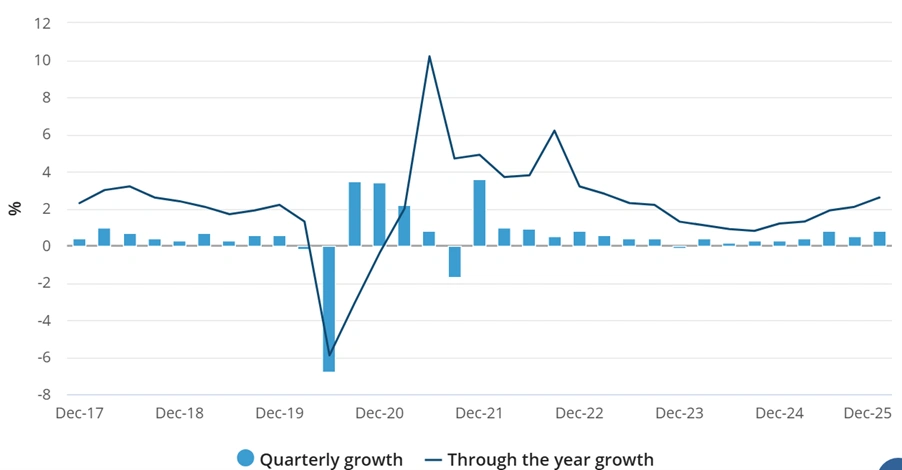
Australia’s quarterly GDP growth from 2023 to December 2025, showing the acceleration to 0.8% in Q4 2025. [ABS]
Chalmers Hails the Numbers
Treasurer Jim Chalmers welcomed the figures with some enthusiasm. He described them as “really encouraging numbers” and a “robust foundation” for Australia to face global economic volatility.
“The defining story of the Australian economy in 2025 was the pick-up in private sector activity,” Chalmers said.
GDP per capita also posted its best annual result in three years, rising 0.9% over the year and 0.4% in the quarter alone. That figure is particularly meaningful because per capita GDP had been falling in earlier periods as population growth outpaced economic output.
The Rate Cut Question Just Got Complicated
The stronger-than-expected result has created a genuine headache for the Reserve Bank of Australia. The RBA had forecast annual growth of 2.3% for 2025. The economy delivered 2.6%.
The RBA cut rates three times across 2025, bringing the cash rate down to 3.60%. Those cuts were made as inflation eased and growth slowed earlier in the year. The December quarter result now raises questions about whether further easing is warranted.
Tony Sycamore, market analyst at IG, noted there were mixed signals underneath the headline number. Household consumption remained “subdued” and the savings ratio rose, suggesting cost-of-living pressures haven’t fully eased for most Australians despite the stronger economy.
Meanwhile, inflation remains above the RBA’s 2–3% target band, sitting at 3.8%. Productivity grew just 1% for the year and was flat in the December quarter — a structural problem that means higher production costs eventually get passed on to consumers.
Our earlier coverage on Australia’s 2025 economic outlook and inflation’s impact on ASX stocks laid out some of these same tensions months before they fully materialised.
Strong Growth, But Not Without Risks
The 2.6% annual result is still below Australia’s long-run growth average of around 3% or more. The IMF, in its November 2025 Article IV assessment, projected that GDP growth would rise to 2.1% in 2026 as monetary easing continued to support private demand. That forecast now looks conservative.
Global headwinds remain real. Trade uncertainty, geopolitical tensions in the Middle East – which are already driving up oil prices – and a potential slowdown in China all represent risks to the outlook.
The Iran-US-Israel conflict, which has elevated energy prices in recent weeks, is a particular concern. Treasurer Chalmers acknowledged the dual challenge: higher oil prices push up domestic inflation at the same time they threaten global growth.
What It Means for Households
For everyday Australians, the strong GDP print is a double-edged result.
The economy growing faster than expected is good for employment and wages. But it also reduces the urgency for the RBA to cut rates further. With the cash rate currently at 3.60%, any expectation of quick relief on mortgage repayments may need to be revised.
As explored in our earlier report on RBA rate cuts and what’s at stake for the Australian economy, the central bank has consistently telegraphed a data-dependent approach. Wednesday’s ABS figures put a new batch of data squarely on its desk.
The next RBA board meeting will draw considerable attention. Traders, economists, and mortgage holders alike will be watching for any signal about whether the strong growth print has altered the rate path.
For now, Australia’s economy is in better shape than most had expected. The challenge is making sure that strength translates into real living standards – not just headline numbers.
FAQs
Q: What is Australia’s current GDP growth rate?
A: Australia’s GDP grew 2.6% annually in the December quarter of 2025, according to ABS national accounts data released on 4th March 2026. This is the fastest pace of annual growth since the March quarter of 2023.
Q: What drove Australia’s GDP growth in December 2025?
A: The key drivers were government spending, private investment in renewable energy and data centres, strong mining output, and a lift in household spending from Black Friday sales and major sporting and entertainment events.
Q: Will Australia’s GDP growth affect RBA interest rate decisions?
A: Yes. The stronger-than-expected result complicates the RBA’s path to further rate cuts. The central bank cut rates three times in 2025 to support the economy, but with growth exceeding forecasts and inflation still above target, additional cuts may be delayed.
Q: How does Australia’s GDP growth compare to global trends?
A: Australia’s 2.6% annual growth outpaces many advanced economies. The IMF had projected growth to recover to 2.1% in 2026, making the December 2025 result a meaningful upside surprise.


