

The reforms of corruption practices in Serbia have opened up anxiety both in the arena of law and in the political world, as President Aleksandar Vucic accepted some of the most contentious judicial reforms.
The laws change the manner in which prosecutors are appointed and controlled. According to critics, they weaken the Organised Crime Prosecutor’s Office. In this office, there are investigations of complex organised crimes and corruption. Authorities threaten that the reforms may leave it without several prosecutors.
That defeat has the power of retarding sensitive cases. It can also hinder the prosecution of senior government officials. The reforms seek to eliminate decentralisation of power through the selection of senior prosecutors.
This is beneficial, according to the supporters of this. Critics believe that it undermines independence. At least a good number of lawyers feel that the system is now endangered by political interference during critical activities of investigations.

Organised Crime Prosecutor’s Office building in Belgrade, handling major corruption cases. [Yahoo]
EU Officials And Lawyers Voice Sharp Concerns
The amendments were promptly responded to by the European Union officials. Serbia is an EU applicant state. Brussels has over and over again called for stronger safeguards for the rule of law stronger safeguards.
Commissioner of Enlargement, Marta Kos, termed the vote a great setback. She opined that curbing judicial independence draws Serbia out of the European standards.
She observed that Montenegro and Albania are doing better. Serbia can now move towards the reverse direction. It was these apprehensions that were echoed by domestic legal bodies. The Belgrade Bar Association threatened that the changes would compromise the separation of powers.
According to the lawyers, political control could widen throughout prosecutions. The question that was raised by anti-graft groups was whether high-level cases of corruption would be taken care of by the new framework.
How Will Serbia’s Judicial Reforms Affect Corruption Cases?
The effects might be the most noticeable in the current investigations. The Organised Crime Prosecutor’s office currently deals with high-profile cases.
One is the railway station disaster at Novi Sad, in which 16 died. The tragedy provoked the protests throughout the country. Nikola Selakovic, who is the Culture Minister, is another example.
Loss of employees would decrease efficiency, say prosecutors. They caution that the proceedings might come to a grinding halt.
According to Transparency Serbia, the amendments would minimise the ability to crack down on corruption at high-level officials. According to the watchdog, previous compliance was already low. The complex cases may also be discouraged by the reforms. Analysts believe this would cause the people to lose confidence in the justice system.
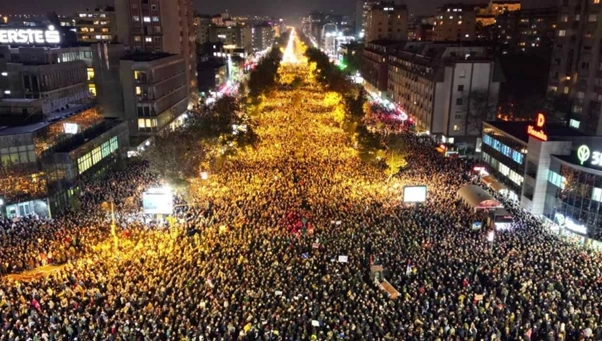
Protesters gather in Novi Sad demanding accountability after the deadly station disaster. [bne IntelliNews]
Changes Centralise Control Within The Prosecution System
Several legal clauses transfer power upwards. Once they appeal to an independent commission, prosecutors who challenge an order dispute it. They are now required to complain to office heads. According to critics, this will lower internal checks.
The High-Tech Prosecution Office is also joined to the Belgrade Higher Prosecution Office. The ruling Serbian Progressive Party is widely perceived to have affected that office.
The activities in international cooperation are now subject to the authorisation of the Justice Minister. According to legal scholars, the measures will concentrate power in the executive branch.
They advise that independence can decrease among inquiries. The proponents argue that the measures simplify the process of decision-making. But tighter political control is viewed by sceptics.
Why Is Expo 2027 Linked To The Reforms?
The government indicates that Expo 2027 would make changes to the administration. The exhibition will be organised in the Surcin municipality of Belgrade. Officials anticipate additional building and real estate controversy.
Lawmakers claim that the courts should be ready to deal with more cases. Efficiency is said to be enhanced by restructuring. This is the question of critics. According to them, anti-corruption bodies should not be deprived of resources.
These people think it is opportunistic to associate reforms with the Expo planning. According to observers, the event has already attracted controversy.
Others are fearful of the rush infrastructure development, which can reduce the analysis of the expenditure of the people. The threat increases the fear of diminished oversight.

Construction activity near Surcin as preparations advance for Expo 2027 developments. [eKapija]
Political Divisions Deepen Amid Serbia Corruption Crackdown Debate
The political responses are still very polarised. Ugljesa Mrdic, the head of the judiciary committee of the parliament, defended the reforms. According to him, they recovered a system that he alleged was stolen by the opponents.
He termed the relocation as historic. That was not accepted by the opposition groups. They claimed that the laws make the ruling party control tightly. Civil society activists fear that the democratic protection could wither away.
Already, the public confidence is under pressure due to corruption claims. Shareholders are keeping an eye on. Sound institutions tend to affect foreign investment.
Courts full of sunlight continue to be critical in the EU aspirations of Serbia, according to the analysts. The next few months could either enforce or not.
FAQs
Q1: What are Serbia’s corruption reforms?
A1: They are legal amendments changing how prosecutors and courts operate in Serbia.
Q2: Why is the EU concerned about Serbia’s judicial reforms?
A2: Officials say the laws reduce judicial independence and weaken rule-of-law standards.
Q3: How could the reforms affect corruption investigations?
A3: Fewer prosecutors and tighter control may slow or block complex cases.
Q4: What role does Expo 2027 play in the changes?
A4: The government links reforms to expected legal workloads around construction and development.


