
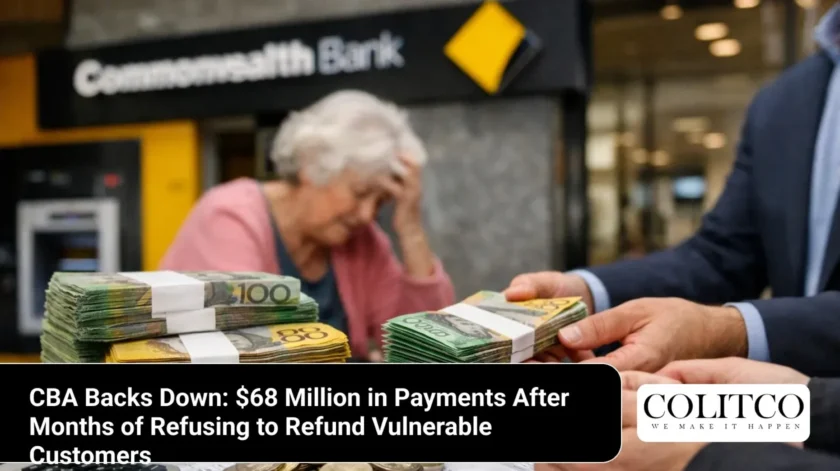
Commonwealth Bank will finally open its wallet to thousands of struggling Australians. The decision comes after ASIC’s Better Banking initiative exposed how Australia’s largest bank charged excessive fees to those who could least afford them.
The announcement on 23 December marks a dramatic reversal for CBA, which spent months defending its position while rival banks moved quickly to compensate affected customers.
The Backflip That Wasn’t Optional
CBA confirmed it will commence goodwill payments worth approximately $68 million to concession customers in early February 2026. Combined with the $25 million already paid to First Nations customers, the bank’s total now reaches $93 million.
Commonwealth Bank Headquarters
But this decision didn’t come easily. For months, CBA stood alone among major banks in refusing bulk refunds. While ANZ committed $48 million and Westpac stepped up with similar compensation, CBA insisted on reviewing cases individually.
That stance drew fierce criticism from regulators, consumer groups, and the public. ASIC Commissioner Alan Kirkland publicly stated CBA’s approach “did not pass the pub test” and urged the bank to reflect on how it compared to competitors.
Why CBA Charged Vulnerable Customers $270 Million
ASIC’s investigation found CBA charged approximately 2.2 million low-income customers around $270 million in fees between 2019 and 2024. These customers qualified for low-fee or no-fee accounts but remained in high-cost products.
The fees included:
- Monthly account-keeping charges
- Overdraft fees
- Dishonour fees
Under the Banking Code of Practice, banks must identify low-income customers and promote basic accounts with minimal fees. CBA sent annual letters about its Streamline Basic account, which carries zero monthly fees for concession cardholders.
But ASIC found these letters weren’t enough. Customers “should have been automatically transferred” to appropriate accounts, not expected to navigate the switching process themselves.
The regulator’s Better and Beyond report in July 2025 revealed this wasn’t just a CBA problem. It examined 21 banks and found widespread patterns of low-income customers stuck in wrong accounts.
However, CBA stood out for the wrong reasons.
The Breaking Point
Several factors finally forced CBA’s hand. Consumer advocacy group CHOICE launched a petition that gathered over 21,000 signatures demanding refunds. The group also awarded CBA its fourth Shonky Award in November 2025, making it the most awarded company in the scheme’s 20-year history.
CHOICE CEO Ashley de Silva didn’t mince words: “A few weeks after refusing to pay $270 million in refunds, CommBank celebrated a $10 billion annual profit. It is thumbing its nose at ASIC and at its low-income customers.”
The criticism intensified after CHOICE highlighted cases like Jordan, a family violence survivor who overdrew her account to escape danger. CBA charged her penalty fees for that emergency withdrawal, then made it difficult to obtain relief.
Bettina Cooper from Mob Strong Debt Help summed up the sentiment: “Penny pinching on account fees received from low-income people doing it tough in a cost-of-living crisis while making super profits is not great optics.”
What CBA Says Now
In its 23 December announcement, CBA emphasised that concession customers are “a large and diverse group with different financial circumstances and requirements.”
The bank noted some customers choose accounts with extra features that incur additional fees, while others opt for the basic Streamline Basic account. It stressed that account terms are available before customers open accounts.
CBA expects its combined goodwill payments to exceed those of any other bank responding to ASIC’s reports. The bank will contact eligible customers directly, they don’t need to take any action.
But Questions Remain
The $93 million commitment represents only about one-third of the $270 million ASIC identified. CBA hasn’t explained why it considers the remaining fees appropriate for vulnerable customers to have paid.
The bank also hasn’t disclosed how many customers will receive payments or the average refund amount. Previous ASIC reports showed individual refunds ranging from $1,200 to $5,200, amounts that represent weeks or months of income for people on JobSeeker or the Age Pension.
Financial Rights Legal Centre’s assessment was blunt: “That banks are returning a whopping $93 million in unnecessary bank fees to low-income Australians is huge news. But the decision by CBA to keep an additional $270 million is shocking.”
The Broader Banking Picture
This controversy erupts as Australia grapples with broader questions about banking accessibility and fairness. Major banks have closed over 1,000 branches since 2018, pushing customers toward digital services.
But not everyone can easily navigate online banking. Digital exclusion affects many First Nations communities, elderly Australians, and those with limited literacy or internet access.
CBA’s initial stance, requiring individual customers to identify themselves and request refunds, placed the burden on those least equipped to advocate for themselves.
Also Read: Ramsay Health Care Acquires National Capital Private Hospital in $251m Deal
What Happens Next
CBA says it remains “committed to delivering products and services for a broad range of customer needs and providing sustainable, full-service banking for all Australians.”
Starting in February 2026, eligible concession customers will receive their payments automatically. The bank promises to contact them with details.
Whether this quiets the criticism remains to be seen. With $270 million in potentially excessive fees still unaccounted for, and questions about why vulnerable customers needed a public shaming campaign to get their money back, CBA’s reputation with low-income Australians has taken a hit that $68 million may not fully repair.
For now, thousands of struggling Australians will finally see some money returned that should never have been taken in the first place.


