
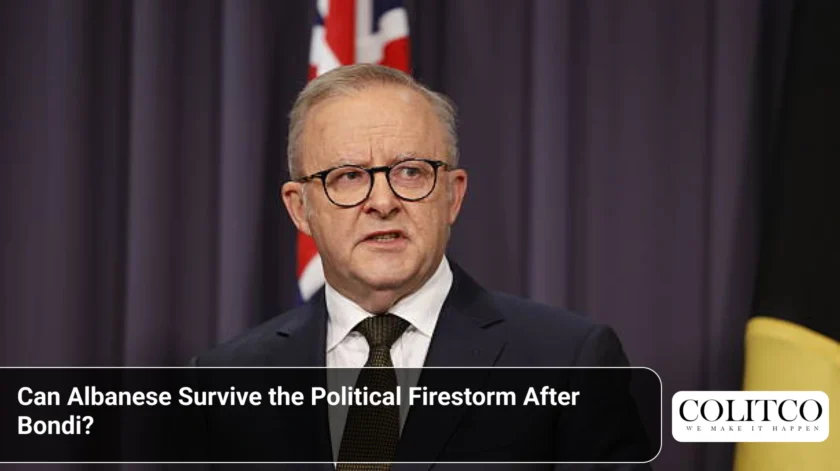
Fifteen lives lost. A nation shaken. A government under siege.
Prime Minister Anthony Albanese confronts the most severe test of his leadership after two gunmen turned Sydney’s iconic Bondi Beach into a killing field. The December 14 attack targeted Jewish families celebrating Hanukkah.
The political fallout threatens to define Albanese’s second term.
The Attack That Changed Everything
Father and son gunmen opened fire from a footbridge at 6:47 pm. Around 1,000 people had gathered at Archer Park for the “Chanukah by the Sea” event. Families ran for their lives as bullets rained down.
Sajid Akram, 50, and his son Naveed Akram, 24, fired on the crowd with rifles. Police later found two homemade Islamic State flags in their vehicle. The elder Akram died at the scene. His son remains hospitalized under arrest.
Victims ranged from a 10-year-old girl to an 87-year-old Holocaust survivor. Two rabbis died in the massacre. The death toll makes it Australia’s deadliest terror attack in modern history.
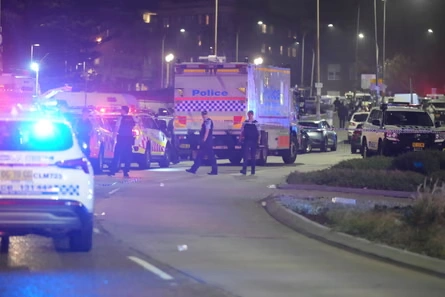
Emergency personnel at the scene of the Bondi Beach terror attack
Syrian-Australian shop owner Ahmed al-Ahmed tackled one gunman and wrestled away his weapon. The 43-year-old suffered serious injuries but likely prevented more deaths. Australian billionaire Bill Ackman donated $99,999 to his recovery fund.
“He is a true Australian hero,” Albanese said during a hospital visit.
Netanyahu’s Damning Indictment
Israeli Prime Minister Benjamin Netanyahu launched an unprecedented attack on Albanese’s government. He accused the PM of letting antisemitism spread unchecked across Australia.
“You replaced weakness with weakness and appeasement with more appeasement,” Netanyahu said. “Your government did nothing to stop the spread of antisemitism in Australia.”
The Israeli leader linked Australia’s September recognition of Palestinian statehood to rising anti-Jewish violence. “Your call for a Palestinian state pours fuel on the antisemitic fire,” he added.
Albanese rejected the criticism. The Prime Minister’s response focused on strengthening gun laws and supporting the Jewish community.
Jewish Leaders Sound the Alarm
Australia’s Jewish community delivered a crushing verdict. Leaders effectively barred Albanese from attending victims’ funerals. The PM did not attend services for Rabbi Eli Schlanger or young Matilda.
NSW Premier Chris Minns received warm welcomes at both services. The contrast highlighted Albanese’s standing with the community.
Jillian Segal, the government’s Special Envoy to Combat Antisemitism, warned the attack “did not come without warning.” She said Australia saw over 1,650 antisemitic incidents in the year to September.
“The writing has been on the wall,” Segal told ABC Radio.
Key incidents before Bondi:
- Adass Israel synagogue firebombing in Melbourne
- Multiple arson attacks on Jewish properties
- Rising graffiti and vandalism targeting Jewish sites
- University campus encampments intimidating Jewish students
The Jewish Council of Australia questioned whether Jews have a future in the country. “The Albanese government was warned so many times but failed to take adequate actions to protect the Jewish community,” the organization stated.
The ISIS Connection
Federal police confirmed the attack was “inspired by Islamic State ideology.” The gunmen travelled to the southern Philippines in November. They spent a month in Davao, an area known for Islamic extremist groups.
Hotel staff reported the pair barely left their rooms. They ordered fast food and had no visitors during their stay. Philippine authorities are investigating possible training or recruitment activities.
Australia’s domestic intelligence agency ASIO investigated the younger Akram in 2019. Officials closed the six-month probe after determining he posed no threat. That decision now faces intense scrutiny.
Naveed Akram faces 59 criminal charges. These include 15 counts of murder and terrorism offences. He remains under police guard in hospital.
Gun Law Reforms Fast-Tracked
The National Cabinet met within 24 hours of the attack. State and territory leaders agreed to sweeping gun law reforms:
- Firearm licenses restricted to Australian citizens only
- Accelerated national firearms register
- Limits on guns per person
- Tighter restrictions on weapon types
“We can’t get around the fact that a fellow was able to get a gun license, have six guns, four of which were used in this attack,” Albanese told ABC Radio.
Australia already maintains some of the world’s strictest gun laws. The 1996 Port Arthur massacre prompted bans on assault rifles and semi-automatic weapons. Yet firearm ownership has increased.
NSW gun licenses jumped from 181,000 in 2001 to 260,000 in 2025. The suspect held a valid license for six weapons.
The NSW Parliament was recalled before Christmas to debate emergency reforms. Both major parties supported the measures.
Political Pressure Mounts
Opposition Leader Sussan Ley accused the government of allowing antisemitism to “fester.” She demanded implementation of all Segal’s July report recommendations.
“Everything must change from today in how governments respond,” Ley said.
Former Liberal treasurer Josh Frydenberg called for a royal commission into antisemitism. The government rejected the proposal as delaying action.
Albanese’s cabinet announced new measures:
- Extended funding for Jewish community security
- Accelerated review of hate crime laws
- Increased monitoring of university campuses
- Enhanced intelligence sharing on extremism
Critics argue the response comes too late. Former PM Malcolm Turnbull defended Albanese’s record. “It is very difficult to prevent single acts of terror,” he told ABC.
“I struggle to see what he could have done that was different,” Turnbull added.
The Community Response
Australians rallied around the victims. Record blood donation numbers followed the attack. Lifeblood reported nearly 50,000 appointments booked on December 16 alone. More than double the previous record.
Close to 1,300 first-time donors signed up. The Bondi donation center had no available appointments through year’s end.
Memorials sprang up across the beach. Thousands laid flowers at the Bondi Pavilion. Vigils drew large crowds showing solidarity with the Jewish community.
The local council asked residents to light candles nightly at 6:47 pm throughout Hanukkah. The time marks when the shooting began.
International leaders expressed shock and support. King Charles III called the attack “appalling.” US President Donald Trump and UK PM Keir Starmer issued strong condemnations.
The Road Ahead
Albanese faces crucial decisions. His government must balance security needs with civil liberties. Immigration policy, university protests, and Middle East diplomacy all attract fresh scrutiny.
Our hearts are with the families mourning after the Bondi terror attack. The Australian community stands with Jewish Australians at this dark time.
Today at Parliament House I signed the condolence book to honour the victims and those who loved them. pic.twitter.com/Pnf7LEMbNJ
— Anthony Albanese (@AlboMP) December 19, 2025
The Prime Minister’s leadership confronts parallel pressures. Domestic security concerns clash with maintaining social cohesion. Australia’s multicultural society hangs in the balance.
ASIO raised the terrorism threat level from “possible” to “probable” in August 2024. Director-General Mike Burgess cited Gaza war tensions as a key factor.
The government appointed both an Antisemitism Envoy and an Islamophobia Envoy. This reflected attempts to address community tensions on all sides.
Pro-Palestine marches since October 2023 created flashpoints. The rally outside Sydney Opera House drew widespread condemnation. University encampments generated conflict between student groups.
“We will not allow this country to be divided,” Albanese declared. “That is what the terrorists seek. We will unite.”
Historical Context
Australia experienced minimal terrorism before this decade. The 2014 Sydney cafe siege killed three people. The 2019 Christchurch shooting involved an Australian perpetrator but occurred in New Zealand.
Bondi represents a watershed moment. It’s the deadliest terror attack and second-deadliest mass shooting in modern Australian history. Only the 1996 Port Arthur massacre claimed more lives.
The attack’s targeting of a specific religious community marks a dangerous escalation. Previous incidents involved property damage and vandalism. Bondi crossed into mass casualty violence.
Australia’s strict gun laws made such attacks seem impossible. The 1996 reforms worked for nearly three decades. The Bondi gunmen exposed vulnerabilities in the licensing system.
Also Read: South Australia’s Major Copper-tunity: BHP Investment Signals Mining Renaissance
FAQs
Q: What happened at Bondi Beach?
A: Two gunmen opened fire on a Hanukkah celebration at Bondi Beach on December 14, 2025. Father and son attackers killed 15 people and injured 40 others. Police killed one shooter and arrested the other.
Q: Who were the Bondi attackers?
A: Sajid Akram, 50, and his son Naveed Akram, 24, carried out the attack. The elder Akram held an Indian passport. His Australian-born son is charged with terrorism and 15 murder counts.
Q: Why is Albanese facing criticism?
A: Jewish community leaders say the government failed to act on antisemitism warnings. Israeli PM Netanyahu accused Albanese of weakness. Opposition politicians demand stronger anti-hate measures.
Q: What changes will Australia make to gun laws?
A: The National Cabinet agreed to restrict gun licenses to citizens only. New rules will limit firearms per person and accelerate the national gun register. NSW Parliament was recalled to pass emergency reforms.
Q: How has the Jewish community reacted?
A: Jewish leaders expressed devastation and questioned their future in Australia. Community representatives barred the PM from attending victims’ funerals. Calls grew for comprehensive action against antisemitism.


