
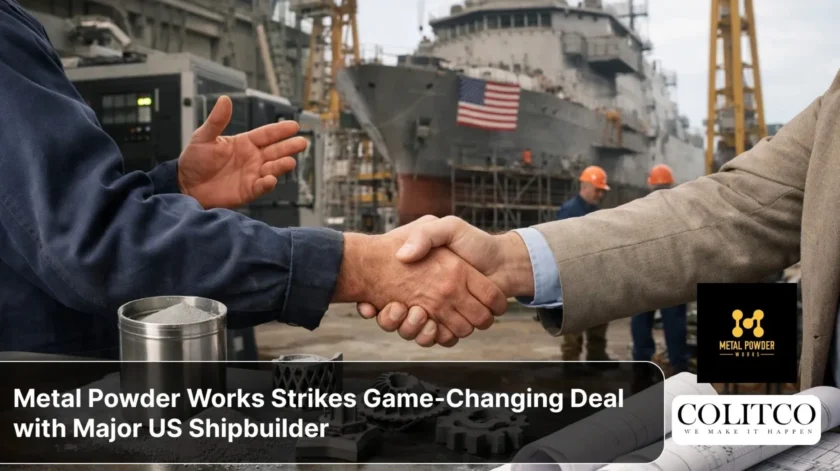
Metal Powder Works Limited (ASX: MPW) has landed a strategic partnership with Austal USA that could position the Pittsburgh-based powder producer as a critical supplier to America’s naval defence industry. The announcement sent shares soaring 12% as investors recognised the potential scale of the opportunity.
The deal centres on co-developing specialised metal powders for additive manufacturing applications. Most notably, the partnership includes work tied to the US Navy’s Additive Manufacturing Center of Excellence, a facility where Austal USA already serves as the lead operator.
What’s Actually in the Deal
The partnership agreement focuses on research and development rather than immediate commercial supply. MPW will work with Austal to refine powder specifications that meet the demanding requirements of naval shipbuilding and submarine components.
Key areas of focus include:
- Development of copper-nickel (CuNi) alloy powders for marine applications
- Testing and validation of powder characteristics for Navy certification
- Potential integration into parts manufacturing for Virginia and Columbia-class submarines
- Supply of powders meeting stringent US Defence Industrial Base specifications
MPW has already achieved a significant milestone. The company’s CuNi alloys have met US Navy specifications, providing a foundation for expanded collaboration.
The agreement builds on an existing commercial relationship. Austal USA is already purchasing MPW powders, and this formalised partnership aims to scale that relationship substantially.
Why Austal USA Matters
Austal brings serious credentials to the table. The company operates the US Navy’s Additive Manufacturing Center of Excellence in Danville, Virginia, working with partners including Phillips Federal, the Institute for Advanced Learning and Research, and the Commonwealth Center for Advanced Manufacturing.
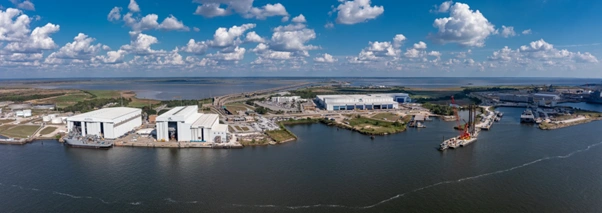
Austal USA Shipbuilding Facility
That facility produces 3D-printed components for submarines and ships, addressing critical supply chain bottlenecks that have plagued naval shipbuilding for years. The centre has already printed over 100 parts for installation on Navy vessels, with ambitious plans to scale production significantly.
Austal’s Advanced Technologies division holds responsibility for developing “build-to-print” capability for long lead time parts. The company aims to transition qualified part recipes to industry suppliers for serial production, creating opportunities for materials providers like MPW.
The strategic importance is clear. America’s shipbuilding capacity has fallen dramatically behind China’s, with estimates suggesting Chinese capacity exceeds US capability by as much as 50-fold. The US Navy is racing to rebuild domestic manufacturing capability, and additive manufacturing represents a cornerstone of that strategy.
DirectPowder Technology: The Secret Sauce
MPW’s patented DirectPowder process represents a fundamental departure from traditional powder production methods. Instead of melting metal and atomising it into droplets, the company uses mechanical energy to shave solid metal wire or bar stock into uniform powder particles.
Think of it as precision machining at the microscopic level. The process produces consistent particle sizes without the high energy requirements and waste associated with conventional atomisation.
This approach delivers several advantages for defence applications:
- Lower production costs compared to traditional methods
- Ability to produce powders from readily available wire stock
- Consistent quality control through mechanical rather than thermal processes
- Portable production capability suitable for forward deployment
MPW produces over 25 types of powders, including high-strength aluminium, pure copper, copper-nickel alloys, titanium, and specialised materials like zirconium and Zircaloy. The company’s aluminium and copper powders have achieved 99.5% density in laser powder bed fusion systems, meeting the exacting standards required for critical applications.

Metal Powder Works DirectPowder Process
The Additive Manufacturing Revolution in Defence
The US Navy has made additive manufacturing a core strategic initiative. Supply chain constraints have created bottlenecks in submarine and ship construction, with some parts requiring months or years to procure through traditional casting and forging processes.
3D printing offers a solution. By producing parts on-demand from digital files, the Navy can dramatically reduce lead times, eliminate obsolete tooling issues, and maintain production capabilities even when traditional suppliers exit the market.
The Naval Postgraduate School has already contracted MPW to deliver a mobile, containerised DirectPowder unit. That system will provide the ability to produce metal powders in remote or contested environments, supporting fleet activities and operational flexibility.
Similar initiatives are accelerating across the defence sector. AML3D has sold its ARCEMY system to Austal USA for deployment at the Additive Manufacturing Center of Excellence. Companies like Titomic are collaborating with powder producers to optimise materials for cold spray applications.
Australia and the United States have also signed agreements to strengthen critical minerals supply chains, recognising that secure access to advanced materials underpins technological and military superiority.
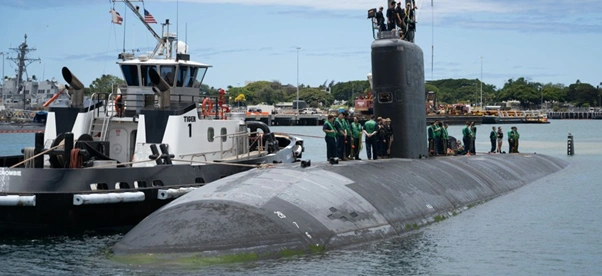
Naval vessels that could incorporate additive manufactured parts
Market Response and Share Price Movement
MPW shares jumped 12% on the partnership announcement, closing at $2.40 on 17th December 2025. The stock has delivered exceptional returns over the past year, rising more than 400% as the company secured major contracts and expanded its customer base.
However, shares remain approximately 60% below their all-time high of $4.90, suggesting significant headroom if the company can convert strategic partnerships into sustained revenue streams.
The company’s market capitalisation now stands at approximately $344 million, with 143.6 million shares on issue. MPW holds around $6 million in cash following recent capital raises, providing a buffer to fund development work without immediate dilution concerns.
Trading volumes have increased significantly following the Austal announcement, indicating heightened investor interest in the defence manufacturing opportunity.
Path to Commercial Scale
The current agreement sits firmly in the early-stage partnership category. MPW will supply samples for testing, with Austal progressively refining requirements until powders consistently meet performance standards.
Success in this development phase could trigger a commercial offtake agreement with defined volumes, pricing, and supply terms. That outcome would provide MPW with predictable revenue and substantially de-risk the investment thesis.
Several factors will determine whether this partnership scales:
- Technical validation that powders meet all Navy specifications
- Qualification of parts manufactured using MPW powders for installation on vessels
- Integration of MPW materials into Austal’s production workflows
- Potential expansion beyond initial copper-nickel focus to other alloys
The defence sector typically moves slowly, with rigorous testing and certification requirements extending over years rather than months. Investors should anticipate a lengthy qualification process before meaningful revenue materialises.
Competitive Landscape and Strategic Positioning
MPW operates in a competitive but rapidly expanding market. The global additive manufacturing industry is projected to grow at 25-30% annually through 2030, with metal powders representing a critical enabling technology.
The company competes with established powder producers like 6K Additive and specialty materials suppliers serving the defence sector. However, MPW’s unique production process and US-based manufacturing provide strategic advantages.
Location matters in defence contracting. US agencies increasingly prioritise domestic suppliers to reduce reliance on foreign sources for critical materials. MPW’s Pittsburgh facility positions the company as a trusted domestic supplier at a time when supply chain security has become a national priority.
The company has also expanded through acquisition. MPW’s merger with K-TIG Advanced Welding Systems in February 2025 broadened its technology portfolio and added complementary capabilities in automated welding. The combined entity raised $10 million and listed on the ASX with a market capitalisation of approximately $28 million at IPO.
Industry Context: Defence Manufacturing Renaissance
The partnership announcement arrives amid a broader renaissance in US defence manufacturing. Geopolitical tensions, particularly with China, have exposed vulnerabilities in American industrial capacity across multiple sectors.
Rare earth processing, semiconductor fabrication, and shipbuilding all require urgent capacity expansion. The Pentagon has committed hundreds of millions in funding to rebuild domestic supply chains, with additive manufacturing identified as a critical enabling technology.
Recent developments illustrate the momentum:
- The US Navy issued a letter of intent to AML3D for production of 1,600 parts by 2030
- ASC and Austal signed a memorandum of understanding to advance AM across Australian naval programs
- Austal expanded its Advanced Technologies research centre in Charlottesville, Virginia by 10,000 square feet
- The Additive Manufacturing Center of Excellence achieved full operational capability and continues scaling production
These initiatives create expanding opportunities for materials suppliers like MPW that can meet the rigorous quality and security requirements of defence applications.
Risk Factors and Execution Challenges
Despite the positive headline, several risks warrant investor attention. The partnership agreement is non-binding at this stage, and there is no guarantee it will progress to commercial terms.
Technical hurdles remain. While MPW’s CuNi alloys have met Navy specifications, expanding to other materials and applications requires additional validation work. Any delays or failures in qualification could derail the partnership.
Financial metrics present challenges. MPW reported revenue of approximately $772,000 in 2024, down 12% from the prior year. The company remains loss-making as it invests heavily in capacity expansion and product development.
Cash burn requires monitoring. With approximately $6 million in the bank, the company has runway to fund near-term operations, but sustained losses could necessitate further capital raises that dilute existing shareholders.
Competition from established powder producers with deeper resources and longer track records creates ongoing pressure. Larger players could undercut MPW on price or outspend the company on R&D if they perceive the defence opportunity as sufficiently attractive.
Investor Outlook
The Austal partnership represents a meaningful validation of MPW’s technology and strategic direction. Landing a relationship with a prime defence contractor operating the Navy’s flagship additive manufacturing facility positions the company for potential exponential growth if execution succeeds.
Near-term catalysts include:
- Results from initial powder testing and validation work with Austal
- Potential announcement of additional defence sector partnerships
- Progress towards commercial offtake agreement with defined volumes
- Expansion of certified powder portfolio beyond copper-nickel alloys
- Delivery of mobile DirectPowder unit to Naval Postgraduate School
Analysts suggest the stock’s 400% gain over the past year reflects growing recognition of MPW’s strategic positioning rather than immediate earnings power. The company remains pre-revenue at commercial scale, making valuation highly dependent on successful execution of the technology roadmap.
For investors willing to accept execution risk, MPW offers leveraged exposure to the US defence manufacturing rebuild and the broader additive manufacturing mega-trend. The combination of proprietary technology, strategic partnerships, and supportive government policy creates a compelling if speculative growth narrative.
Conservative investors may prefer to wait for clearer evidence that R&D partnerships are converting to commercial supply agreements before committing capital. The gap between strategic potential and near-term financial performance remains substantial.
What Happens Next
MPW will begin supplying powder samples to Austal for testing in coming weeks. The companies will work through iterative refinement cycles, with Austal’s engineers providing feedback on powder characteristics and performance in their additive manufacturing systems.
Successful validation would typically lead to qualification trials where parts manufactured using MPW powders undergo destructive and non-destructive testing to verify they meet Navy specifications. Parts passing qualification would then be eligible for installation on vessels, with traceability documentation following each component through its lifecycle.
If all goes according to plan, the partnership could progress to commercial terms within 12-24 months. That timeline assumes no major technical roadblocks emerge during validation testing.
The broader opportunity extends well beyond this single partnership. Success with Austal could open doors to other defence prime contractors, submarine builders, and shipyards seeking qualified powder suppliers.
MPW founder and Managing Director John Barnes will host an investor webinar on 17th December 2025 to review the company’s 2025 performance and discuss strategic priorities for 2026. That presentation may provide additional colour on the Austal partnership and commercialisation timeline.
For now, the market has delivered its verdict. A 12% share price pop signals investor enthusiasm about MPW’s positioning in the US defence manufacturing renaissance. Whether that enthusiasm translates to sustained returns will depend entirely on execution over the coming quarters.


