
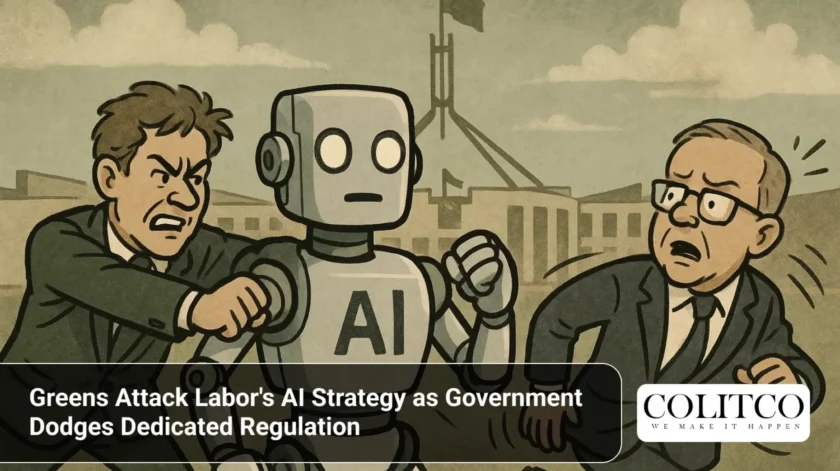
The Albanese government faces sharp criticism over its newly released National AI Plan, with the Greens warning Australia is becoming “AI’s wild west” while other nations build robust protections.
Industry Minister Tim Ayres unveiled the long-awaited strategy on December 2, 2025, promising to balance innovation with safety. The plan commits $29.9 million to establish an AI Safety Institute but stops short of creating standalone AI legislation.
That choice has triggered backlash from multiple quarters.

Tim Ayres, Minister for Industry and Innovation Incumbent
Greens Warn of “Reckless” Approach
Greens Senator David Shoebridge, the party’s Digital Rights spokesperson, delivered a withering assessment of the government’s direction.
“The commission is using overly optimistic financial projections to dodge proper AI rules and kill off basic digital protections,” Shoebridge said following the Productivity Commission’s earlier recommendation against heavy regulation.
He warned that Labor’s hands-off strategy would allow AI systems to “continue to rip off creators and spy on individuals” while countries like Europe, Canada and the UK implement comprehensive AI laws.
The Greens advocate for a standalone AI Act with an independent regulator and Digital Rights Commissioner. They argue current frameworks fail to address AI-specific harms ranging from workplace automation to algorithmic bias.
“We need a government that is nimble enough to respond to AI risks as they emerge,” Shoebridge told a recent tech summit. “We can’t spend eight years working out a white paper before we roll out regulation in this space.”
What the National AI Plan Actually Delivers
The 37-page strategy outlines three core goals: capturing economic opportunities, spreading benefits broadly, and keeping Australians safe.
Key elements include:
- AI Safety Institute to monitor emerging risks and advise regulators
- GovAI Framework for secure adoption across public services
- Investment in digital infrastructure and data centres
- Skills development programs across schools, TAFEs and universities
- Reliance on existing laws covering copyright, privacy and consumer protection
Assistant Minister for Science Andrew Charlton emphasised the plan aims to “attract positive investment, support Australian businesses to adopt and create new AI tools, and address the real risks faced by everyday Australians.”
The government argues Australia’s current legal regime provides sufficient protection, with targeted updates possible as specific harms emerge.
Business Backs Plan, Opposition Questions Protections
The Business Council of Australia and Universities Australia welcomed the plan as “an important step forward” in positioning Australia for the AI economy.
Opposition Leader Sussan Ley struck a different tone, particularly on intellectual property protections.
“It is not appropriate for big tech to steal the work of Australian artists, musicians, creators, news media, journalism, and use it for their own ends without paying for it,” Ley said, criticising “wishy-washy language” around protecting Australian content.
The government has since clarified that AI developers won’t receive copyright exemptions for training models on Australian creative works without consent.
Tensions Over Former Minister’s Work
The political friction runs deeper than policy disagreements.
Shoebridge praised former Industry Minister Ed Husic for developing AI guardrails and mandatory safeguards for high-risk applications. Husic was removed in a ministerial reshuffle earlier in 2025.
“I think it’s shameful that his project has been binned,” Shoebridge told the TechLeaders Summit. “The fact that they’ve also jumped all of that work, I find incredibly dangerous.”
Current minister Tim Ayres defended the government’s timeline, stating officials are “going to take our time to work through” AI regulation questions “over the coming months.”
“Regulation requires precision and the capacity to meet individual harms,” Ayres explained.
Productivity Focus Drives Direction
The government’s approach aligns with August 2025 recommendations from the Productivity Commission, which estimated AI could add over $116 billion to Australia’s economy.
The Commission warned that “adding economy-wide regulations that specifically target AI could see Australia fall behind the curve, limiting a potentially enormous growth opportunity.”
Treasurer Jim Chalmers echoed this perspective when he rejected union demands for immediate AI workplace regulation in June, stating the government was “overwhelmingly focused on capabilities and opportunities, not just guardrails.”
That priority order frustrates AI critics who see workers, artists and consumers bearing the costs of rapid deployment.
Data Centre Push Raises Environmental Concerns
The plan positions Australia as an attractive location for global AI infrastructure investment, highlighting stable governance, strategic location and renewable energy resources.
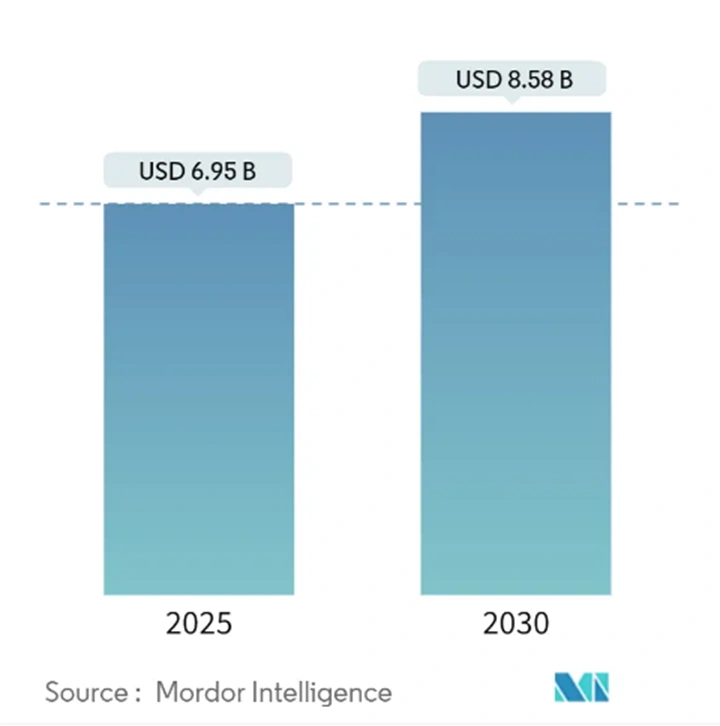
Australia Data Center Market Size
States are already competing aggressively. New South Wales streamlined data centre approvals while Victoria created incentives to “ruthlessly” chase investment.
However, environmental concerns are mounting over energy and water demands. Recent environmental law reforms may fast-track data centre approvals when co-located with renewable power, potentially limiting environmental impact assessments.
The plan remains “remarkably silent” on water use impacts beyond promising “efficient liquid cooling,” according to analysis from The Conversation.
International Context
Australia’s light-touch approach contrasts sharply with international developments.
The European Union’s AI Act, effective from August 2026, creates a risk-based regulatory framework with significant penalties for non-compliance. High-risk systems face outright bans while lower-risk models must meet stringent transparency requirements.
The UK unveiled its AI Opportunities Action Plan in January 2025, maintaining flexibility while establishing sector-specific best practices.
Even the United States, traditionally hands-off, released a comprehensive AI Action Plan in July 2025 under the Trump administration, focusing on American AI dominance, infrastructure buildout and removing “ideological bias” from government-procured models.
Also Read: NEXTDC Supercharges Data Centre Expansion with $400 Million Investment Surge
What Happens Next
The government will finalise its GovAI Framework for public sector AI use and launch funding rounds for AI research commercialisation through the Cooperative Research Centres program.
The AI Safety Institute begins operations in early 2026, though critics question whether a $29.9 million agency can effectively monitor and guide a rapidly evolving technology landscape.
For now, the fundamental question remains unresolved: can existing laws adequately govern AI, or does the technology demand purpose-built regulation?
The Greens hold significant Senate power following Labor’s May 2025 landslide election victory. While they can’t block government operations, they can shape legislation and maintain pressure on the AI issue.
“Australia is becoming AI’s wild west while Europe, Canada and the UK build proper AI laws,” Shoebridge warned. “People want to be able to say no to their personal information being used in training AIs, yet this report says their consent is less important than corporate profits.”
The debate is only beginning.