
Treasury Wine Estates Ltd (ASX: TWE) has announced that it expects to recognise a non-cash impairment on its United States asset portfolio following updated modelling on long-term earnings for its Americas business. The disclosure was released to the ASX as part of the company’s 2025 financial reporting process and marks the most significant balance-sheet adjustment for the division since the 2020 restructuring initiatives.

The impairment is linked to revised cash-flow expectations, which assume an 11 per cent reduction in future earnings per annum over the forecast period. Treasury Wine Estates stated that the change reflects a more conservative view of demand conditions in the US wine market, even as several premium brands continue to outperform the broader category. The revision eliminates previous headroom on impairment testing and signals reduced carrying values across the Treasury Americas and Treasury Collective – Americas cash-generating units.
The update arrives at a time when investors are closely watching consumer demand trends and inflation-linked spending behaviours across the region. It also places TWE in a key position within ongoing discussions surrounding the U.S. economic outlook 2025 and broader Americas economic forecast 2025, both of which remain central to earnings visibility for beverage producers with exposure to North American retail channels.
Key financial implications
Treasury Wine Estates has indicated that the final allocation of the impairment will form part of its 2026 interim financial results. Management expects the charge to result in the full write-off of at least all goodwill currently held against the Americas business, valued at $687.4 million as at 30 June 2025. The company also noted that further impairments may be recognised depending on final assessment outcomes.
Key highlights:
- Expected write-down of goodwill in the Americas division
- Value of goodwill at June 2025: $687.4 million
- Driver: forecast 11% annual decline in future regional cash flows
- Potential flow-through impact to other assets, depending on final allocation
TWE confirmed that strong performances continue across premium brands, including DAOU, Frank Family Vineyards, and Matua. However, moderated volume growth in US wine categories has compelled management to adjust long-term growth assumptions to reflect a slower medium-term recovery pathway.
Economic and strategic considerations
The impairment warning follows a period of mixed trading conditions in US alcoholic beverages, influenced by soft discretionary spending, competitive retail pricing, and evolving consumer preference towards alternative drinks categories. These dynamics intersect with slowing corporate investment forecasts linked to the U.S. economic outlook for 2025. Analysts note that wine producers with heavy exposure to mid-market brands have faced margin pressure through the 2024–25 period.

Chair and Chief Executive Sam Fischer
Despite the impairment, TWE has emphasised that its premiumisation strategy remains unchanged. Chair and Chief Executive Sam Fischer will brief investors in mid-December, providing an update on trading performance across the Americas and China, alongside initial leadership commentary following his commencement in the role. Management is also expected to outline strategic levers available for cost control, brand-mix optimisation, and market share retention.
Resource allocation and operational adjustments
The company stated that full impairment allocation will be finalised alongside interim accounts, enabling capital-allocation decisions to be made without long-term model uncertainty. TWE has continued to invest in production efficiency, distribution strategy, and brand development across its North American business units. The update reiterates that the adjustment is non-cash and does not affect trading operations or liquidity.
While no material changes have been announced to operating methodology, the impairment is expected to refine investment prioritisation in high-return brand clusters while also shaping portfolio decisions for 2026. TWE confirmed that there is potential for broader asset impact, subject to final review outcomes.
Market and sector positioning
Global beverage markets remain sensitive to US consumer sentiment, freight inflation, and supply-chain normalisation. Competitors in the premium wine category have also adopted conservative growth assumptions for 2025 as analysts track shifting volume trends.

Australia retains favourable trade stability, providing TWE with access to Asia-Pacific demand recovery mechanisms while the Americas recalibration progresses. These jurisdictional advantages frame Treasury’s medium-term risk profile in contrast to peers with single-region concentration.
Investor outlook
Treasury Wine Estates shares last traded at $5.68, down 2.40% for the session, with intraday volume of 3.98 million units. The stock continues to reflect caution tied to the TWE impairment warning, although retained premium-brand growth offers forward strategic optionality. The company holds a market capitalisation of $4.69 billion, with investors awaiting December’s briefing for guidance on earnings trajectory and restructuring scope.
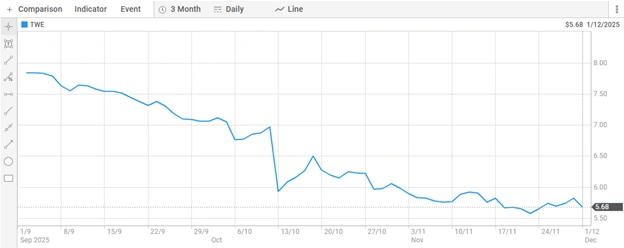
Treasury Wine Estates share Price
Analysts expect market attention to remain centred on goodwill removal timing, margin protection measures, and the extent to which America’s earnings can stabilise under new growth assumptions.
Also Read: Trump cancels all Biden “autopen”-signed orders — declares them void
Conclusion
The impairment disclosure marks a material accounting event for Treasury Wine Estates and reflects more conservative positioning within the global wine sector. With goodwill in the Americas division expected to be written off in full, the update underscores the role of macro-economic conditions across the region and reinforces the importance of ongoing performance in premium brand segments. Investor focus will now shift to mid-December commentary outlining operational levers, capital allocation plans, and updated market strategy heading into FY2026.


