
US equity markets staged their worst single-session selloff in months on Thursday, March 27, as escalating fears over a prolonged Middle East conflict rattled investor confidence and sent oil prices surging above $100 a barrel. The S&P 500 fell 1.74%, the Nasdaq shed 2.38%, and the Dow Jones Industrial Average dropped roughly 1%, dragging all three major indices to their lowest closing levels since late 2025.
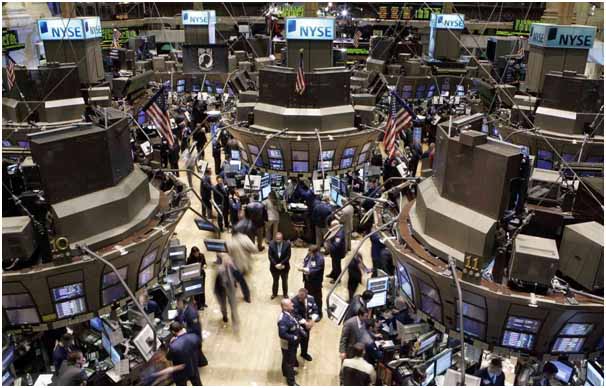
US stock markets fall sharply as geopolitical tensions in the Middle East drive investor panic and global uncertainty.[Investopedia]
Stocks Crater as Pentagon War Plans Leak and Oil Tops $100
US stocks fell sharply on Thursday following an Axios report that the Pentagon is actively developing extensive military options against Iran, prompting President Trump to warn that Iran had “better get serious soon, before it is too late.”
The threat of a broader conflict sent shockwaves through financial markets, with WTI crude oil surging more than 5.4% to settle near $100 a barrel and Brent crude climbing over 4% to around $112. Eight of the eleven primary S&P 500 sectors closed in the red, with communication services and technology leading losses.
The selloff accelerated as traders priced in the risk of supply disruptions through the Strait of Hormuz, a critical chokepoint for global energy shipments.
The closure of the strait has already been causing disruptions to energy supplies, and any further escalation threatens to deepen the inflationary shock hitting economies worldwide. The S&P 500 closed at 6,477, its lowest level since September 2025.
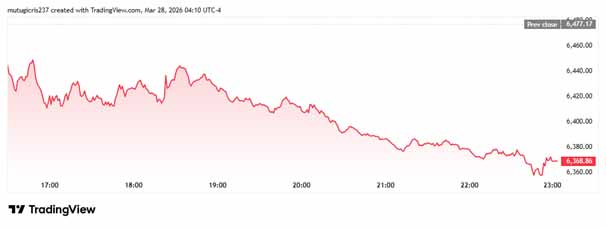
Major US indices, including the S&P 500 and Nasdaq, slide as fears of a prolonged Middle East conflict intensify. [TradingView]
Why This Sell-Off Is Different and Why Investors Should Pay Attention
The market reaction underscores how geopolitical risk has re-emerged as a dominant driver of asset prices in 2026. A sustained conflict in the Middle East would keep energy prices elevated, fuelling inflation at a time when central banks are already navigating a delicate balancing act between growth and price stability.
Higher oil costs feed directly into consumer prices, corporate margins, and transportation costs, creating a compounding headwind for the global economy.
Key Takeaways
- Investors should brace for continued volatility — the S&P 500 has now lost ~9% from its January record, and the Nasdaq has entered correction territory (down ~11%).
- Energy stocks are a near-term beneficiary — Valero Energy rose 5%+, and Occidental Petroleum gained 4%+ as oil prices surged.
- Fed rate-cut bets have reversed sharply — money markets now price a ~60% chance of a rate hike in 2026, versus expectations of two cuts just weeks ago.
- Companies with Middle East exposure face direct earnings risk — furniture maker MillerKnoll plunged 22%+ after citing the conflict as a driver of weaker guidance.
Trump, the Pentagon, and Iran: The Key Players Moving Markets
The United States government and its military apparatus are central to the story, with the Pentagon reportedly preparing options for strikes against Iran amid stalled nuclear negotiations. President Trump has taken a hard public line, issuing direct warnings via social media. On the market side, the Federal Reserve is a key actor — its policy trajectory has shifted materially as inflation risks mount.
Secondary Stakeholders
- Iran — The primary geopolitical counterparty; its response to US threats determines the conflict’s escalation path.
- OPEC+ member states — Any supply disruptions through the Strait of Hormuz would affect the broader cartel’s output and pricing power.
- US energy companies — Valero, Occidental, and other oil majors are direct beneficiaries of elevated crude prices.
- MillerKnoll / multinational corporates — Companies with Middle East supply chains or customer bases face the sharpest earnings headwinds.
From Wall Street to the Strait of Hormuz: A Crisis with Global Reach
Geographic or Platform Context
The financial fallout originated on Wall Street, with the New York Stock Exchange and Nasdaq witnessing heavy selling throughout the Thursday session. The underlying geopolitical flashpoint is centred on the Persian Gulf region, specifically the Strait of Hormuz, through which approximately 20% of global oil supply transits. Iran borders the Strait on its northern shore, giving it significant leverage over global energy flows.
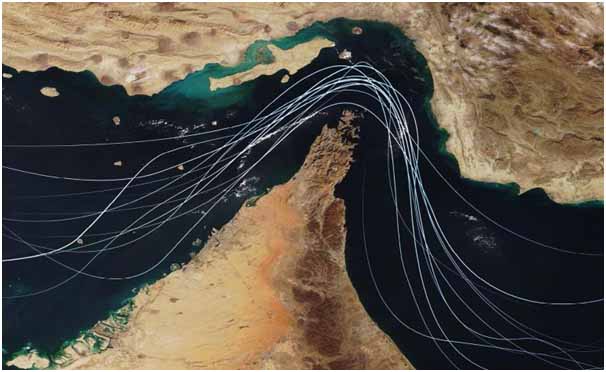
The Strait of Hormuz remains a critical global chokepoint, handling nearly 20% of the world’s oil supply. [Roland Berger]
Regional or Global Implications
While the immediate military tension is concentrated in the Middle East, the economic consequences are global. Europe faces acute energy vulnerability given its dependence on seaborne LNG imports.
Asian manufacturing economies reliant on Gulf crude, notably Japan, South Korea, and China, are also exposed. In the United States, higher pump prices risk reigniting consumer inflation, complicating the Federal Reserve’s policy path.
From Record Highs to Correction: How Fast the Mood Has Shifted
Timeline of Key Dates
- Late October 2025 — Nasdaq hits record closing high; markets pricing in two Fed rate cuts for 2026.
- January 2026 — S&P 500 reaches its record close; geopolitical tensions begin to simmer.
- Late February 2026 — Money markets still pricing in two rate cuts; Iran nuclear talks stall.
- March 27, 2026 — Pentagon military options report breaks; stocks plunge, oil surges above $100/bbl.
- Next catalyst — Any direct military engagement or Strait of Hormuz closure would trigger a further leg lower in equities and higher in crude.
Historical Context
The current episode shares hallmarks with previous Middle East-driven energy shocks, where an initial spike in oil prices fed through to broader equity weakness before stabilising once the geopolitical picture clarified. If the current standoff escalates into sustained military action, history suggests the drawdown could deepen materially before markets find a floor.

Rising oil prices raise inflation concerns, complicating central bank policy decisions in 2026. [fxtrustscore]
How a Single News Report Triggered the Market’s Worst Session in Months
Mechanism & Process
The selloff was triggered by a classic geopolitical risk transmission mechanism: a credible military threat raises the probability of energy supply disruption, oil prices spike, inflation expectations rise, real growth forecasts fall, and equity risk premia widen. Thursday’s catalyst was the Axios report on Pentagon planning, which shifted market perception from a low-probability tail risk to a plausible near-term scenario. Algorithmic selling amplified the move, particularly in high-beta technology names sensitive to rising discount rates.
What Happens Next: Two Scenarios Every Investor Needs to Consider
Forward-Looking Analysis
The near-term trajectory for markets hinges on two variables: whether diplomatic back-channels can de-escalate the US-Iran standoff, and whether the Federal Reserve signals it will look through the oil-driven inflation spike. If talks resume and crude stabilises below $100, equities could recover swiftly, as they did after several geopolitical scares in 2022–2024. However, if Brent remains above $110 into Q2 2026, corporate earnings guidance will be revised lower, sustaining the pressure on risk assets.
Risks & Counterarguments
The bull case rests on Iran’s history of calculated restraint; it has consistently avoided triggering a full-scale US military response, preferring proxy engagements. Some strategists argue the Pentagon report was deliberately leaked to strengthen Washington’s negotiating position rather than signal imminent action. If that reading is correct, the current oil spike and equity dip could prove transient.
Also Read: CLINUVEL Launches AI Vitiligo Tool at AAD 2026 Denver – Colitco
Bottom Line: Geopolitical Risk Is Back at the Centre of Every Portfolio Decision
Thursday’s selloff is a reminder that geopolitical risk can rapidly reprice markets that had largely dismissed tail scenarios. With the S&P 500 in a technical correction and the Fed’s rate-cut path now in doubt, investors face a more complex macro backdrop than at any point since 2022.
The key watch for markets is whether the US-Iran standoff escalates from rhetoric to action, and whether oil can hold below the psychologically critical $100 threshold.
FAQS
Q1. Why did US stocks fall recently?
A1. US stocks fell due to rising fears of a prolonged Middle East conflict, which increased uncertainty in global markets and triggered a broad risk-off selloff among investors.
Q2. How did oil prices react to the situation?
A2. Oil prices surged above $100 per barrel as traders priced in potential supply disruptions from the Middle East, especially through the Strait of Hormuz.
Q3. Which sectors were most affected in the selloff?
A3. Technology and communication services stocks led the declines, while most S&P 500 sectors ended the session in the red.
Q4. Why is the Strait of Hormuz important?
A4. The Strait of Hormuz is a key global oil shipping route, handling a significant share of the world’s crude supply, making it highly sensitive to geopolitical tensions.
Q5. What could happen to the stock market next?
A5. Markets may remain volatile depending on whether tensions ease or escalate further, with oil prices and inflation expectations acting as key drivers.
Q6. Are any sectors benefiting from the crisis?
A6. Yes, energy stocks have gained as higher oil prices boost revenues for major oil producers.
Disclaimer:
This article is for informational and editorial purposes only. It is published by Colitco and is based on publicly available market data and news reports at the time of writing. It does not constitute financial, investment, or trading advice. Readers should conduct their own research or consult a licensed financial advisor before making any investment decisions. Colitco and the author accept no liability for any losses arising from the use of this information.
Sources
https://english.news.cn/northamerica/20260327/a20e00b3e2b741bda32eb6cc3eeb3d9b/c.html
https://stockpil.com/stocks-drop-iran-war-chipmaker-weakness