
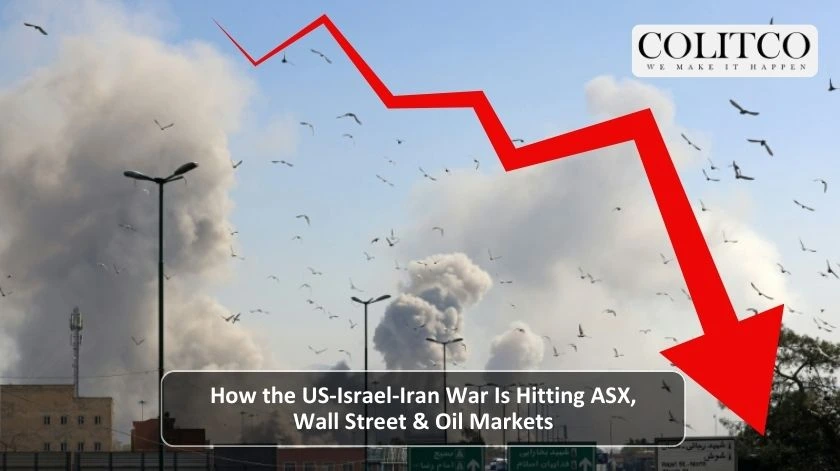
The implication of the Middle East conflict on ASX is also emerging since investors are responding to the growing tension of the war. The recent development of the conflict between the United States, Israel and Iran caused the Australian share market to fall drastically.
The index standard S/P/ASX 200 Index dropped 111.10 points or 1.2 per cent to 8829.50 shortly after the market opened as investors grew increasingly worried about the world becoming a more insecure place.
The losses of approximately 4 per cent per week put the index on its path to the worst weekly performance since May 2022, when the Reserve Bank started to increase interest rates.
According to analysts, geopolitical riskis driving traders towards less risky assets since uncertainties abound in international markets. During the same time, oil prices shot up, exacerbating inflation anxieties and straining equity values globally.
Increasing geopolitical unrest tends to create instability since investors reevaluate expansion prospects, fuel prices and chain security. Consequently, the effect of the Middle East conflict on ASX is not limited to the energy industry but has an effect on the overall investor sentiment.

Global conflict fears trigger a sharp sell-off in Australian share markets. [The Economic Times]
Why Are Investors Reacting So Strongly To The Middle East Conflict Impact On ASX?
The geopolitical confrontations are causing investors to respond intensely since such disputes can quickly interfere with the movement of energy and financial security around the world. The present war escalated with the escalation of military attacks and retaliatory strikes taking place in the Middle East.
Shipment routes and energy infrastructure are becoming increasingly vulnerable, especially in the Strait of Hormuz, one of the routes used to transport oil to the world. According to the analysts, the disturbances in this region would affect around 20 per cent of the world’s oil trade.
These risks immediately spread across the financial markets since traders expect an increased inflation and reduced rate of growth. Transportation and manufacturing costs increase in the world as the costs of energy skyrocket.
This is a dynamic that compels investors to re-evaluate the profit expectations of most of the listed companies. Therefore, the share markets such as the ASX usually fall during geopolitical shocks.
During the uncertainty phase, global investors also divert their finances to commodities such as oil and gold. These counteractions have the potential of increasing volatility in the equity markets.
Oil Price Surge Intensifies ASX 200 Oil War Impact
This effect of the ASX 200 oil war is especially felt in the energy sector, where the price of crude is skyrocketing. The oil prices soared following the fear that the conflict would disrupt the tanker traffic and the world supply chains.
Brent crude has already soared due to the fears of shipping restrictions in the Strait of Hormuz. Strait is considered a critical region to the global energy markets since it generally takes care of a huge portion of oil shipments in the world on a daily basis.
Other observers have given warnings that the price of crude oil may rise to about US100 a barrel in case the war escalates. Increased prices of energy usually favour the oil producers but hurt the overall economic performance. The increased prices of crude have benefited the Australian energy firms.
But this may be offset by increasing the cost of fuel, increasing inflation and straining consumer spending. The outlook of the ASX 200 oil war is thus a mixed picture for investors and businesses.
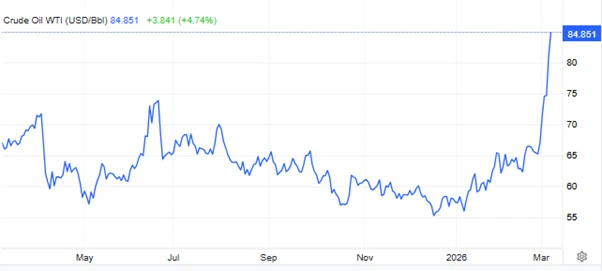
Rising oil prices fuel market volatility during the Middle East conflict. [Trading Economics]
Could Australia’s Petrol Prices War Oil Shock Hit Households Next?
The oil prices may be high, and the Australian households may soon experience economic impact. Australian petrol prices are well monitored against international crude oil standards since the country also imports a lot of the refined fuel.
The local petrol prices usually follow the oil prices within the weeks when the oil prices surge because of geopolitical tensions. The increased fuel prices have an impact on transportation, food distribution and logistics throughout the economy.
These inflation rates tend to trickle down to the daily goods and services, straining domestic spending. Economists have expressed an alarm that long-term oil shocks would make central bank policy decisions difficult.
An increase in inflation can reduce the capacity of policymakers to lower interest rates. This would mean that consumers will be exposed to increased costs of borrowing, and their living costs will also go up. These situations tend to undermine retail expenditure and sluggish economic progress.
How Are Wall Street And Global Markets Responding?
The same is also being reflected in the reaction of global markets as the investors track the developments in the conflict. There have been fluctuations in Wall Street where traders have turned to safer commodities and assets.
Traditionally, geopolitics causes interim selling in equities and energy and defence stocks are accumulative. The trend is re-emerging as investors consider supply risks and economic blowback.
According to the market analysts, the biggest issue is the uncertainty of the duration of the conflict. In case the tensions are contained, we may stabilise the markets in a couple of weeks.
Nevertheless, a broader escalation of the region will push the oil prices pretty high and increase the market volatility. The global supply chains are also vulnerable to disruptions in the event that shipping paths are limited.
These are the reasons as to why the investors across the world are paying close attention to the military events and diplomatic reactions.
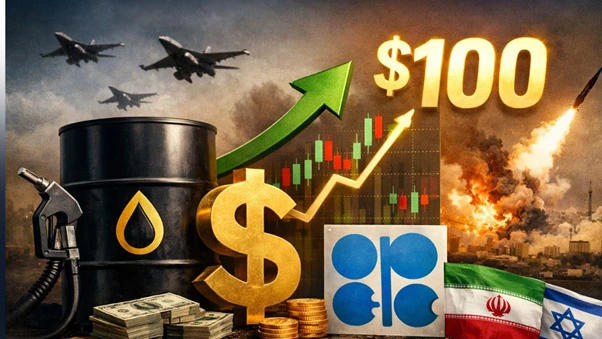
Global investors monitor markets as geopolitical tensions drive volatility. [The Financial Express]
What Could Happen Next For The Middle East Conflict Impact On ASX?
The effect of the Middle East conflict on ASX in the future will be highly determined by the duration of the conflict. Short-term conflicts usually have short-term market shocks and recovery rallies.
Nevertheless, the long-term geopolitical conflicts can redefine the economic environment across the world. Increased energy costs can bring up inflation pressures in most economies.
Companies may have to deal with increased operational expenses, and consumers may reduce discretionary consumption. Investors can also move portfolios to commodities, defence stock and safe-haven assets.
In the case of the Australian share market, producers of energy can enjoy the prolonged gains of oil prices. Nonetheless, industries relying on consumer expenditure or transport expenses may not do well.
Market strategists thus anticipate that the market will continue to be volatile as the war is not over. Investors are following closely the progress of diplomacy and oil market indications to get a better direction.
Also Read: How Investors Can Navigate an ASX Sell‑Off Amid Oil Rally
FAQs
Q1. Why is the Middle East conflict affecting the ASX?
A1: The conflict raises oil prices and economic uncertainty, which reduces investor confidence and pushes share markets lower.
Q2. How much has the ASX fallen due to the conflict?
A2: The S&P/ASX 200 dropped 111.10 points, or 1.2 per cent, to 8829.50 during early trading.
Q3. Why are oil prices rising during the war?
A3: Energy traders fear disruptions to global oil shipments, especially through the Strait of Hormuz, a key shipping route.
Q4. Could petrol prices rise in Australia?
A4: Yes. Australia imports much of its fuel, so global oil price increases usually push local petrol prices higher.