Donald Trump’s appearance at the World Economic Forum on 21 January 2026 sent shockwaves through global markets, delivering a speech that both reassured and rattled investors watching from Sydney to New York.
The US President told business leaders and world officials in the Swiss Alps resort town that he would not use military force to acquire Greenland. That statement alone triggered a sharp reversal in market sentiment after Tuesday’s brutal sell-off.
Dow Jones Industrial Average futures climbed 0.7 per cent following the remarks. The S&P 500 futures gained 0.8 per cent, while the Nasdaq Composite advanced 0.7 per cent. This came after all three indices suffered their worst daily losses since October, with the S&P 500 plunging 2.1 per cent on Tuesday.
What Trump Said and What It Means
Speaking to an audience he described as “so many friends, a few enemies,” Trump outlined his administration’s position on the Danish territory.
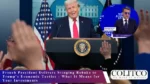
“We probably won’t get anything unless I decide to use excessive strength and force, where we would be, frankly, unstoppable,” Trump said at the World Economic Forum. “But I won’t do that. That’s probably the biggest statement I made, because people thought I would use force.”
The President called for “immediate negotiations” to discuss US acquisition of the Arctic island. He insisted Greenland represents “a core national security interest of the United States of America” due to its strategic location and mineral wealth.
Børge Brende, President of the World Economic Forum, pressed Trump during a question-and-answer session about the US national debt, which has surpassed USD 38 trillion. Trump insisted America would “grow its way out” of the fiscal burden.
President Trump speaks on the national security interests of the United States in acquiring Greenland.
“This would not be a threat to NATO—this would greatly enhance the security of the entire alliance.” pic.twitter.com/gBDm5ZZuul
— The White House (@WhiteHouse) January 21, 2026
Markets Whipsaw on Greenland Crisis
Tuesday’s market carnage reflected deep investor anxiety about Trump’s territorial ambitions. The President had threatened eight NATO allies with escalating tariffs beginning at 10 per cent on 1 February, rising to 25 per cent by June if they refused to support his Greenland acquisition plans.
Those countries – Denmark, Norway, Sweden, Germany, France, the United Kingdom, the Netherlands, and Finland – issued a joint condemnation of the threats on Sunday. European Commission President Ursula von der Leyen warned the tariffs would be “a dangerous downward spiral.”
Gold prices smashed through the USD 4,800 per ounce barrier for the first time on Wednesday, gaining 2.2 per cent. Investors scrambled into safe-haven assets amid the geopolitical uncertainty.
European markets showed mixed results. The pan-European Stoxx 600 trimmed earlier losses to trade 0.2 per cent lower by mid-afternoon in London. Mining stocks bucked the trend, with Anglo American adding 4.8 per cent and Rio Tinto gaining 4.7 per cent.
Australia’s S&P/ASX 200 slipped 0.4 per cent to 8,782.90 on Wednesday.
The Bigger Trade War Picture
Trump’s Davos appearance comes as the administration pursues an aggressive trade policy across multiple fronts.
The President has previously imposed tariffs reaching 104 per cent on Chinese imports. He’s also threatened major duties on 60 countries running trade surpluses with the United States.
Commerce Secretary Howard Lutnick told CNBC’s “Money Movers” on Tuesday that America’s “tariff deals, our trade deals with Europe, with the UK—these are durable and stable.”
“You can have a fight with your allies. You can disagree with your allies. It doesn’t stop them from being your allies or your big trading partners,” Lutnick added.
Treasury Secretary Scott Bessent urged calm at Davos. “Everyone take a deep breath,” he told CNBC. “Do not escalate. President Trump has a strategy here. Hear him out, and then everything will be fine.”
Market observers remain sceptical. JPMorgan’s Joyce Chang wrote that “America First is quietly driving diversification away from dollar assets, especially among government entities.”
European Leaders Push Back
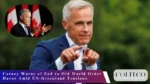
Canadian Prime Minister Mark Carney delivered one of the most forceful responses at Davos on Tuesday. He called other nations to join Canada in pursuing shared values while warning them to “stop invoking rules-based international order as though it still functions as advertised.”
“The powerful have their power,” Carney said to a standing ovation. “But we have something too – the capacity to stop pretending, to name reality, to build our strength at home and to act together.”
French President Emmanuel Macron said Saturday that “tariff threats are unacceptable” and Europeans would “respond in a united and coordinated manner should they be confirmed.”
Trump’s view of Macron has since soured. The President threatened to impose 200 per cent tariffs on French wine after reports suggested Macron would not join his “Board of Peace” initiative for Gaza.

French President Emmanuel Macron at Davos as tensions with the US escalated. [World Economic Forum]
What Analysts Are Saying
The BBC reported on Wednesday that European Parliament trade committee chair Bernd Lange would announce a suspension of the US-Europe trade deal finalised last summer. This would represent a significant escalation in transatlantic trade tensions.
Ray Dalio, founder of Bridgewater Associates, warned at Davos about “capital wars” following trade conflicts.
“If you take the conflicts, you can’t ignore the possibility of the capital wars,” Dalio told CNBC. “Maybe there’s not the same inclination to buy US debt and so on.”
Brende acknowledged the challenges facing the global economy. “We are most worried about major escalations of wars,” the WEF President said. “That can kill global growth.”
The forum takes place against what Brende described as “the most complicated geopolitical backdrop since the World Economic Forum was founded” in 1971.
Earnings Season Adds Another Layer
Corporate America is navigating these geopolitical headwinds during fourth-quarter earnings season. About 81 per cent of S&P 500 companies have beaten profit expectations so far. Yet their shares have underperformed the benchmark by an average of 1.1 percentage points – the worst relative performance since 2017.
3M Company shares fell 7 per cent on Tuesday despite beating estimates. Investors focused on a weak outlook instead. State Street Corporation dropped 6.1 per cent as a dimmer net interest income forecast overshadowed better-than-expected quarterly results.
Netflix declined about 6 per cent in premarket trading Wednesday after a disappointing subscriber growth outlook.
Investor Outlook
Markets are caught between optimism about Trump’s softer rhetoric on Greenland and anxiety about the broader trajectory of US trade policy.
The President’s confirmation that he won’t use force represents a tactical retreat from his more bellicose weekend statements. But his insistence on “immediate negotiations” signals he hasn’t abandoned the territorial ambition.
European countermeasures remain on the table. The proposed US-EU trade deal now faces an uncertain future. And Trump’s willingness to threaten NATO allies with tariffs has fundamentally altered perceptions of transatlantic relations.
For Australian investors, the implications are indirect but real. Weaker European growth would dampen global demand for commodities. A stronger US dollar, if trade tensions ease, would pressure Australian mining exports.
The benchmark ASX 200 has declined 0.4 per cent this week but remains near record highs set in recent months. Resource stocks continue to benefit from China’s renewed focus on domestic technology development and infrastructure spending.
Gold’s surge above USD 4,800 per ounce reflects genuine uncertainty about the durability of the post-World War II international order. That Trump felt compelled to reassure markets he won’t invade an ally’s territory speaks volumes about how far norms have shifted.
The coming weeks will reveal whether Trump’s Davos performance represents a genuine pivot toward negotiation or merely a tactical pause in a more aggressive strategy. Markets are pricing in both possibilities.