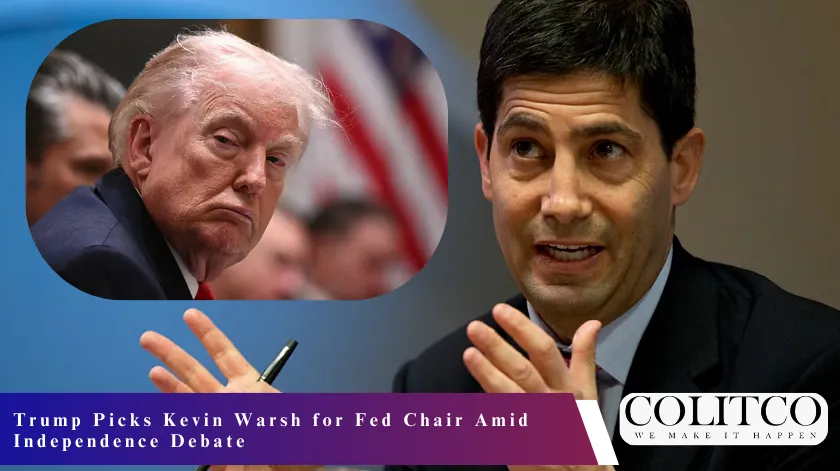
President Donald Trump has nominated former Federal Reserve Governor Kevin Warsh to succeed Jerome Powell as chair of the U.S. central bank. The decision ends months of speculation and shifts attention to a Senate confirmation process that is expected to be closely contested.
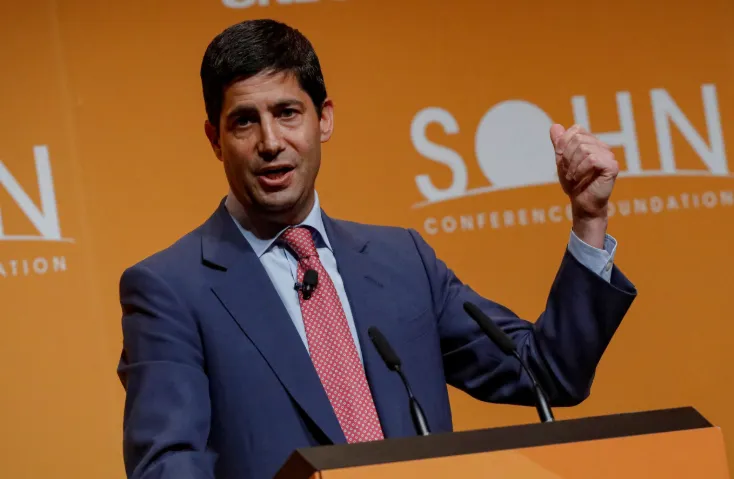
Former Federal Reserve Governor Kevin Warsh was nominated by President Donald Trump to succeed Jerome Powell as Fed chair. (Source: The Wall Street Journal)
Trump Announces Warsh as Fed Chair Nominee
Trump confirmed the nomination on Truth Social on Friday afternoon. In his post, he described Warsh as a proven leader and praised his record in financial markets. The president wrote that Warsh could become “one of the GREAT Fed Chairmen.”
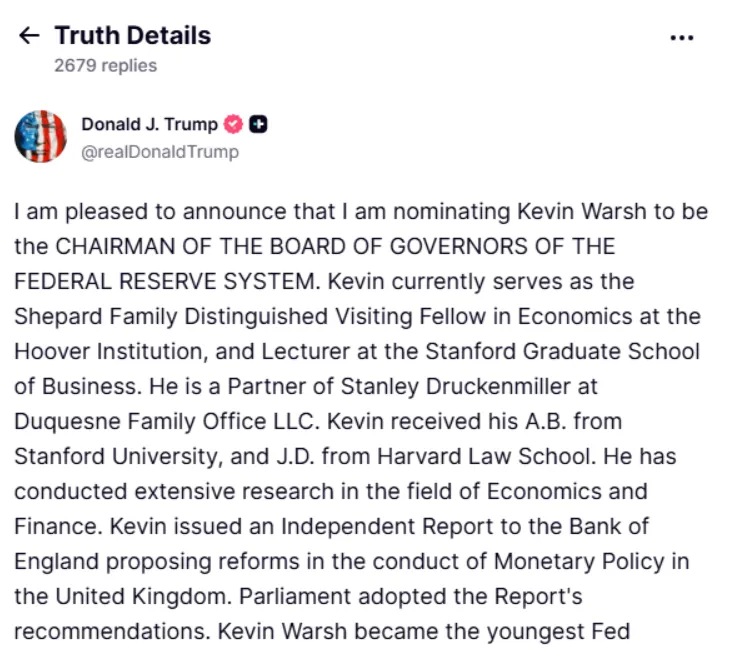
President Donald Trump announced Kevin Warsh’s nomination on Truth Social following months of speculation. (Source: Truth Social)
The announcement followed an extended and public search process. More than a dozen names were considered during the vetting phase. Investors and lawmakers closely monitored the selection as inflation remained above the Federal Reserve’s 2% target and economic growth showed signs of slowing.
Warsh, 55, previously served as a Federal Reserve governor from 2006 to 2011. His tenure covered the global financial crisis and its immediate aftermath. Since leaving the board, he has remained active in financial commentary and policy discussions.
Market Reaction Remains Measured
Financial markets reacted cautiously after the announcement. Stock futures moved lower early Friday but recovered some losses once Warsh emerged as the likely nominee. Analysts described the response as orderly.
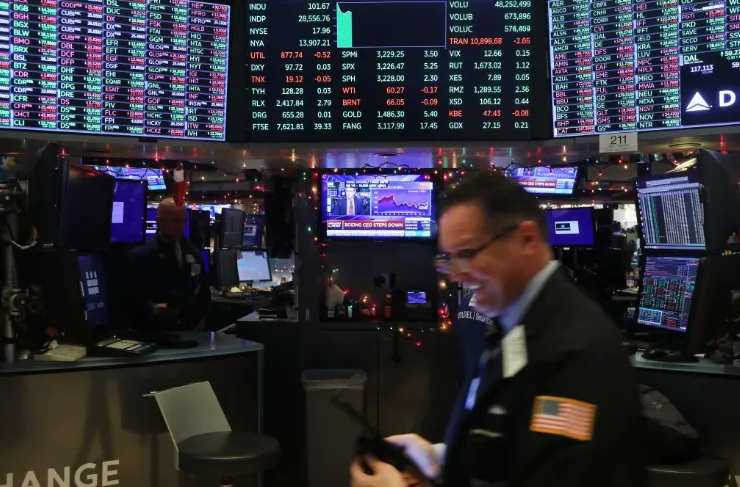
U.S. markets showed modest movement following the announcement of Warsh’s nomination. (Source: Investopedia)
Bond markets also reflected measured expectations. Traders currently price in no more than two additional rate cuts this year. The benchmark federal funds rate is expected to settle near 3%, which policymakers view as neutral.
Investors appear to anticipate continuity rather than abrupt policy shifts. Warsh is widely regarded as experienced in central banking operations. As a result, the nomination did not trigger immediate volatility across major asset classes.
Debate Over Federal Reserve Independence
The nomination arrives during a period of heightened political attention on the Federal Reserve. Trump and several administration officials have publicly questioned long-standing norms related to central bank independence.
In recent weeks, the Justice Department subpoenaed Jerome Powell regarding renovations at the Federal Reserve’s Washington headquarters. Powell has described the investigation as a pretext linked to pressure over monetary policy. The inquiry has intensified debate over executive influence on interest rate decisions.
Some administration figures have discussed closer consultation between the White House and the Federal Reserve. Such proposals have prompted discussion among lawmakers about the boundaries between fiscal and monetary authority. The issue is expected to feature prominently during confirmation hearings.
Warsh’s Record and Policy Positions
Warsh has previously expressed criticism of current Federal Reserve leadership. In a CNBC interview, he stated that the institution required a “regime change.” He argued that the central bank’s credibility had weakened in recent years.
At the same time, Warsh has emphasized disciplined monetary policy. During his tenure as governor, he participated in decisions aimed at stabilizing markets during the financial crisis. His background includes experience on Wall Street before joining the Federal Reserve Board.
Observers note that Warsh’s comments about credibility and policy direction could receive attention from senators. His record suggests familiarity with crisis management and financial market operations. Lawmakers are expected to question him on interest rate strategy and inflation management.
Senate Confirmation Faces Obstacles
The confirmation process is not expected to be straightforward. Republican Senator Thom Tillis of North Carolina has indicated he may block Federal Reserve nominations until the Justice Department concludes its probe into Powell.
By contrast, Senate Banking Committee Chair Tim Scott has publicly praised Warsh’s expertise. Scott described him as knowledgeable about both markets and monetary policy. The committee will play a central role in advancing the nomination to a full Senate vote.
Given the divided political environment, the timeline remains uncertain. Senators are likely to examine Warsh’s previous statements and policy positions in detail. The confirmation hearings may also address broader questions about presidential authority over independent agencies.
The Broader Economic Backdrop
The Federal Reserve faces persistent inflation above its long-term target. At the same time, labor market conditions have shown signs of softening. Government borrowing continues to rise, adding complexity to fiscal and monetary coordination.
These conditions create a challenging environment for any incoming chair. Interest rate decisions in the coming months will influence borrowing costs, housing markets, and business investment. Therefore, the leadership transition carries added attention from financial institutions and global investors.
Powell’s future role remains unclear. Although chairs traditionally step down from the board when replaced, Powell still has two years remaining in his term as governor. He could remain on the board, depending on his decision.
Also Read: DOJ Releases 3 Million Pages in Major Epstein Files Disclosure
Legal Questions and Institutional Authority
The Supreme Court is currently considering a case involving another Federal Reserve governor. That case could clarify the scope of presidential authority over members of the central bank. The outcome may shape the broader relationship between the executive branch and independent agencies.
Meanwhile, the Warsh nomination moves through the established constitutional process. The Senate’s advice and consent role ensures public hearings and formal debate. Lawmakers will evaluate qualifications, past conduct, and policy philosophy before voting.
As the process unfolds, financial markets are expected to monitor developments closely. Investors, economists, and policymakers will watch for signals about the future direction of U.S. monetary policy. For now, attention remains fixed on Capitol Hill and the upcoming confirmation hearings.
FAQs
- Who has President Trump nominated as the next Federal Reserve Chair?
President Donald Trump has nominated Kevin Warsh, a former Federal Reserve governor, to succeed Jerome Powell as chair of the U.S. central bank.
- Who is Kevin Warsh?
Kevin Warsh is a former member of the Federal Reserve Board of Governors. He served from 2006 to 2011, including during the global financial crisis, and has experience in financial markets and economic policy.
- When would Kevin Warsh take office if confirmed?
If confirmed by the Senate, Warsh would assume the role after Jerome Powell’s term as chair ends in May 2026.
- Does Jerome Powell remain at the Federal Reserve after his chair term ends?
Powell still has two years remaining in his term as a governor. He could remain on the Federal Reserve Board even after stepping down as chair.
- What is required for Warsh to become Fed Chair?
Warsh must be confirmed by the U.S. Senate. The Senate Banking Committee will first hold hearings before a full Senate vote.
- How have financial markets responded to the nomination?
Markets reacted cautiously, with modest movements in stock futures and bond yields following the announcement.
- Why is the nomination drawing political attention?
The nomination comes amid debate over Federal Reserve independence and a Justice Department probe involving Jerome Powell, raising questions about executive influence over monetary policy.










:max_bytes(150000):strip_icc()/GettyImages-1195603075-7e8dc700af47458e9b4f03a91c1397d8.jpg)