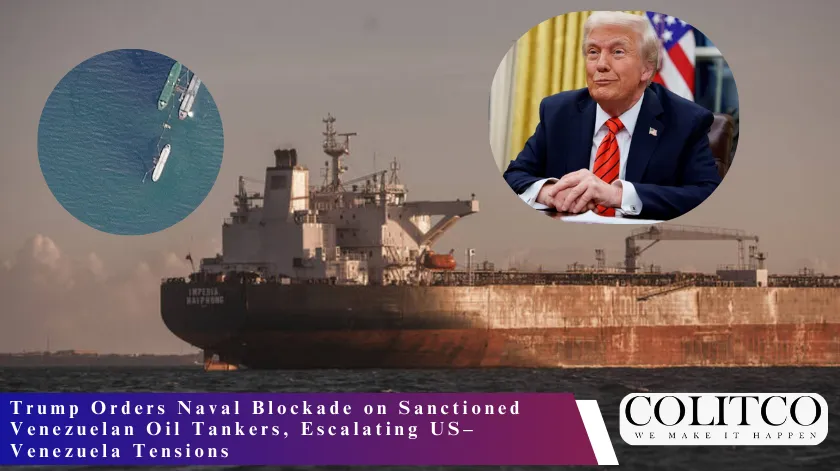
United States President Donald Trump has ordered a “total and complete” naval blockade targeting US-sanctioned oil tankers entering or leaving Venezuela, escalating tensions between Washington and Caracas following the recent seizure of a Venezuelan crude carrier by US forces.
Blockade Announced After Tanker Seizure
The blockade order was announced late Tuesday through Trump’s Truth Social account, following last week’s seizure of an oil tanker off Venezuela’s coast. The vessel, identified by Venezuelan officials as the Skipper, was reportedly taken to Texas to unload its crude cargo.
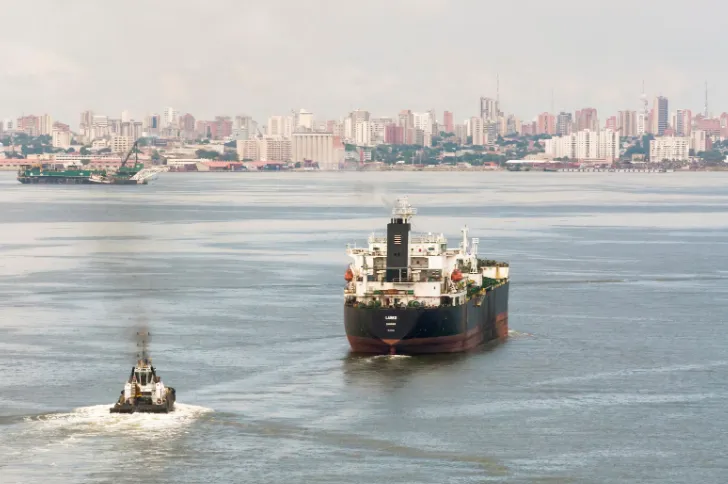
US officials have not publicly detailed the legal basis for the seizure or the scope of enforcement measures. Pentagon representatives referred all questions on the blockade announcement to the White House.
Trump stated that Venezuela was surrounded by a large naval force and accused its government of theft and criminal activity. His post described the Maduro administration as a “foreign terrorist organization,” language that drew immediate scrutiny.
Claims of Terrorism and Criminal Financing
In his social media post, Trump alleged Venezuelan oil exports were financing terrorism, drug trafficking, and human trafficking. He said the blockade would remain until Venezuela returned assets he claimed were taken from the United States.
Trump is cranking up his pressure on Venezuela.
Trump has designated the Maduro regime as a foreign terrorist organization, and has ordered a blockade of all oil, into and out of Venezuela.
I see some parallels to Iran.
Deep State assets/proxies are being neutralized. pic.twitter.com/Zkg2cvnfXf
— Clandestine (@WarClandestine) December 17, 2025
The administration has not released evidence linking state oil exports directly to terrorist activity. Venezuela is not listed by Washington as a state sponsor of terrorism.
Legal experts note that foreign terrorist designations typically apply to non-state actors. In rare cases, the United States has applied the label to arms of foreign governments.
Caracas Rejects ‘Grotesque Threat’
Venezuela’s government issued a statement rejecting the blockade announcement, calling it an irrational and hostile act. Officials accused Washington of attempting to steal national resources through military pressure.
We reject the naval blockade against #Venezuela announced by the #US government, which is a very serious violation of International Law and a new escalation of the aggression against the Bolivarian government.
Our all-out and firmest support goes to the constitutional President… pic.twitter.com/hemaOjAojt
— Bruno Rodríguez P (@BrunoRguezP) December 17, 2025
President Nicolás Maduro addressed the situation on state television, saying Venezuela would resist what he described as piracy. He claimed the tanker seizure formed part of a broader campaign against the country.
Caracas maintains that US actions violate international law and threaten global energy trade. Venezuelan officials have repeatedly denied involvement in drug trafficking allegations.
International Reaction and Russian Warning
Russia’s Foreign Ministry warned that escalating tensions around Venezuela could create unpredictable consequences across the Western hemisphere. The statement was carried by Russia’s state news agency, TASS.
US Congressman Joaquin Castro described the blockade as an act of war in a social media post. He said Congress had not authorized hostilities and announced plans for a House vote directing the president to end actions against Venezuela.
Castro added that lawmakers would soon decide whether they supported deeper military engagement aimed at regime change.
Military Buildup and Maritime Operations
The blockade follows an expanded US naval presence in the Caribbean and eastern Pacific, officially linked to counter-narcotics operations. US forces have conducted numerous strikes on vessels in recent months.
According to reports cited in the provided material, at least 90 people have been killed in attacks on boats near Venezuela since September. International law experts have criticized the operations as lacking transparency.
Washington maintains the strikes target drug smuggling routes. Venezuelan officials argue the campaign serves as cover for economic pressure and military escalation.
Oil Exports and Sanctions Pressure
Venezuela holds the world’s largest proven oil reserves and relies heavily on crude exports. Strict US sanctions, first imposed during Trump’s earlier term, have restricted access to global markets.
Reuters reported that only tankers chartered by Chevron have recently left Venezuelan ports carrying crude. Chevron operates through joint ventures with the state oil company PDVSA under US authorization.
Most Venezuelan exports are sold at discounted rates through informal channels, primarily to China. A US court has also ordered the forced sale of Citgo assets to satisfy outstanding debts.
Also Read: U.S. Military Aircraft Near Venezuela Triggers JetBlue Near-Collision Incident
Questions Over Enforcement and Scope
It remains unclear how the United States will enforce a blockade limited to “sanctioned oil tankers.” Trump did not clarify operational rules or engagement thresholds.
The US Navy currently has multiple vessels in the region, including an aircraft carrier and amphibious ships. Surveillance aircraft are also monitoring maritime traffic.
As tensions rise, Venezuela has turned to the United Nations Security Council, formally denouncing the tanker seizure and detention of its crew as state piracy.