The social media ban on under-16s in Australia is transforming access to major social media by the youth, with regulators paying close attention and companies scrambling to enforce strict age verification.
Snapchat claims to have blocked over 415,000 local teen accounts with a combination of self-reported age and automated detection software, but most families claim no difference in real-life behaviour, making it questionable how it is applied and over time.
The numbers indicate the magnitude of the policy, revealing gaps that tech companies acknowledge to be challenging to seal in various digital ecosystems.
Why Are Snapchat Age Limits 2026 Tightening Controls In Australia?
Snapchat’s age restrictions 2026 policies are based on the government regulations that prevent digital users (persons below 16 years of age) from accessing the services of mainstream social media platforms and compel the platforms to validate ages more closely.
Snapchat affirmed that it locked or disabled more than 415,000 accounts in Australia that either stated that they were younger than 16 years old or were detected by a detection technology.
According to the same framework, a reported blocking of 544k accounts was reported, meaning that hundreds of thousands of teens lost their access at the same time.
Regulators claim these measures decrease the detrimental exposure, but technical accuracy is still not at its ideal and poses new problems to the companies aiming to comply at scale.

Snapchat login on a smartphone screen with a warning about teen safety. [Android Central]
Platforms Report Large-Scale Teen Account Restrictions
The sum of the two platforms (Snapchat and Meta) means that approximately one million restricted accounts throughout Australia is an indicator of a malicious enforcement policy by the two companies and the government.
According to Snapchat, the majority of limitations are based on automated systems that approximate age by using behavioural indicators and account information instead of official identification.
These systems are fast, yet they do not eliminate errors, which may block the old users mistakenly and leave the young ones behind.
The outcome is unequal protection that is not equal between applications and allows the determined teens to evade protection by using other accounts or browsing as a guest.
Are Teens Actually Staying Off Social Media Apps?
Although the number of parents and students subject to an official total has been many, day-to-day use has hardly changed as teens make secondary profiles or switch services with fewer checks.
There are access platforms where one does not have to log in, and there are access platforms where one steals the credentials of their older friends that undermine the desired barrier.
Snapchat cautions that blocking access to apps could only drive the youth to less popular communication platforms with weaker safety protocols. Such a change may lead to less supervision and higher risk, instead of the safeguarding that legislators assured.

Adolescents assembled in the street with the help of several social media applications on their phones. [BBC]
Technical Limits Complicate Age Verification Systems
Snapchat acknowledges actual technical constraints that inhibit precise and reliable age verification on any online service and uses an example of the 2025 government pilot in Australia as proof.
The available age estimation technology was not found to be accurate within the range of two to three years on average that is quite a big margin of error. Younger teens can go through, and older users can be deprived of legitimate access, become frustrated, and face legal problems.
The absence of a national standard that every company works with means that all companies use different tools, making it harder to enforce by the regulators and the users themselves.
Will A Patchwork Policy Create More Risks?
A fragmented approach implies that big platforms are looked at, whereas smaller ones or foreign services are not subject to the regulations that stimulate migration and divide the online space.
According to Snapchat, more than 75 per cent of the time spent on the app in Australia is messaging close friends and family that indicates that teens see connection over entertainment.
When such communication channels are no more, some of them will switch to unregulated alternatives with no reporting capabilities and moderation protection.
Achieving the goals of safety and realistic behaviour patterns should be balanced by policymakers to prevent the unintended consequences.
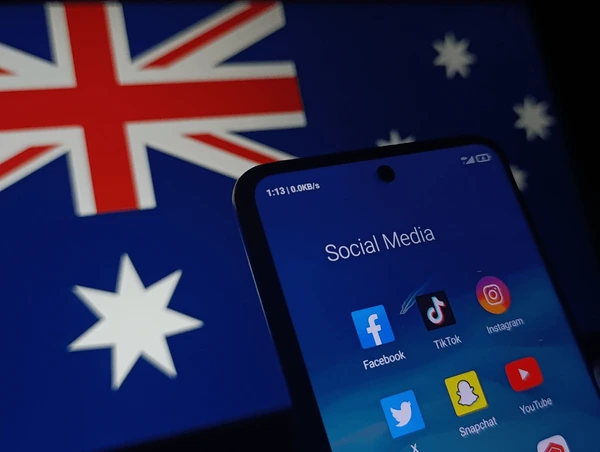
The Australian flag and the mobile phone with social media icons. [Shutterstock]
Digital Literacy May Offer A Stronger Long-Term Solution
Specialists theorise that, in terms of any platform, education and digital literacy can provide more sustainable results than prohibitions since educated teens make wiser decisions.
Education about privacy awareness and thinking with critical thinking and respectful communication can help mitigate harm, but will not push the users into the shadows.
The existing figures depict the strength of enforcement, but behaviour changes rapidly, thus restricting effectiveness.
It is expected that the experiment conducted in Australia will be used as other countries think of such laws as companies’ perfect technology, and governments reconsider their strategy to safeguard young users without secluding them from modern communication.
Also Read: Meta Australia Teen Accounts Removed As Law Tightens Access
FAQs
Q1: What are Snapchat’s age limits for 2026?
A1: They refer to Australia’s rules preventing users under 16 from accessing Snapchat and similar platforms.
Q2: How many teen accounts did Snapchat restrict?
A2: Snapchat reported restricting over 415,000 Australian accounts.
Q3: Are teens still using social media despite the ban?
A3: Many reportedly switch accounts or use alternative services to stay connected.
Q4: What could work better than bans?
A4: Digital literacy education and consistent standards may offer stronger protection.