
Reliance Worldwide Corporation (ASX: RWC), the Australian-based manufacturer of plumbing and water control products, has declared a change to its RWC on-market repurchase plan, which is an indication of its continuous priorities in managing capital.
The revision comes in light of the recent reports that have been reported to the Australian Securities Exchange, and which attest to the fact that the company was still undertaking a share buy-back. The buy-back program is an element of the overall distribution policy of the company aimed to give its shareholders back the capital while keeping the flexibility of operations.
The recent filings show the repurchase of shares as part of the programme, which is subject to the regulatory rules and to the market conditions, based on open market trading. The new notification provides how the company can change the timing and volumes based on the share performance and liquidity.
This kind of capital allocation is normally indicative of confidence of the management in long-run fundamentals and balance sheet strength. The RWC on-market repurchase plan would then be of significance to investors in terms of the management sentiment and financial discipline.

Reliance Worldwide Corporation updates its share buy-back strategy to manage capital and shareholder returns. [Courtesy: RWC]
RWC On-Market Repurchase Plan Signals Active Capital Management
The RWC on-market repurchase scheme remains an organised buy-back programme that enables the firm to buy its ordinary stock via the ASX trading. Within the context of such programmes, firms lower the total shares outstanding in the market, which can help boost earnings per share in the long term.
According to market alerts, the company has periodically been purchasing shares and reporting the business to the exchange. This openness will make investors track the daily buy-back operation and how it can impact the supply and demand of the market.
Analysts usually perceive buy-backs as an indication that the management is of the opinion that the share of the company is underpriced. The plan also assists the company in its general capital allocation system, in addition to the dividends and reinvestment plans.
This strategy, in the case of RWC, will be used in addition to its emphasis on enhancing stockholder payouts even as it retains investments in product development and international distribution networks.
What Does The RWC Buy-Back Impact On Share Price Mean?
The RWC buy-back impact on share price is one of the primary areas of interest among the majority of investors because share repurchases usually have an effect on market sentiment. Earnings per share can rise when the company decides to lower the number of shares in the market, although the profits can be constant.
This dynamic would appeal to investors who consider buy-backs to be an encouraging sign of long-term value creation. But the net impact on the price is determined by various factors such as the macroeconomic factors, industry demand and investor mood.
Buy-backs are also applied in stabilising the volatility of trade and maximising the capital structure of companies that are listed on the ASX. In RWC, the programme will be deployed under the rules of exchange that provide the flexibility to buy depending on the volume of trading and liquidity per day.
The updates of the buy-back are thus closely followed by the investors since they can give hints concerning the future performance of the shares and the distribution of capital in the future.
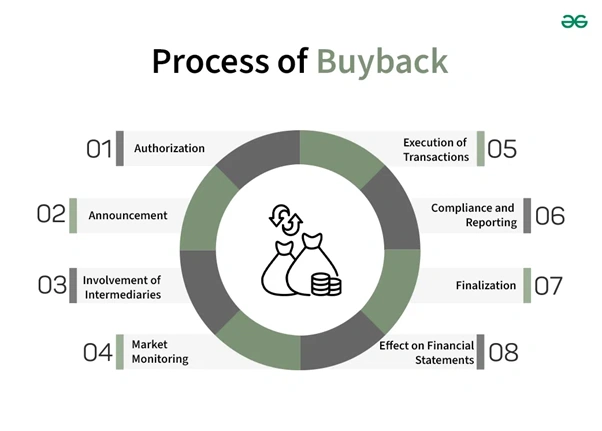
Share buy-backs may influence earnings per share and investor perception in capital markets. [Courtesy: GeeksforGeeks]
RWC Dividends And Buy-Back Update Reflect Financial Strategy
RWC dividends and buy-back update are also connected with the recent financial performance and shareholder delivery model of the company. RWC also reported net profit after tax of US$43.7 million in its half-year results at the end of 31 December 2025 and adjusted net profit after tax of US 52.2 million.
During the period, the net sales of the company stand at US 645.4 million, which is a decrease of 4.6 per cent with respect to the same corresponding period. The company has been able to generate high levels of cash flows and moderate net debt by US 21.2 million despite the dampened revenue environment.
The board also affirmed a payment of 4.0 cents per share, including an interim dividend of US2.0 cents per share and a share buy-back element on-market valued at US15.3 million.
This moderate approach means that RWC will continue to retain shareholder rewards and also overcome the weaker demand situations in certain markets. Since the company was founded, it has consistently grown in the global marketplace.
Where Is RWC Positioned In The Global Plumbing Sector?
Reliance Worldwide Corporation is a manufacturer of water control and plumbing products based in Australia, but operating globally. Its products have found extensive application in residential and commercial construction, especially in North America, Europe and the Asia-Pacific region.
The company is also famous for the push-to-connect plumbing fittings and water control systems that are used to support modern construction and infrastructure projects. The demand for such products is highly connected with the housing construction cycles and the renovation activity across the globe.
With the global housing markets changing, businesses such as RWC will also change capital allocation plans so that they can safeguard the margins and retain investor confidence.
The new RWC on-market repurchase plan is thus useful in stabilising the returns to the shareholders as the firm invests further in innovation and distribution worldwide.

RWC operates globally in plumbing and water control technologies used in construction. [Courtesy: RWC]
What Could Happen Next For The RWC On-Market Repurchase Plan?
In prospect, the RWC on-market repurchase plan will keep running as long as market conditions and capital requirements are met. Buy-back programmes usually enable boards to take a break, make or buy at varying speeds in response to share price changes and liquidity.
Share repurchases and the effect they may have on earnings measures will be the topics of interest to the investors in future ASX notifications. Should the market conditions stabilise, further buy-backs would lead to a steady decrease in the number of shares and complement the valuation multiples of the company.
The company, however, needs to strike a balance with investment requirements in manufacturing capacity, product development and supply chain resilience. To the shareholders, the major lesson learnt is that RWC will remain focused on disciplined capital management as it copes with the unpredictable construction demand across the world.
Also Read: Reliance Worldwide Corporation Confirms Director Retirement in ASX Announcement
FAQs
Q1. What is the RWC on-market repurchase plan?
A1: The RWC on-market repurchase plan allows the company to buy its own shares through ASX trading.
Q2. Why do companies conduct share buy-backs?
A2: Companies repurchase shares to return capital to investors and potentially improve earnings per share.
Q3. How does the RWC buy-back impact the share price?
A3: Buy-backs can reduce share supply and increase earnings per share, which may support the stock price.
Q4. How does the buy-back relate to RWC dividends?
A4: The company distributes shareholder returns through both dividends and share repurchases.
Disclaimer:
This article is for informational purposes only and does not constitute financial or investment advice. Investors should conduct independent research or consult a licensed adviser before making investment decisions.
Sources:
- ASX Announcement – Reliance Worldwide Corporation Interim Results 2026
- TipRanks Market Update – RWC Share Buy-Back Activity
- RWC– Financial Reports