Rio Tinto hosted an investor site visit to Argentina on 8 December 2025 to highlight its world-class integrated lithium business and substantial growth pipeline. The presentation underscored the company’s unique position in an energy transition-driven market demanding significant new supply capacity.
Strong Fundamentals Drive Lithium Market Growth
Barbara Fochtman, Rio Tinto’s Managing Director of Lithium, presented the company’s strategic vision to a gathered audience of investors. Global lithium demand is set to grow at a compound annual rate of 13 per cent through 2035, driven by electric vehicle adoption and battery energy storage systems deployment. This expansion creates a durable market requiring significant greenfield investments to meet projected demand.
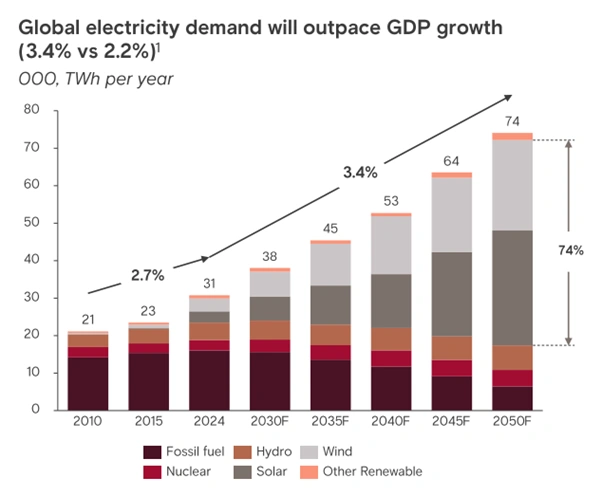
Rio Tinto’s analysis reveals that global electricity demand will outpace gross domestic product growth, expanding from 53 terawatt hours annually in 2010 to forecasted 74 terawatt hours by 2050. The energy transition continues to accelerate due to environmental imperatives, geopolitical considerations, and recognised economic advantages. Policy frameworks and technological advancements further strengthen the structural demand case for lithium and related battery materials.
Product Diversity Across Global Markets
Rio Tinto operates a diverse product portfolio spanning lithium carbonate, lithium hydroxide, lithium chloride, lithium metal, and specialty chemicals. The company serves distinct end markets, including electric vehicle manufacturers, grid-scale energy storage providers, aerospace and defence sectors, and non-battery industrial applications.
Sarah Maryssael, Head of Strategy for Rio Tinto Lithium, explained that lithium-ion battery technology remains the dominant pathway for energy storage. Lithium’s superior performance characteristics include lightweight properties as the periodic table’s lightest metal, high voltage output per cell, significant energy density, and rapid recharging capability across thousands of cycles. These properties make lithium indispensable for portable electronics, mobility applications, and stationary energy storage.

Sarah Maryssael, Head of Strategy for Rio Tinto Lithium
Battery demand splits clearly between two major products. Lithium carbonate represents approximately 80 per cent of the market, primarily serving Chinese customers and driving mass-market adoption. Lithium hydroxide commands premium pricing in western markets, particularly for high-performance applications requiring product reliability and stringent quality specifications.
Competitive Cost Position Underpinned by Assets
Rio Tinto maintains a first quartile cost position driven by low-cost South American brine deposits and high-grade Canadian hard-rock resources. The company’s operating assets include Fenix in Catamarca Province, which operates best-in-class direct lithium extraction technology at commercial scale for approximately 30 years. Operating costs at Fenix reach just 5 dollars per kilogram of lithium carbonate equivalent, underpinned by resource quality and proprietary technology.
Olaroz, located in Jujuy Province with 66.5 per cent Rio Tinto ownership, operates a proven low-cost evaporation pond process. The facility operates at full capacity producing both technical and battery grade carbonate. Operating costs of 6 dollars per kilogramme reflect resource characteristics and existing infrastructure proximity to road and rail networks.
The company has successfully deployed direct lithium extraction at commercial scale, reducing processing timelines from two to three months to just one to two days. This technology improvement enhances lithium yield beyond 80 per cent whilst simultaneously reducing land-use footprint, water consumption, and product cycle times.
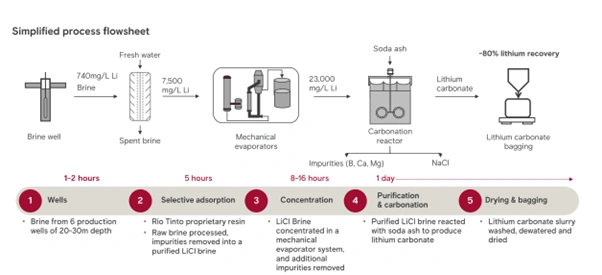
Fenix DLE: improves speed, quality and yield
Argentina as Strategic Cornerstone
Rio Tinto’s lithium strategy centres on Argentina, where the company maintains continuous presence spanning more than 25 years across Jujuy, Salta, and Catamarca provinces. The company operates as the region’s largest mining employer, supporting more than 2,000 full-time employees with approximately 70 per cent drawn from local communities. Local procurement exceeded 600 million dollars in 2024, supporting more than 100 local suppliers.
The company’s asset footprint comprises two major hubs. The Olaroz-Cauchari-Rincon hub holds 37 million tonnes of lithium carbonate equivalent in measured, indicated, and inferred mineral resources. The Salar de Hombre Muerto hub, encompassing Fenix and Sal de Vida operations, contains 19 million tonnes of lithium carbonate equivalent mineral resources.
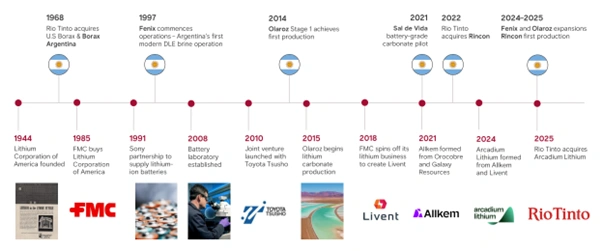
Rio Tinto’s history and presence in Argentina
Growth Projects Advancing Toward Production
Rio Tinto currently operates a committed nameplate lithium capacity of approximately 85 kilotonne per annum lithium carbonate equivalent in 2024, targeting expansion to approximately 200 kilotonne per annum by 2028. The company plans to deploy approximately 3 billion dollars in remaining capital expenditure from 1 January 2026 across four major growth projects.
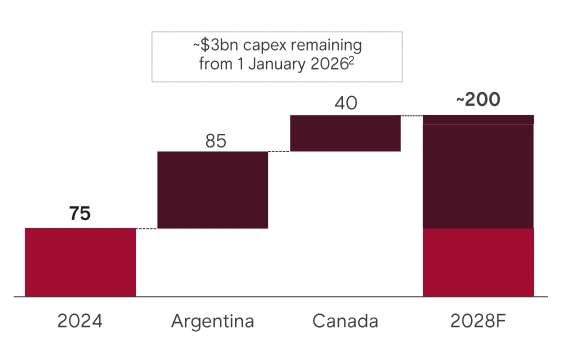
Committed nameplate lithium capacity
Fenix 1B expansion will add 10 kilotonne per annum of capacity utilising the same proprietary direct lithium extraction technology deployed at Fenix 1A. Mechanical completion is 60 per cent complete, with planned first production in the second half of 2026. Total capital expenditure of 633 million dollars supports projected operating costs of approximately 5 dollars per kilogramme.
Sal de Vida will produce 15 kilotonne per annum using pond-based systems tailored to superior brine chemistry supporting battery grade production. Mechanical completion stands at 40 per cent, with first production anticipated in the second half of 2026. Total project capital of 660 million dollars supports projected operating costs of 6 to 7 dollars per kilogramme.
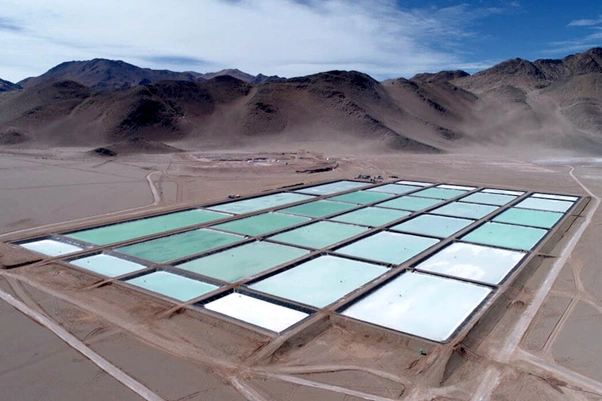
Rincon represents the portfolio’s largest development project, utilising modular direct lithium extraction technology across two identical production trains targeting 60 kilotonne per annum capacity. Detailed engineering is 40 per cent complete, with technology packages 60 per cent through manufacturing. Train 1 mechanical completion is targeted for the third quarter of 2027, with staggered first production commencing in 2028. Total capital expenditure of 2.5 billion dollars supports competitive operating costs below 5 dollars per kilogramme.
Bécancour lithium hydroxide facility in Quebec represents Rio Tinto’s 50 per cent interest in a spodumene-to-hydroxide conversion plant. Engineering is complete, with construction 57 per cent finished. Train 1 completion is targeted for the second quarter of 2026, with planned first production in 2028. The 32 kilotonne per annum facility supports integrated system operating costs of 8 to 10 dollars per kilogramme depending on spodumene feed characteristics.
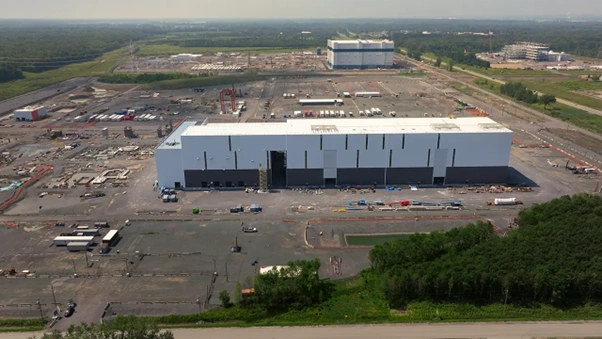
Bécancour lithium hydroxide facility in Quebec
Long-Term Contractual Commitments Provide Stability
Rio Tinto has secured long-term supply agreements underpinning more than 40 per cent of projected 2026 volumes, providing downside protection during price downturns. The company’s premium hydroxide products command contractual floor pricing mechanisms, reflecting quality and reliability valued by customers.
The company serves customers across the entire battery value chain, from advanced active materials suppliers through cell manufacturers to automotive assembly operations. Customer relationships include major battery producers, electric vehicle manufacturers, and established automotive leaders.
Also Read: Woodside Strengthens 2025 Sustainability Agenda With New Global Standards
Capital Discipline and Return Expectations
Rio Tinto targets capital intensity of approximately 65 dollars per kilogramme to reach committed 200 kilotonne per annum capacity by 2028. Operating cash costs across the brine portfolio range between 5 and 8 dollars per kilogramme lithium carbonate equivalent, positioning Rio Tinto in the industry’s lower cost quartile.
The company expects operating earnings before interest, taxes, depreciation, and amortisation margins to reach 37 per cent by 2028 at consensus pricing assumptions. This margin expansion reflects volume additions and improved plant availability, with a transitory 2026 dip reflecting pre-operating costs ahead of Sal de Vida and Fenix 1B production commencement.
Rio Tinto maintains a deep pipeline of uncommitted growth options targeting more than 370 kilotonne per annum capacity across Argentina, Canada, and Chile. The company commits additional capital only when supported by market dynamics and achieving strict hurdle rate expectations including capital intensity below 30 dollars per kilogramme, operating costs below 5 dollars per kilogramme, and internal rates of return exceeding 15 per cent.
Strategic Support Framework
Argentina’s RIGI (Regimen de Incentivo para Grandes Inversiones) investment regime provides 30-year regulatory stability guarantees covering taxation, customs, and foreign exchange rules. Rincon qualifications secured under this framework provide corporate income tax reductions from 35 per cent to 25 per cent, dividend withholding tax reductions from 7 per cent to 3.5 per cent, and elimination of 3 per cent export duties. Additional benefits include accelerated depreciation schedules, unlimited tax loss carry forward provisions, and expedited value added tax return mechanisms.
Rio Tinto’s integrated lithium business combines operational excellence, proven technology, and disciplined capital deployment. The company’s positioned to supply both mass-market carbonate applications and premium hydroxide requirements across key global markets through 2050.