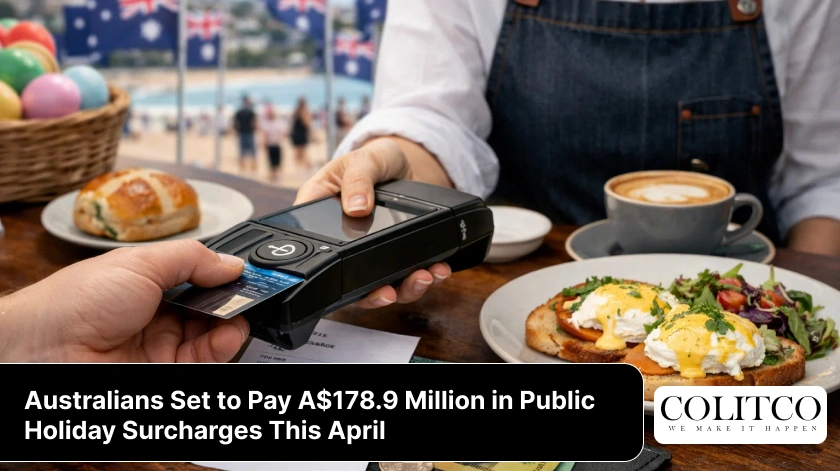
Australians heading out to cafes, pubs, and restaurants this April are in for a costly surprise. Public holiday surcharges across the Easter long weekend and Anzac Day are set to add up to A$178.9 million in extra fees for diners across the country.

Figure 1: Group of diners at a restaurant highlighting rising costs of eating out during public holidays in Australia [Courtesy: Freepik]
The Easter surcharge dining out burden is landing at a time when household budgets are already stretched. Rising fuel costs, wage pressure, and broader living expense increases are all feeding into what is shaping up as one of the most expensive public holiday periods in recent memory for Australian consumers.
The Numbers Behind April’s Public Holiday Surcharge Bill
New analysis has put hard figures on what Australians will collectively spend on the public holiday surcharge Australia this month. The scale of the total is striking.
Easter Weekend Alone Will Cost Diners A$129.7 Million
Diners are expected to pay A$129.7 million in surcharges across the Easter long weekend, according to analysis by Money.com.au. Easter Saturday is forecast to be the single busiest trading day of the weekend, with surcharges on that day alone expected to reach A$49.2 million across most states and territories where it falls as a public holiday.
Anzac Day Adds Another A$49.2 Million to the Total
Anzac Day falls on a Saturday this year, which brings it into the same surcharge calculation as Easter Saturday. The public holiday surcharge Australia total for Anzac Day is estimated at A$49.2 million, bringing the combined April figure to A$178.9 million across both events.
What Surcharges Actually Cost the Average Diner?
Public holiday surcharges in Australia are not capped by law. Venues are free to set their own rates, and charges of up to 20 per cent on top of the listed menu price are not uncommon during public holidays.
Households Already Under Pressure
Finance expert Sean Callery described the Easter surcharge dining out impost as an added strain on budgets already under pressure. “It is another cost burden at a time when households are already dealing with rising living expenses,” Callery said. “The combined cost of getting out and about, from fuel to dining surcharges, could make staying home a more appealing option for some Australians.”

Figure 2: Sean Callery, finance expert, discussing the impact of cost-of-living pressures on Australian households [Courtesy: LinkedIn]
Research from Money.com.au found that 64 per cent of Australians were planning to avoid cafes and restaurants over the Easter weekend specifically because of the public holiday surcharge. The remaining 36 per cent said they were undeterred by the additional fees.
Some Venues Are Opting Out of Surcharges
A small number of Australian venues have chosen to promote surcharge-free trading over the Easter period. Perth cafe Village Cafe and Burgers is among those that have publicly committed to not passing on a public holiday surcharge to their customers this weekend.
Why Businesses Say the Surcharges Are Unavoidable?
The restaurant cost-of-living Australia debate has two sides. While consumers feel the pinch, venues argue the surcharges are the only way they can afford to open on public holidays at all.
Penalty Rates Drive the Cost for Employers
Businesses are legally required to pay penalty rates to staff working on public holidays. Wages typically rise by 225 to 250 per cent on public holidays, depending on whether the worker is employed on a part-time or casual basis. For venues operating on thin margins, the surcharge is often the only mechanism available to cover that cost increase without trading at a loss.
Callery acknowledged this directly. “It is important to recognise cafes and restaurants are also under pressure and public holiday surcharges are often the only way they could afford to trade,” he said.
ARCA Is Calling for an Additional Fuel Surcharge on Top
The Australian Restaurant and Cafe Association has gone a step further, calling on venues to introduce a temporary fuel surcharge of up to 5 per cent on top of existing charges. ARCA chief executive Wes Lambert said suppliers were passing rising fuel costs down the chain to small businesses that had no capacity to absorb them.
Figure 3: Australian Restaurant and Cafe Association (ARCA) logo representing the industry body advocating for cost recovery measures [Courtesy: Wix]
“Big companies, large suppliers, they are passing on the costs to their customers,” Lambert said. “It is small restaurants and cafes around the country that are on razor-thin margins that just cannot afford to absorb the increased delivery or minimum purchasing requirements.”
Lambert noted the fuel cost pressure was compounding several other upcoming changes hitting venues simultaneously. These include the Reserve Bank of Australia’s planned ban on credit and debit card surcharges, a Fair Work decision to abolish junior pay rates, and an anticipated increase to the minimum wage.
What the Rules Say About Surcharge Disclosure?
There is no legislated cap on the public holiday surcharge Australia venues can apply. Businesses are legally free to set their own surcharge levels. However, the Australian Competition and Consumer Commission requires that any surcharges or additional fees be clearly displayed before a customer places an order, and in a prominent location. Consumers have the right to know what they will be charged before they commit to a purchase.
Industry Outlook
The restaurant cost-of-living Australia pressure is not easing in the near term. With minimum wage increases, the phase-out of junior pay rates, and rising input costs all on the horizon, the structural cost challenges facing the hospitality sector are set to intensify through 2026.
The broader debate around public holiday surcharges is also attracting growing consumer and political attention. As surcharge totals reach record levels, pressure on policymakers to review the regulatory framework around penalty rates and surcharge transparency is likely to increase.
Future Direction and Impact on Australian Consumers and Hospitality
The A$178.9 million public holiday surcharge Australia for April 2026 is not just a number. It reflects a widening gap between what consumers expect to pay and what it actually costs to run a hospitality business in Australia today.
For consumers, the Easter surcharge dining out reality means careful budgeting is increasingly necessary before heading out over any long weekend. Checking whether a venue charges a surcharge and at what rate before arriving is becoming a standard part of the dining decision.
For the hospitality industry, the tension between consumer price sensitivity and genuine cost pressures shows no sign of resolving quickly. The restaurant cost-of-living Australia challenge will remain a defining issue for the sector throughout the year, particularly as further wage and regulatory changes take effect.
ALSO READ: Auric Mining Names Processing Lead to Drive Burbanks Mill Development
Frequently Asked Questions
Q1. How much will Australians pay in public holiday surcharges this April?
Ans. Australians are expected to pay a combined A$178.9 million across the Easter long weekend and Anzac Day in April 2026.
Q2. Is there a legal cap on public holiday surcharges in Australia?
Ans. No. Businesses are free to set their own surcharge rates. However, the ACCC requires surcharges to be clearly disclosed before a customer orders.
Q3. Why do restaurants charge a public holiday surcharge?
Ans. Businesses must pay penalty rates of 225 to 250 per cent of standard wages to staff working on public holidays. Surcharges help cover this additional labour cost.
Q4. What is the ARCA fuel surcharge proposal?
Ans. The Australian Restaurant and Cafe Association is calling on venues to add a temporary fuel surcharge of up to 5 per cent to cover rising supplier delivery costs being passed on to small businesses.
Q5. How many Australians are avoiding dining out this Easter due to surcharges?
Ans. Research found 64 per cent of Australians planned to avoid cafes and restaurants over Easter specifically because of the public holiday surcharge.
Disclaimer
This article is intended for informational purposes only and does not constitute financial or investment advice. All content is based on reporting published on 3 Apr 2026 and analysis sourced from Money.com.au. Figures cited reflect estimates available at the time of publication. Readers should conduct their own research before making financial or consumer decisions. Colitco does not hold any commercial position in the businesses or organisations mentioned.