
Platina Resources Limited (ASX: PGM) (“Platina” or “the Company”) is accelerating exploration at its Mt McKenna Gold Project near Laverton, Western Australia, with consecutive drilling programs set to test multiple high-priority targets across a 20-kilometre stretch of prospective greenstone belt.
The campaign marks the first wave of Platina’s fully funded 20,000-metre drilling strategy announced earlier this month, positioning the explorer to maintain consistent field activity throughout 2026.
Phase 2 aircore drilling at Target 2 is scheduled to commence in late February, following up on promising results from November 2025 that identified multiple mineralised structures across a 1.5-kilometre zone. The program will test geochemical and geological anomalies within areas already cleared for cultural heritage.
In parallel, systematic exploration is advancing at Targets 4 and 5, where two regional structures converge around a diorite hill intrusive complex. Early work includes geological mapping, ground gravity surveys and targeted geophysics to refine drill locations before heritage clearance surveys begin in late February.
Gold Shines as Laverton District Draws Fresh Investment
Gold is currently trading above $7,000 AUD per ounce, bolstering the commercial case for exploration across Western Australia’s Eastern Goldfields. The Laverton Gold District, home to Mt McKenna, has produced more than 28 million ounces of gold and hosts tier-one operations including Sunrise Dam, Wallaby, and Granny Smith.

Figure 1: Gold Price chart [Gold Bullion Australia]
The district’s geological prospectivity stems from its position within the Laverton Tectonic Zone, a highly mineralised structural corridor characterised by deep-seated fault systems, intrusive complexes and extensive greenstone sequences. These features create favourable conditions for orogenic gold deposits that have defined the region’s endowment.
Platina’s Mt McKenna tenement spans approximately 20 kilometres of strike along the Granite Well Fault, a major regional structure analogous to those controlling mineralisation at nearby operations.
Target 2: Building on November’s Discovery
Target 2 delivered significant intercepts during Phase 1 aircore drilling in November 2025, including results that confirmed structural controls on gold mineralisation. The Phase 2 program will infill and extend this zone, aiming to define dimensions and continuity ahead of reverse circulation (RC) drilling.
Previous drilling identified gold-bearing structures across a strike length of approximately 1.5 kilometres. The Company interprets these as part of a larger system potentially extending beneath shallow cover.
Aircore drilling remains a cost-effective method for exploring beneath transported sediments and lateritic cover, conditions common across the Laverton region. Results from Target 2’s Phase 2 program are expected to shape priorities for the first RC campaign, planned for April.
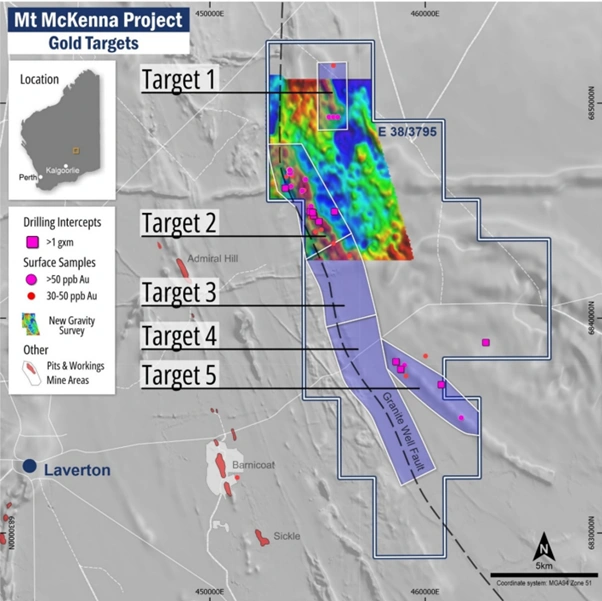
Figure 2: Mt McKenna Gold Project location near Laverton with interpreted regional Granite Well fault and delineated target zones. [Platina Resources]
Targets 4 and 5: Exploring Structural Convergence
Targets 4 and 5 are being advanced through a methodical sequence of mapping, geophysics and heritage clearance before drilling commences. These zones sit at the convergence of two major structures intersecting the diorite hill intrusive complex, a geological setting that Platina believes mirrors controls seen at productive deposits elsewhere in the district.
Features between the intrusive complex and the nearby syenite body exhibit geophysical characteristics consistent with intrusion-related gold systems. Ground gravity data recently collected will be integrated with magnetic surveys and structural mapping to refine drill collar locations.
Heritage clearance surveys are scheduled for late February, with aircore drilling to follow once approvals are secured. The Company is working with traditional owners and archaeological consultants to ensure responsible exploration practices.
Exploration Strategy Reflects District-Scale Approach
Platina’s approach aligns with methods that have successfully defined gold resources across the Laverton district. Near-surface depletion of primary mineralisation is a common feature in the region, requiring systematic drilling to test beneath oxidised zones and into fresh rock.
The Company’s 20,000-metre campaign includes aircore and RC drilling across multiple projects, with Mt McKenna receiving the majority of initial activity. Results from early-stage aircore work will determine priority targets for RC follow-up, which is designed to intersect primary mineralisation at depth and provide samples for metallurgical testing.
Managing Director Corey Nolan emphasised the significance of maintaining consistent field activity: “Mt McKenna is a highly prospective asset covering more than 20km of favourable greenstones, structures and intrusives close to established infrastructure. We look forward to advancing targets towards RC drilling as we work hard to unlock the project’s significant potential.”
Market Context: Gold Exploration in the Eastern Goldfields
Western Australia’s Eastern Goldfields continues to attract exploration and development capital despite more than a century of production. Advances in geophysical techniques, deeper drilling capacity and improved geological understanding are enabling explorers to test under-cover extensions and previously overlooked structural settings.
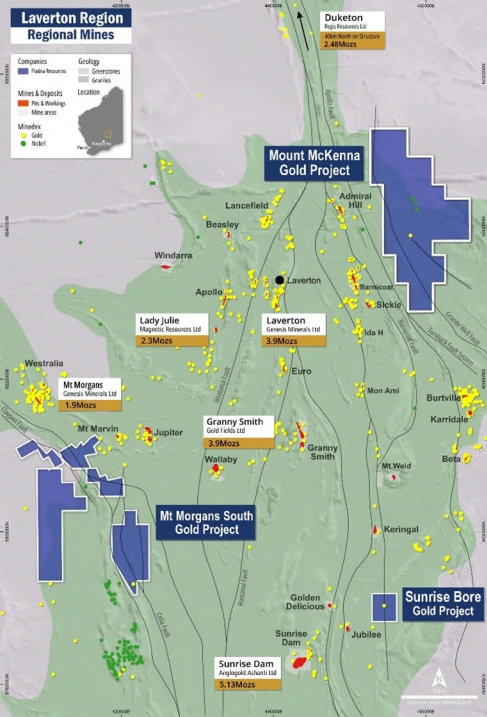
Figure 3: Platina’s gold portfolio in the Laverton Gold District is surrounded by multiple world-class mines and gold deposits [Platina Resources]
The region benefits from established infrastructure, including power, water, haulage and processing facilities, reducing development timelines and capital requirements for discoveries that progress to production.
Platina’s Mt McKenna project is accessible year-round and lies within trucking distance of several toll-milling facilities, providing optionality for future development scenarios.
Investor’s Outlook
Platina Resources (ASX: PGM) is trading around $0.032 per share as of mid-February 2026, within a 52-week range of $0.018 to $0.045. The Company’s market capitalisation sits at approximately $20.63 million.
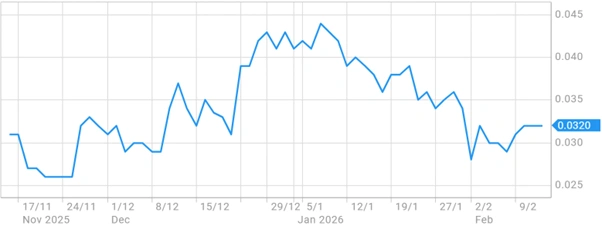
Figure 4: PGM Price Chart [ASX]
With cash reserves supporting the 2026 drilling campaign and no debt, Platina maintains financial flexibility to execute its exploration strategy without near-term dilution pressures.
The Company’s portfolio includes multiple projects across the Yilgarn Craton, providing diversification within a single jurisdiction. Mt McKenna represents the most advanced asset within the Laverton-focused strategy, with Sunrise Bore and Mt Morgans South projects also scheduled for activity later in the year.
Key catalysts ahead include:
- Phase 2 aircore assay results from Target 2 (expected March 2026)
- Initial drilling results from Targets 4 and 5 (Q2 2026)
- Commencement of maiden RC drilling program (April 2026)
- Integration of geophysical datasets and drill results for resource targeting
The Company’s systematic approach to exploration, combined with its presence in a tier-one gold district during a period of elevated gold prices, positions it to deliver consistent news flow as drilling programs advance.
Investors seeking exposure to gold exploration in Western Australia’s most productive districts may find Platina’s diversified project portfolio and funded drilling strategy an attractive proposition.