
The Australian sharemarket is taking a beating. The S&P/ASX 200 opened 6 Mar 2026 down 125 points, or 1.4%, to 8,801. The oil price impact on ASX has been swift and sharp, and investors across the country are watching their portfolios slide.
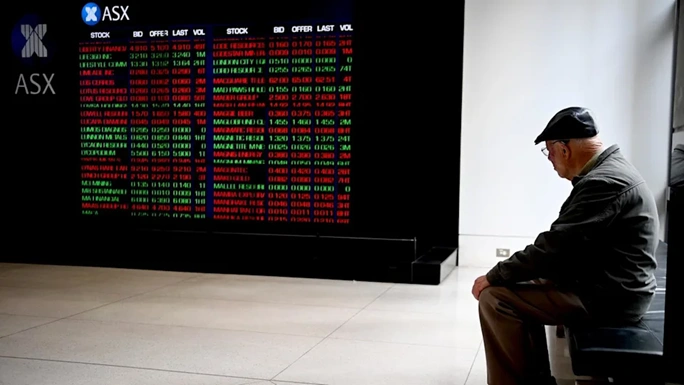
Figure 1: Investors monitor falling share prices on the ASX trading board during a market sell-off. [Yahoo Finance]
It is not just a local story. Wall Street fell hard overnight. The Dow Jones dropped 784.67 points, or 1.61%, to 47,954.74. The S&P 500 slid 0.56% to 6,830.71. When the US catches a cold, Australia tends to follow.
Why Oil Is the Problem Right Now?
West Texas Intermediate crude jumped sharply to hit a 20-month high of US$82 a barrel during the session, before trimming some of those gains. Global benchmark oil surged around 5% to US$85.41 a barrel on Thursday, extending the week’s gain to roughly 20%. That kind of move in energy prices does not stay in the energy sector for long.

Figure 2: Rising petrol prices reflect the global surge in crude oil costs. [Freepik]
The trigger is the Middle East conflict and growing fears around the Strait of Hormuz, a critical shipping lane for roughly one-fifth of the world’s crude oil supply. Signs of disruption have sent energy markets into a tailspin. Analysts at Jarden warned that traders may be underestimating what they called the “systemic risk” to global energy markets, noting that traffic through the chokepoint had fallen to near zero.
Keep Perspective Before You Panic
Not every analyst is reaching for the alarm button. IG market analyst Tony Sycamore pointed out that despite crude’s roughly 20% surge over the month, the price remains only around $3.40 above its four-year average. It is also well below the US$100 level oil spent months above in mid-2022 after Russia invaded Ukraine.
The Australian market strategy in moments like this starts with context. This is a shock, not necessarily a structural collapse. Capital.com senior financial market analyst Kyle Rodda noted that risk aversion is rising, but much of the near-term direction depends on whether any news emerges suggesting the conflict is at or near its peak escalation level. Japan and South Korea, both heavily energy-dependent economies, are also being closely watched in the region.
Australian Market Strategy: What Rising Bond Yields Mean for You
Higher oil prices do not just hurt at the petrol bowser. Every $1 rise in the price of crude adds roughly one cent to what Australian motorists pay per litre. More importantly, rising energy costs reignite inflation expectations, which in turn push bond yields higher and put pressure on central banks to act.

Figure 3: Global money markets react to rising oil prices and shifting economic conditions. [Freepik]
Australia’s three-year bond rate surged to 4.43%, the highest since early November 2023. That is a 19-basis-point jump in a single week, the sharpest weekly rise since October 2025. Money markets are now pricing in between two and three RBA rate hikes by Christmas, up from fewer than two just the week prior. For income-sensitive portfolios, this is a meaningful shift in the Australian market strategy outlook. For investors following an Australian market strategy built around income and rate-sensitive holdings, this is a significant shift.
Industry Outlook: Oil Price Impact on ASX and the Stagflation Risk Ahead
Stephen Innes, managing partner of SPI Asset Management, put it plainly. Prolonged elevated oil prices create an uncomfortable policy mix where inflation expectations rise while growth expectations fall. If that dynamic takes hold, the risk shifts from a simple growth wobble to something closer to stagflation, slower growth and rising prices at the same time.
Australia is not uniquely exposed, but it is not immune either. The RBA’s hand may be forced sooner than markets were hoping. For investors looking for ASX trading tips Australia right now, the key consideration is whether your portfolio is positioned for a higher-for-longer rate environment and sticky energy costs. Christian Baylis, co-founder of Fortlake Asset Management, noted that bond yields are now pricing a more structurally undersupplied oil market, with implications that go beyond short-term headline inflation.
FAQ
Q1. What caused the ASX to fall sharply on 6 Mar 2026?
Ans. The ASX 200 dropped 125 points (1.4%) after oil prices surged due to escalating tensions in the Middle East and concerns around disruptions in the Strait of Hormuz, alongside weak overnight leads from Wall Street.
Q2. How high has the oil price risen?
Ans. West Texas Intermediate crude reached a 20-month high near US$82 per barrel, while global benchmark oil climbed to around US$85, marking roughly a 20% weekly gain.
Q3. Should Australian investors sell during this sell-off?
Ans. Analysts urge caution before reacting. Despite a roughly 20% surge, oil prices remain only slightly above their four-year average and well below the US$100 levels seen in 2022.
Q4. Which ASX sectors are most exposed to higher oil prices?
Ans. Rising oil costs increase inflation pressure, which tends to hurt rate-sensitive sectors on the ASX. Energy-importing economies such as Japan and South Korea are also closely watched.