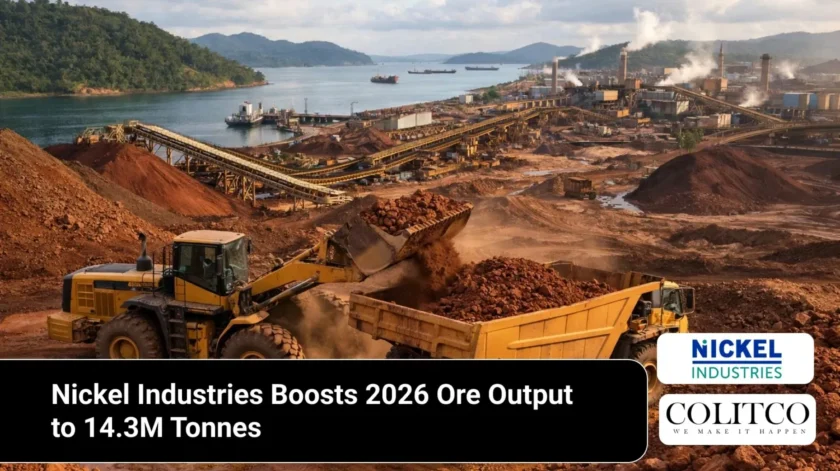
Hengjaya Mine Wins Key Production Approval
Nickel Industries Limited announced on 25 March 2026 that its Hengjaya Mine has received approval to increase its 2026 RKAB nickel ore sales license from 9.0 million to 14.3 million wet metric tonnes (wmt). The approval marks the final regulatory step required for the company’s annual production planning.
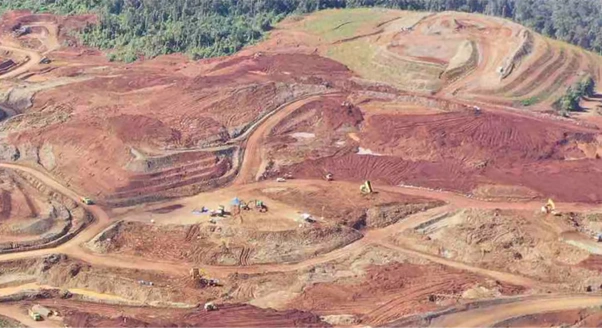
Nickel ore operations at Hengjaya Mine as production capacity expands under new RKAB approval. [Petromindo]
The company also confirmed a binding 15-year ore supply agreement to deliver a minimum of 9.2 million wmt of limonite ore annually to the Excelsior Nickel Cobalt (ENC) project. Managing Director Justin Werner said the approval “provides certainty of supply” while the long-term deal enhances earnings visibility. Notably, there was a 14.3 million wmt approved for 2026 (up from 9.0 million wmt)
Shares of Nickel Industries Limited (ASX: NIC) jumped 6.78% to $0.945 after the announcement, with trading volume exceeding 16 million shares. The stock traded within a narrow range of $0.940 to $0.945, reflecting strong investor interest following the production boost and long-term supply deal.
What This Means for Global Nickel Demand
The increased production quota and long-term supply agreement strengthen Nickel Industries’ position in the global nickel supply chain, particularly as demand for electric vehicle (EV) battery materials continues to rise. Nickel is a critical component in lithium-ion batteries, making supply stability a key concern for manufacturers.
- Supply certainty: A higher quota ensures steady feedstock for processing operations
- Revenue visibility: 15-year contract reduces market uncertainty
- Cost efficiency: Shift to slurry pipeline lowers transport costs
- Sustainability angle: Reduced carbon intensity supports ESG goals
Key Stakeholders Driving the Expansion
Nickel Industries Limited is an ASX-listed mining company focused on nickel production in Indonesia. It operates the Hengjaya Mine and multiple rotary kiln electric furnace (RKEF) projects, producing nickel pig iron used in stainless steel and battery supply chains.
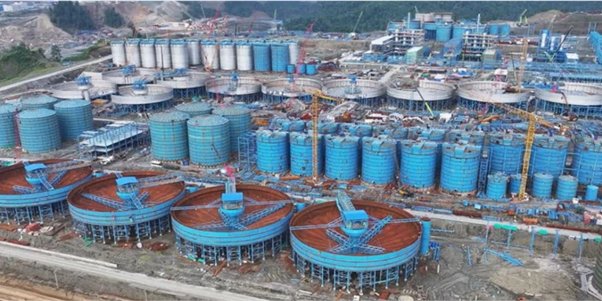
The ENC project will process limonite ore into battery-grade nickel products. [Petromindo]
Secondary Stakeholders
- Excelsior Nickel Cobalt (ENC): Key downstream processing project nearing commissioning
- Indonesian regulators: Approved the RKAB production quota
- EV battery manufacturers: Indirect beneficiaries of increased nickel supply
The Global Hotspot for Nickel Production
The development centres on the Hengjaya Mine in Indonesia, a major nickel-producing region. Nickel Industries is headquartered in Sydney, Australia, and listed on the Australian Securities Exchange (ASX).
While the announcement is Indonesia-focused, its impact is global. Indonesia is the world’s largest nickel producer, and supply changes directly influence global battery and stainless steel markets.
From Approval to Action: Key Dates
- Late 2025: Environmental approval (AMDAL) granted
- 18 Feb 2026: Initial RKAB quota issued
- 25 March 2026: Final RKAB approval confirmed
- End of March 2026: First ore delivery to ENC expected
Nickel Industries has steadily expanded its Indonesian operations, transitioning from nickel pig iron production toward battery-grade materials. This shift aligns with global EV demand growth and the company’s long-term strategy.
The Process Behind the Production Surge
The RKAB approval process involves environmental clearance followed by annual production quotas set by Indonesian authorities. After securing environmental approval in 2025, the company finalized its 2026 quota in March, enabling full-scale operations.
The ore supply agreement was negotiated as part of the ENC project ramp-up, ensuring a dedicated feedstock pipeline for processing.
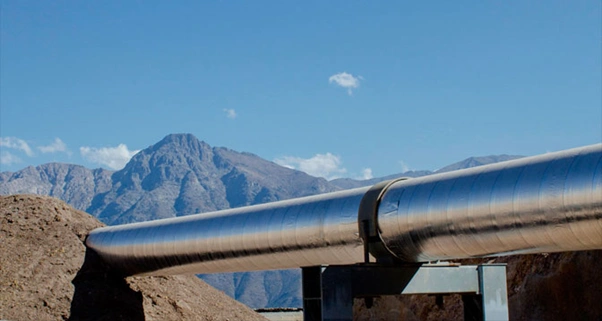
Slurry pipeline system set to reduce transport costs and carbon emissions compared to trucking. [International Mining]
What Comes Next for Nickel Industries
Nickel Industries plans to apply for further quota increases later in 2026 as ENC ramps up production. The project is expected to produce around 72,000 tonnes of nickel annually, expanding the company’s footprint in the EV battery supply chain.
Despite strong fundamentals, risks include fluctuating nickel prices, regulatory changes in Indonesia, and execution challenges during ENC commissioning. Market-linked pricing in the supply agreement may also expose revenues to volatility.
Also Read: Aussie Broadband Director Phillip Britt Resigns from Board – Colitco
A Defining Moment for Nickel Industries
Nickel Industries’ increased production license and long-term supply deal mark a significant step in securing its role in the global nickel market. As EV demand accelerates, the company is positioning itself for sustained growth through integrated operations and stable supply chains.
FAQs
Q1. What is the new RKAB quota for 2026?
A1. The quota has been increased to 14.3 million wet metric tonnes.
Q2. What is the Hengjaya Mine supply agreement?
A2. A 15-year deal to supply at least 9.2 million wmt of limonite ore annually.
Q3. What is the ENC project?
A3. A nickel processing facility producing battery-grade materials.
Q4. Why is this important?
A4. It ensures a stable nickel supply for EV battery production.
Q5. Will production increase further?
A5. The company plans to apply for additional quota increases later in 2026.
Disclaimer
The information in this article is for informational purposes only and does not constitute financial, investment, or professional advice. It is based on publicly available data and official announcements from Nickel Industries Limited and may be subject to change. Any references to Nickel Industries Limited (ASX: NIC) stock performance are provided for context only and do not represent a recommendation to buy, sell, or hold any securities. Readers are advised to conduct their own independent research and consult a qualified financial advisor before making any decisions. Colitco and the author accept no liability for any losses or damages arising from reliance on this information.
Sources
https://www.asx.com.au/markets/company/NIC