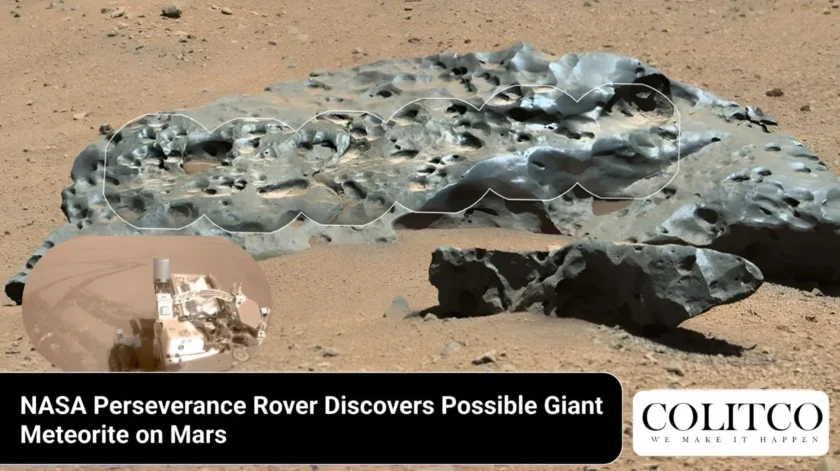
NASA’s Perseverance rover has spotted an unusual metal-rich rock on Mars. Scientists call the discovery significant after the rover spent nearly five years exploring the red planet. The rock sits in the Vernodden area near Jezero crater’s rim. Researchers nicknamed the boulder Phippsaksla for identification purposes. The discovery marks a watershed moment in Mars exploration. Perseverance finally joins other rovers in detecting foreign space rocks.
The Rock That Stands Apart
Phippsaksla measures approximately 80 centimetres across or about 31 inches wide. The boulder rises above the surrounding terrain like a small statue. Low, flat, fractured bedrock carpets the landscape beneath it. Images reveal a pale orange rock pitted with deep cavities. Dark sand fills many of these surface indentations. The rock’s distinctive appearance immediately caught the team’s attention. Scientists noticed it looked fundamentally different from native Martian stones.
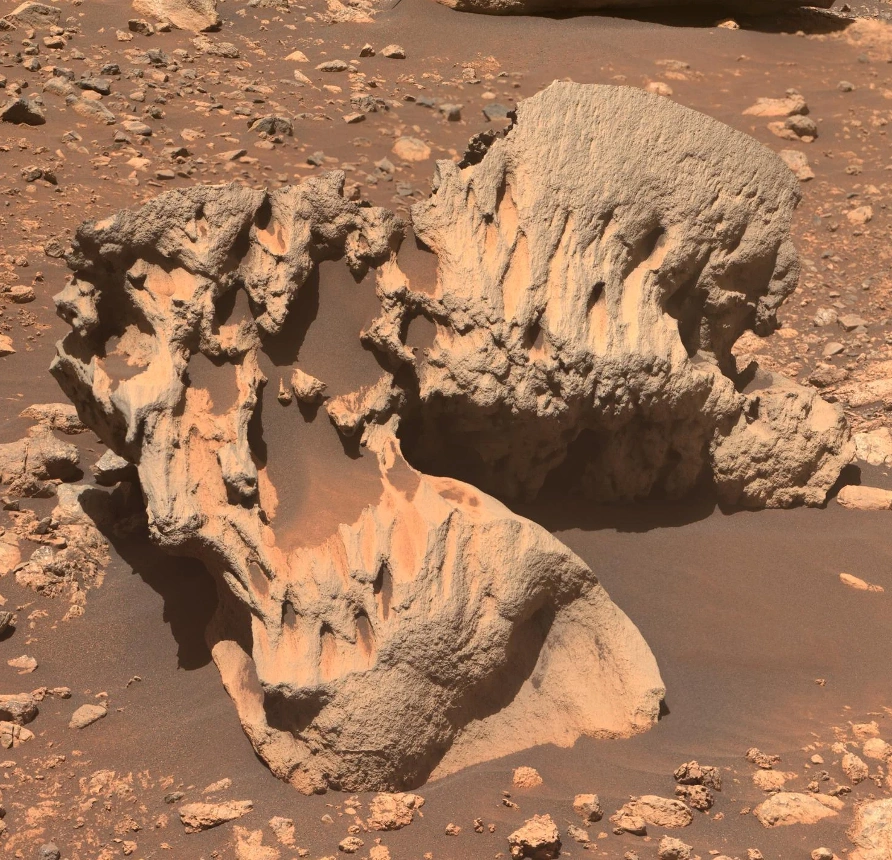
Phippsaksla Rock [Reddit]
Candice Bedford, a research scientist at Purdue University, led the investigation. Bedford’s team examined the unusual formation during routine exploration activities. The Vernodden bedrock area offered numerous geological features to study. This rock simply stood out from everything surrounding it. The team understood they had encountered something extraordinary.
Scientific Analysis Reveals Iron-Nickel Composition
Perseverance deployed its SuperCam instrument to analyse the mysterious boulder. SuperCam fires tiny laser bursts at rock surfaces. The instrument then reads the light bouncing back to reveal chemical fingerprints. Scientists use spectroscopy to identify elements from their unique light patterns. Results showed an unusually high concentration of iron and nickel. This combination matches iron-nickel meteorites perfectly. Such meteorites originated from asteroid cores billions of years ago.
The chemical signature strongly suggests Phippsaksla arrived from outer space. The rock almost certainly did not form from native Martian materials. Scientists believe it is slamming into Mars after travelling through the solar system. The composition provides crucial evidence of its extraterrestrial origin.
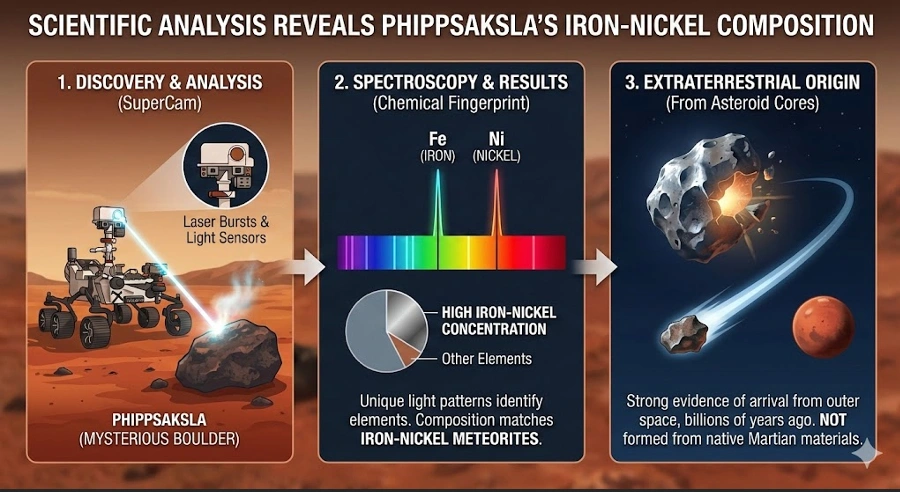
Scientific Analysis Reveals Phippsaksla Iron-Nickel Composition
A Discovery Long Awaited
Researchers initially spotted Phippsaksla during early September surveys. The rover’s Mastcam-Z camera system first captured the unusual rock. Mastcam-Z provides detailed colour views and wide-area scanning capabilities. Scientists noticed the distinctive pale colouration immediately. They recognised the sculpted appearance differed markedly from the surrounding stones. Mid-September observations included close-up imaging and detailed laser analysis. These intensive studies confirmed the initial assessment.
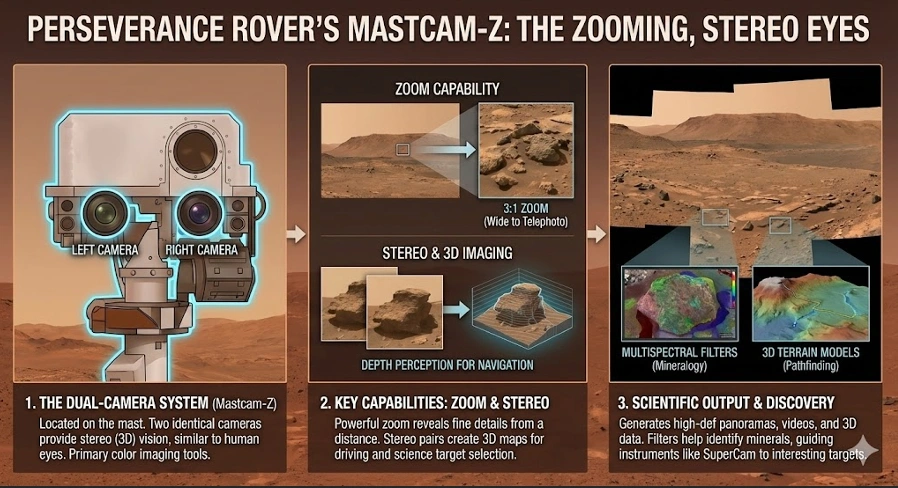
Perseverance Rover’s Mastcam-Z camera system
Curiosity, Spirit and Opportunity rovers previously found meteorites on Mars. Curiosity discovered Lebanon in Gale crater in 2014. Lebanon measured approximately one metre across. The rover later spotted Cacao, a smaller iron-rich meteorite. Spirit and Opportunity also crossed paths with metallic boulders during their missions. Scientists, therefore, expected Perseverance to encounter similar discoveries earlier.
The absence of meteorite findings puzzled researchers considerably. Jezero crater showed features similar to Gale crater, where Curiosity operated. Both regions displayed numerous impact craters, suggesting meteorite delivery. Phippsaksla’s discovery solves the mystery and opens new research opportunities.
Unlocking Ancient Solar System Secrets
Iron-nickel meteorites serve as time capsules preserving early solar system conditions. These rocks originated from differentiated asteroids whose cores once melted. Metal and rock separated during cooling processes billions of years ago. Measuring precise elemental and isotopic compositions reveals ancient events. Scientists can reconstruct incidents occurring within the first few million years after the Sun formed. That era witnessed the assembly of raw materials for rocky planets.
Carbon-rich meteorites carry water-bearing minerals and organic molecules. Such meteorites contain amino acids and genetic material building blocks. Researchers increasingly view meteorites as delivery vehicles for essential ingredients. Water and chemical compounds potentially reached Earth via cosmic transportation. Similar processes may have delivered life-supporting materials to Mars.
Connection to Mars’ Habitable History
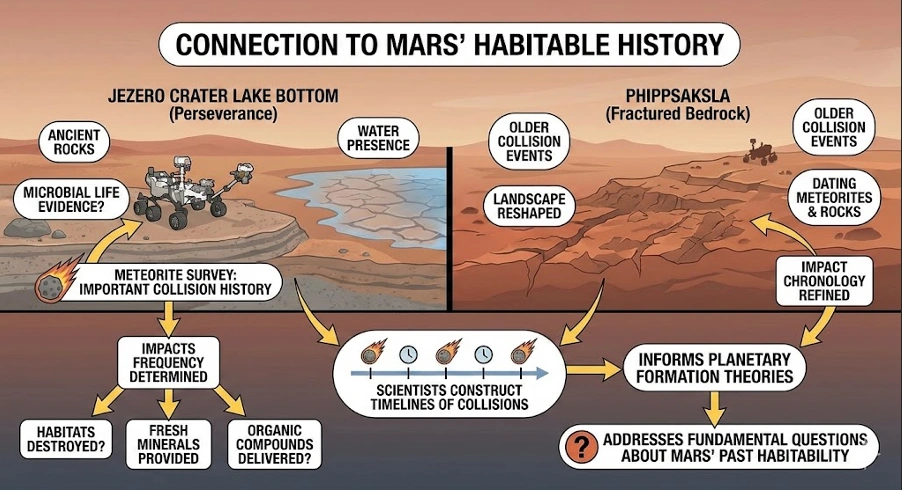
Perseverance explores ancient rocks that once occupied Jezero Crater’s lake bottom. The rover searches for evidence that Mars supported microbial life. A meteorite survey across the landscape reveals important collision history. Scientists determine how frequently large objects struck during water presence. Impacts potentially destroyed habitats or alternatively provided fresh minerals. Meteorites might have delivered organic compounds feeding early life development.
Phippsaksla rests on fractured bedrock outside Jezero crater’s main basin. The rock’s location records older collision events, reshaping that landscape. Dating the meteorite and analysing the surrounding rocks refines the impact chronology. Scientists construct timelines showing when collisions struck Mars’ surface. Understanding impact frequency informs theories about planetary formation. This knowledge directly addresses fundamental questions about Mars’ past habitability.
Mars’ Habitable History
Implications for Future Exploration
The meteorite discovery carries practical significance for human Mars colonisation. Metal-rich meteorites could someday provide iron sources for tools or shielding. Their distinctive chemistry differs sharply from native rocks. Engineers might process these materials using robotic equipment safely. Mapping meteorite locations across Martian surfaces helps gauge landing hazards. Scientists assess durability requirements for long-term infrastructure development.
Data from Phippsaksla feeds impact models used in planning missions. Engineers consult these models when selecting base locations. Sample depot positioning depends upon understanding impact distribution. Future crews will benefit from comprehensive meteorite surveys. Each discovery provides essential information for sustainable operations.
Also Read: St George Mining Extends Araxá Footprint as High-Grade Niobium Discovery Opens Northwest Zone
Continuing the Exploration Mission
The Perseverance team treats Phippsaksla as a candidate meteorite requiring further investigation. Plans include follow-up observations confirming chemical composition details. Engineers can command the rover’s arm to brush or image the rock. Instruments gain closer views of internal structure through detailed examination. Whether Phippsaksla proves meteoritic or represents unusual Martian material adds knowledge. The investigation contributes another chapter to Perseverance’s exploration narrative.
Perseverance continues exploring the Jezero crater rim and surrounding areas. The rover balances main biosignature searches with opportunistic investigations. Unusual targets receive closer scrutiny when appearance suggests importance. The mission teams maintain constant vigilance for extraordinary geological features. Each strange rock potentially advances Mars science substantially.
The Broader Significance
Earth’s active geology continuously recycles the crust. Weather and ocean processes erase many ancient impact traces. Mars maintains a clearer impact record for scientific study. Researchers estimate how frequently asteroids of various sizes strike planets. This knowledge directly informs planetary defence efforts protecting Earth’s future. Understanding impact hazards helps societies prepare for potential threats.
Phippsaksla represents more than an eye-catching boulder on a dusty hillside. Within that sculpted metal lump lie clues about ancient asteroids. The rock records Mars’ bombardment history and cosmic material traffic. Water and organic matter delivery mechanisms shaped planetary evolution. Life on Earth may have originated with such cosmic assistance.
NASA’s commitment to Mars research continues to strengthen scientific understanding. Perseverance systematically investigates geological formations, revealing planetary history. The rover combines main mission objectives with opportunistic discoveries. Such investigations position humanity closer to comprehending Mars’ habitability potential. Phippsaksla stands as a remarkable symbol of persistent exploration success.