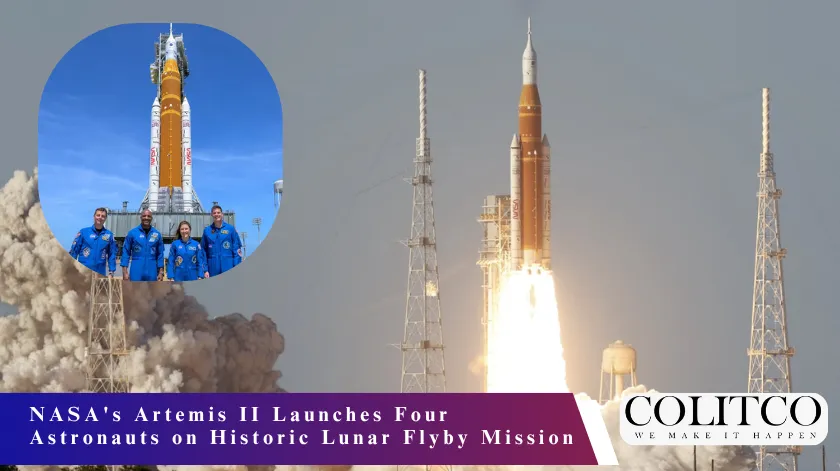
NASA’s Artemis II lifted off at 6:35 pm EDT from Kennedy Space Centre’s Launch Complex 39B in Florida. It is carrying four astronauts on a 10-day journey that no crew has attempted since the Apollo program ended in 1972.
The Crew Carrying Humanity Back to the Moon
The mission carries NASA astronauts Reid Wiseman, Victor Glover, and Christina Koch, along with Canadian Space Agency astronaut Jeremy Hansen, on a free-return trajectory around the Moon and back to Earth.
Each crew member is making history in their own right. Glover became the first person of colour, Koch the first woman, and Hansen the first non-US citizen to travel beyond low Earth orbit. All three will also be the first of their kind to reach the vicinity of the Moon.
The four signed their names on the wall of the “white room” before boarding the Orion capsule, continuing a tradition that dates back to the Gemini program.
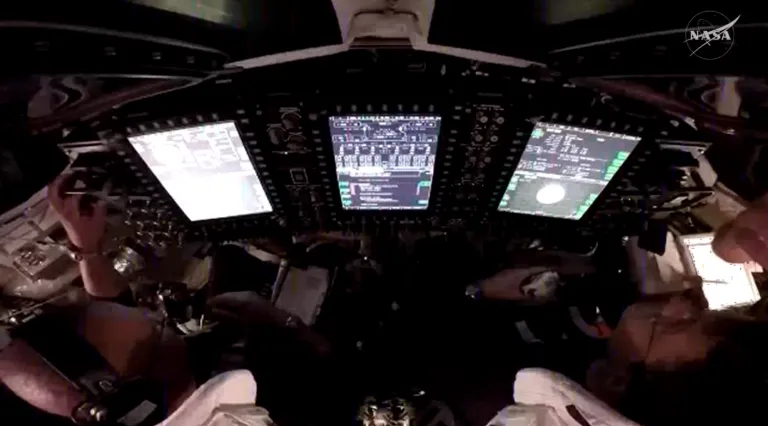
A view over the shoulders of NASA astronauts Victor Glover (left) and Reid Wiseman (right), pilot and commander, respectively, inside the Orion spacecraft. [NASA]
What the Artemis 2 Moon Mission Launch Actually Involves
This is not a landing. The crew will loop around the Moon, getting an unprecedented view of the far side, and is expected to travel farther from Earth than anyone before them: 252,000 miles.
The Orion spacecraft, named Integrity, is completing two Earth orbits before a translunar injection burn sends it toward the Moon. Day 2 will see the translunar injection burn carried out, which increases Orion’s velocity and allows it to leave a circular Earth orbit and transfer to an oval-shaped trajectory toward the Moon.
All four solar array wings on the European Service Module have fully deployed, giving Orion a wingspan of roughly 63 feet when extended. Power generation is confirmed, and the spacecraft is operating as planned.
A Last-Minute Scare That Nearly Grounded the Mission
The mission team had to troubleshoot a critical technical issue with the Flight Termination System, a safety mechanism that allows engineers to destroy the rocket if it veers off course. Without a cleared system, the rocket could not fly.
Engineers solved it using hardware from the old Space Shuttle program. NASA confirmed the mission was back on track just over an hour before the scheduled launch time.
There was also a brief issue with the toilet on board the Orion capsule. That was fixed before the crew went to sleep on their first night in space.
Why This NASA Launch Matters After 50 Years
Humans last travelled to the Moon’s vicinity in December 1972 aboard Apollo 17. The commander of that mission, Gene Cernan, was the last person to walk on the Moon and left with the words: “We leave as we came, and, God willing, we shall return.” Over half a century later, that return is now underway.
Artemis II builds on the success of the uncrewed Artemis I in 2022 and will demonstrate a range of capabilities needed for deep-space missions. The mission tests life support, navigation, communication, and crew operations in real deep-space conditions. Everything it proves or flags directly shapes the path to landing astronauts on the Moon in 2028.
President Donald Trump opened a separate public address by congratulating NASA, noting that the spacecraft will travel farther into space than any crewed mission in decades. Senator Mark Kelly, a retired astronaut himself, called it “the start of a new era of Moon missions.”
More than three million people watched the launch across NASA’s YouTube channels alone. That number does not count the crowds who turned up in person at Cape Canaveral, or the broadcast audiences worldwide.
Liftoff.
The Artemis II mission launched from @NASAKennedy at 6:35pm ET (2235 UTC), propelling four astronauts on a journey around the Moon.
Artemis II will pave the way for future Moon landings, as well as the next giant leap — astronauts on Mars. pic.twitter.com/ENQA4RTqAc
— NASA (@NASA) April 1, 2026
For context on the broader commercial and governmental race for lunar access, read our earlier coverage onspace mining startups targeting the Moon and asteroids and howispace’s Resilience lander crashed during a 2025 attempt. We also coveredArtemis II’s pre-launch hardware integration earlier this year.
What Happens Next: Day by Day
- Day 2: Translunar injection burn sends Orion toward the Moon
- Day 3: Communications test through the Deep Space Network
- Day 5: Orion enters the Moon’s sphere of gravitational influence
- Days 6-7: Lunar flyby, including views of the far side
- Day 10: Splashdown and recovery
Also Read:BHP Just Pocketed US$4.3 Billion – Here’s What It Quietly Gave Away
FAQs
Q: What is the NASA Artemis 2 mission?
A: Artemis II is a 10-day crewed lunar flyby mission launched on April 1, 2026. Four astronauts are flying around the Moon and returning to Earth without landing, testing the Orion spacecraft and Space Launch System under crewed conditions for the first time.
Q: Who are the Artemis II astronauts?
A: The crew is commander Reid Wiseman, pilot Victor Glover, and mission specialists Christina Koch and Jeremy Hansen. Hansen flies for the Canadian Space Agency.
Q: Will Artemis II land on the Moon?
A: No. Artemis II is a flyby mission. The crew will loop around the Moon and return to Earth. A crewed Moon landing is being targeted for the Artemis III mission in 2028.
Q: Why did it take 53 years to send astronauts back to the Moon?
A: As CNN noted this week, the short answer is political will. Sustaining the funding, political commitment, and technical momentum required for human lunar exploration proved difficult after Apollo ended in 1972. NASA’s Artemis program, backed by a new heavy-lift rocket and renewed political interest, finally closed that gap.
Q: What records will Artemis II set?
A: The mission is expected to set records for the farthest distance from Earth ever travelled by a human crew, approximately 252,000 miles, and will reach the highest atmospheric reentry velocity of any crewed spacecraft.
Disclaimer: This article reports on publicly available information sourced from NASA and other credible outlets. Details of the Artemis II mission are subject to change as the mission progresses. Readers are encouraged to follow NASA’s official channels for real-time updates.
Source:
Last modified: April 3, 2026