

Google has opened up its experimental world-building technology to paying subscribers, marking a shift from lab testing to public access. Project Genie lets users create navigable 3D environments by typing descriptions or uploading images.
The prototype, announced on 29 January 2026, uses Google DeepMind’s Genie 3 model to generate interactive spaces rather than static scenes. Users can explore these AI-created worlds in real time as the system builds paths ahead based on their movements.
Access remains restricted to Google AI Ultra subscribers in the United States aged 18 and over. The subscription costs USD 250 per month.
What Project Genie 3 Actually Does
The system creates playable environments from simple instructions. Users describe what they want: “a forest path at sunset” or “a futuristic cityscape.” Project Genie generates a preview image, then builds an explorable world around it.
The technology differs from video generation. While most AI models produce passive videos, project genie 3 creates interactive spaces where actions have consequences. Walking left triggers new terrain generation on the left. Looking up reveals sky details that didn’t exist moments earlier.
Google describes the core capabilities:
- World Sketching: Text or image prompts define the environment, character, and movement style
- World Exploration: First-person or third-person navigation through the generated space
- World Remixing: Building on existing worlds or curated examples from Google’s gallery
Sessions currently last 60 seconds, though the underlying technology can maintain consistency for several minutes. The system renders at 720p resolution and runs at 20 to 24 frames per second.

Project Genie’s interface allows users to sketch worlds using text prompts and uploaded images [Google DeepMind]
Technical Foundation: How Genie 3 Works
The model operates through auto-regressive generation. It creates each frame based on previous frames, user actions, and the initial world description. This approach differs from rendering pre-built 3D models.
Google DeepMind first previewed Genie 3 in August 2025. The technology builds on earlier versions, with Genie 2 producing environments lasting 10 to 20 seconds primarily for robot training scenarios.
The current iteration maintains environmental consistency through memory systems. When users revisit locations after exploring elsewhere, the model recalls previous changes. This memory function operates for up to one minute.
Integration with other Google AI systems enhances the experience. Nano Banana Pro handles image generation for world sketching. Gemini assists with understanding complex prompts.
Current Limitations Worth Noting
Google acknowledges several constraints. Generated worlds may not perfectly match prompts or real-world physics. A ball might float instead of falling. Water might behave unexpectedly.
Character controls sometimes lag. Multiple characters in the same environment struggle to interact properly. The system cannot render legible text reliably.
The 60-second session limit creates obvious restrictions. Users cannot build extended narratives or complex game sequences. Some features announced in August, including promptable events that dynamically change worlds during exploration, remain unavailable in this prototype.
A Google spokesperson clarified to The Register that Genie “is not a game engine and can’t create a full game experience.” The company positions it as a tool for creative ideation and rapid prototyping.
Gaming Industry Watches Nervously
The announcement arrives amid difficult times for game developers. An Informa Game Developers Conference report published this week found that 33% of surveyed US game developers experienced at least one layoff in the past two years.
Project Genie won’t replace traditional game development soon. But it demonstrates where AI-assisted creation might head. Indie developers and studios could use the technology for concept validation or environment prototyping.
Artificial intelligence continues to reshape multiple industries, from financial planning to commodities trading. Google’s move into interactive world generation expands AI’s creative applications.
The gaming implications extend beyond professional developers. Content creators, educators, and hobbyists gain access to world-building tools previously requiring technical expertise and substantial time investment.
The AGI Connection
Google frames Project Genie as research toward artificial general intelligence. World models like Genie 3 help AI systems understand how environments evolve and how actions affect outcomes.
Traditional AI excels at specific tasks: playing chess, recognising images, and translating languages. AGI would handle the full range of human cognitive tasks.
Building AGI requires systems that navigate real-world complexity. Training AI agents directly in physical spaces proves costly, slow, and potentially dangerous. Simulated environments provide safer testing grounds.
The company tested Genie 3 with its SIMA agent, a generalist system for 3D virtual settings. Agents receive goals like “find the red door” or “climb the mountain.” They send navigation commands to Genie 3, which simulates the world’s response.
This approach differs from traditional game environments with fixed rules. Genie 3 environments emerge from learned patterns rather than programmed physics.
Australia’s Tech Scene Takes Notice
Australian technology sectors increasingly integrate AI capabilities. The mining and energy industry uses AI for operational efficiency, while forex traders adopt algorithmic systems for market analysis.
Project Genie’s geographic restrictions mean Australian users must wait. Google confirmed plans to expand availability but provided no timeline for international rollout.
The high subscription cost creates another barrier. At USD 250 monthly, Google AI Ultra targets professional users and early adopters rather than casual experimenters.
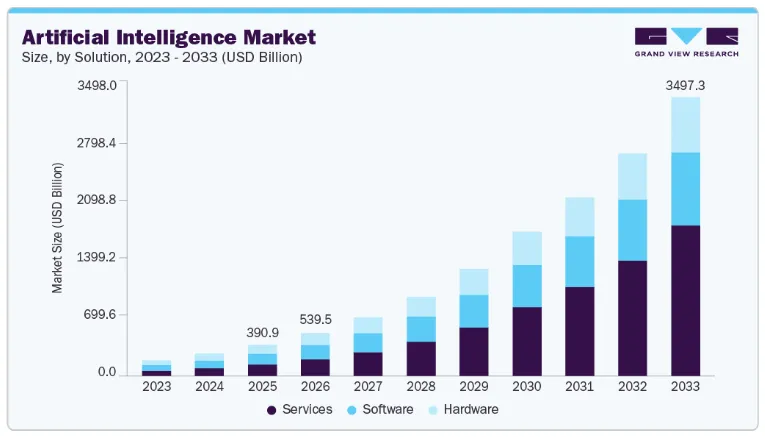
The AI market is projected to reach USD 3,497.26 billion by 2033, driving investment in immersive technologies (Grand View Research)
Practical Applications Beyond Gaming
Education represents one promising use case. Students could explore historical settings or scientific concepts through interactive worlds. A history lesson might involve walking through ancient Rome. A biology class could navigate inside a human cell.
Virtual reality training programs could generate diverse scenarios. Emergency responders might practice in AI-created disaster zones. Medical students could encounter varied patient presentations.
Product designers and architects might prototype spaces rapidly. Instead of building 3D models manually, they could describe concepts and iterate through multiple variations quickly.
The technology could support film and animation pre-visualisation. Directors could explore scene layouts and camera angles before committing resources to full production.
Privacy and Safety Considerations
Google emphasises responsible AI development. The company worked with its Responsible Development & Innovation Team throughout Project Genie’s creation.
Age restrictions limit access to adults. The company aims to prevent misuse while gathering feedback from mature users.
Real-time world generation introduces unique safety challenges. Unlike curated content libraries, AI-generated environments might produce unexpected or inappropriate results. Google’s safety systems must monitor outputs dynamically.
The model’s training data and decision-making processes remain partially opaque. Like most large neural networks, Genie 3 operates as a statistical black box. Understanding exactly why it makes specific choices proves difficult.
Also Read: From Gold Rush to Nickel Boom: How Kambalda Shaped Australia’s Mining Identity
What Comes Next
Google plans gradual expansion. More territories will gain access in coming months. The company may eventually offer API access for developers, given its cloud AI service offerings.
Feature development continues. The promptable events system demonstrated in August should appear in future versions. Session length limits might increase as the technology matures.
https://www.youtube.com/watch?v=YxkGdX4WIBE&t=6s
The virtual environment training data Genie 3 generates could feed other AI projects. Creating diverse synthetic datasets helps train computer vision and robotics systems.
Competition will intensify. Microsoft already explores entire game worlds made from AI, while other tech giants develop similar capabilities. The race toward more capable world models has just begun.