
Copper prices are hovering near historic highs around USD 6.00 per pound, driven by what analysts are calling an “AI Squeeze” and the demands of the green energy transition. For investors watching from Australia, the question is straightforward: is FCX the most accessible, most direct way to play this copper super-cycle – and has the dip already passed?
What Is Driving Copper’s 2026 Rally
This is not just another commodity spike. The demand picture has structurally changed.
AI data centres are projected to account for 1 to 2 per cent of global copper demand by 2030, while electric vehicles already require three to four times more copper than internal combustion engines.
Add grid modernisation, renewable energy rollouts, and defence spending to the mix, and you have a metal in serious structural demand.
LME copper surpassed USD 12,000 per tonne in December 2025 and briefly exceeded USD 14,500 per tonne in January 2026 on an intraday basis, with COMEX copper reaching approximately USD 5.65 per pound by early January.
The IEA has flagged a supply shortfall of 30 per cent by 2035, driven by declining ore grades and the long lead times needed to build new mines. That does not change overnight.
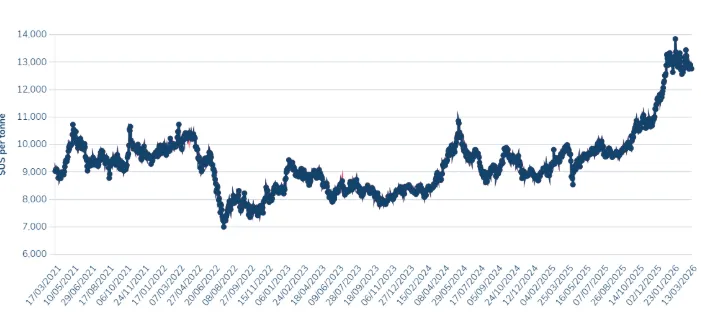
LME copper price trajectory, 2020–2026. Data sourced from the London Metal Exchange. [London Metal Exchange]
Why Freeport-McMoRan Is the Stock Everyone Is Watching
FCX is not a diversified mining giant hedged across iron ore and coal. It is, in the clearest sense, a copper play.
The company sold around 1.1 million metric tons of copper in 2025, making it one of the world’s largest copper miners by volume. Its portfolio includes the Grasberg minerals district in Indonesia, one of the world’s largest copper and gold deposits, plus major operations in Arizona, New Mexico, Peru, and Chile.
In 2025, FCX reported USD 25.9 billion in revenue and adjusted EBITDA of USD 9.9 billion. Its net debt has fallen from a peak of around USD 20 billion to approximately USD 2.3 billion by the end of 2025.
That balance sheet transformation matters. It gives management room to invest in growth without diluting shareholders.
On 22 January 2026, the company reported Q4 diluted EPS of USD 0.47, beating the consensus estimate of USD 0.28. Quarterly revenue reached USD 5.63 billion, beating estimates of USD 5.42 billion by 6.63 per cent.
Those are not soft beats. The market noticed.
The Grasberg Problem – and Why It May Now Be Priced In
FCX’s biggest asset is also its biggest risk.
A mud rush incident at the Grasberg Block Cave mine in Indonesia in September 2025 temporarily halted production. The company outlined plans for a phased restart in Q2 2026, targeting restoration of approximately 85 per cent of district production by the second half of 2026.
The disruption weighed on sentiment through late 2025. But as that “Grasberg discount” fades, investors are increasingly looking past the incident toward the production recovery ahead. FCX has been trading near a 15-month high of USD 52.29 as of late December 2025, reflecting the market’s confidence in the recovery path.
Beyond Indonesia, FCX is rated “Buy” by analysts, with its Americas Leach Innovation Initiative unlocking 42 billion pounds of copper with negligible capital expenditure. That is a significant reserve addition at almost no additional cost.
What Analysts Think: Price Targets and the Bull Case
Wells Fargo increased its price target from USD 47 to USD 55 in December 2025. BofA Securities raised its price target to USD 81 from USD 68 in February 2026, maintaining a “Buy” rating. As of 14 March 2026, 29 Wall Street analysts had a consensus “Strong Buy” rating with a median price target of USD 69.50.
That consensus target implies meaningful upside from current levels.
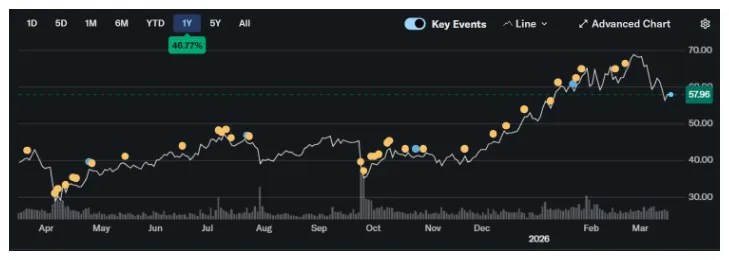
FCX Price chart [Yahoo Finance]
FCX vs Southern Copper: Who Has the Better Deal?
Southern Copper (NYSE: SCCO) is the other name that comes up in every copper conversation. It has an outstanding operating margin.
Southern Copper’s operating margin of 50.3 per cent leads peers, signalling strong cost control and favourable copper pricing conditions.
But SCCO has its own headwinds. Southern Copper expects copper production at 911,400 tons in 2026, implying a decrease of 4.7 per cent from 2025, due to lower ore grades at its Peruvian operations. Falling production in a rising copper market is a real constraint.
On valuation, FCX holds a Zacks Value grade of B versus SCCO’s D, with FCX carrying a more attractive valuation and improving earnings outlook.
SCCO has outperformed FCX year-to-date in 2026, but FCX’s lower valuation, production recovery trajectory, and leaching innovation arguably offer more room to run from here. FCX’s more attractive valuation and higher earnings growth projections suggest it may offer better investment prospects in the current market environment.
Investors building exposure to ASX copper stocks may find FCX a useful comparison point when evaluating pure-play copper names globally.
The Supply Side Tells the Real Story
The bull case on copper ultimately rests on supply constraints, not just demand optimism.
New copper mines are expensive to build and take over a decade to permit and develop. FCX’s capital expenditure strategy focuses on brownfield expansions at Bagdad, El Abra, and Lone Star, aiming to add 2.5 billion pounds of copper supply in a structurally tight market.
Meanwhile, the IEA has warned of a 30 per cent supply shortfall by 2035. A projected global refined copper deficit of approximately 330,000 metric tons is expected in 2026 alone.
BHP, for its part, is also chasing this theme. As we reported earlier, BHP’s copper segment saw a 44 per cent EBITDA increase as the miner repositions toward the metal of electrification. The global race for copper supply is real. FCX is better positioned than most.
Risks Worth Watching
This is not a one-way trade. Key risks include:
- Grasberg operational recovery – any delay pushes back production growth
- US-China trade tensions – tariffs can affect copper flows and pricing
- Indonesia regulatory uncertainty – FCX is negotiating long-term mining rights extension beyond 2041
- Commodity cycle timing – copper is volatile, and macro shocks can reverse price gains quickly
FAQ
Q: What does Freeport-McMoRan actually do?
A: Freeport-McMoRan is the world’s largest publicly traded copper miner. It operates major mines in Indonesia, the United States, Peru, and Chile. The company also produces gold and molybdenum as by-products.
Q: Why is copper AI demand a major investment theme in 2026?
A: AI data centres require vast amounts of copper for wiring, cooling infrastructure, and power transmission. Combined with electric vehicle adoption and grid upgrades, this is pushing long-term copper demand structurally higher.
Q: Is FCX cheap compared to Southern Copper?
A: By most valuation metrics, yes. FCX trades at a lower multiple with a more attractive earnings growth outlook, though Southern Copper has a higher operating margin and has recently outperformed on price return.
Q: What is the copper price forecast for AI data centres?
A: AI data centres are projected to represent 1 to 2 per cent of global copper demand by 2030, according to current IEA and industry projections. That may appear small but represents millions of additional tonnes of demand in a market already facing a structural supply deficit.
Q: What is the Grasberg mine?
A: Grasberg, located in Indonesia, is one of the world’s largest copper and gold deposits. It is FCX’s flagship asset and accounts for a significant share of its annual production. A 2025 mud rush incident disrupted operations, but a phased restart is underway for 2026.
Disclaimer: This article is for informational purposes only and does not constitute financial advice. Investors should conduct their own due diligence before making investment decisions. Past performance is not indicative of future results.
Sources