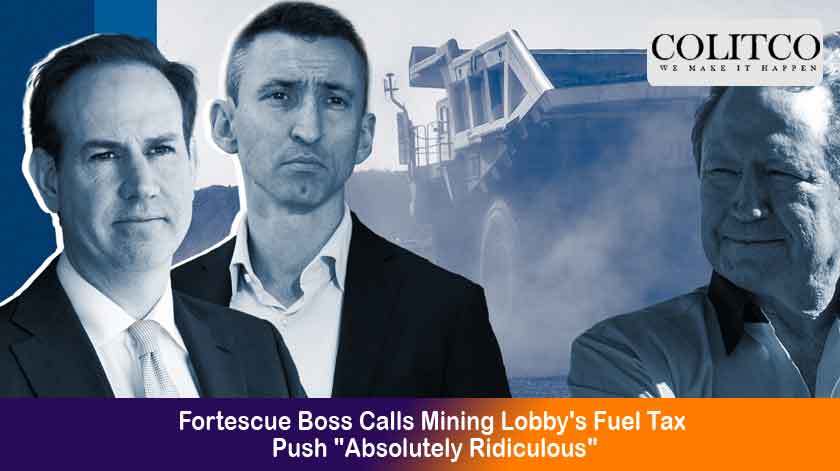
The Minerals Council of Australia has cited geopolitical fuel supply risks as a reason to slow the pace of renewable adoption in the mining sector. Fortescue leadership rejected that position outright.
CEO Dino Otranto did not mince words. “It’s completely expected… but it’s absolutely ridiculous,” he said, responding to calls from industry groups to water down national climate policy mechanisms.

Fortescue CEO Dino Otranto [LinkedIn]
The remarks came as Fortescue formally proposed capping the amount large mining companies can claim under Australia’s fuel tax credit (FTC) scheme. Fortescue proposed a $50 million annual limit on the diesel subsidies that Australia’s biggest companies can claim, a move likely to prove controversial among fellow Pilbara miners.
The company claims the change could generate savings of up to $2.2 billion a year.
Billions in Diesel Subsidies Under Fire
The FTC scheme has become one of the most contentious fiscal debates in Australian politics. From FY24 to FY27, the Australian government has forecast over $18 billion will be paid to mining under the fuel tax credit scheme. Extrapolated to FY30, that figure could reach $37 billion.
The mining industry’s case for the rebate largely stems from its longstanding position that it shouldn’t pay taxes on roads it doesn’t use, an argument originally pushed by farmers, and on the premise that many miners have to build their own access roads to get to site.
Fortescue argues that logic no longer holds. The company is deep into electrifying its own fleet and has set a target to eliminate fossil fuels from Pilbara operations by 2030. Keeping the subsidy intact, it argues, props up a fossil fuel dependency the sector needs to break.
Fortescue has a clear strategy: achieve its first mine electrification by deploying battery drills, excavators, and haul trucks at scale in the Pilbara. The technology exists. The investment decision is a matter of incentive, not readiness.
For context, Fortescue has already struck a $350 million deal with Epiroc to electrify its mining fleet and has been recognised as a global leader in decarbonisation for its real zero approach.
Fortescue vs the Minerals Council
This is not a quiet internal disagreement. It is a public confrontation between one of Australia’s largest miners and the peak body that is supposed to represent it.
The Fuel Tax Credit Alliance is authorised by the CEO of the Minerals Council of Australia, and its largest beneficiaries include BHP, Rio Tinto, Glencore, Fortescue, Roy Hill, Yancoal Australia, Whitehaven Coal, Peabody Energy, and Anglo American.
Fortescue remains a current beneficiary of the credits. But it is the one calling for reform. That alone makes the position unusual, and it has drawn support from some corners.
The Australian Council of Trade Unions and the Labor Environmental Action Network have signalled support for a less-generous scheme, as has Fortescue. The iron ore miner is presently a beneficiary of the credits but has set itself a target to eliminate fossil fuels from its operations by 2030.
The NSW Net Zero Commissioner has also weighed in. NSW Net Zero Commissioner Katerina Kimmorley identified reforms to the fuel tax credit for the mining industry as her top opportunity to underpin faster decarbonisation, saying “we need to see our mining sector electrified.”
Andrew Forrest, Fortescue’s executive chairman, has been pushing a version of this argument for years. “We’re subsidising the hell out of fossil fuel,” Forrest said at a high-level mining summit in Perth. “And then we tell companies that want to go green that they’ll have to fight against government policy. That’s madness.”
Pilbara to Parliament House
The practical battleground is the Pilbara, where Fortescue operates some of Australia’s most energy-intensive mining sites. But the policy fight is in Canberra.
Federal Resources Minister Madeleine King has said the government is not considering changes to the fuel credits in the 2026 budget and has defended their use by farmers, miners and tourism operators who don’t use public roads.
That position leaves Fortescue isolated within the industry lobby but increasingly aligned with climate advocates, trade unions, and some government advisory bodies.
The stoush also reflects a wider split inside the Australian mining sector over its future direction, as companies diverge sharply on how fast to decarbonise.
A Row That Has Been Building for Months
Fortescue has been at odds with two of WA’s most powerful mining lobby groups over their push to keep fuel tax credits since at least January 2026.
The proposal to cap credits at $50 million per company put the conflict into sharp relief. Otranto’s “ridiculous” remark followed as the Minerals Council held firm on opposing any reform to the scheme.
The timing is significant. Fortescue targets 24-hour fossil fuel-free mining operations by 2027, and its Pilbara green grid is being scaled to 1.2 GW solar, 600 MW wind, and up to 5 GWh battery storage by 2028.
A Sector Divided
The gap between Fortescue and the broader mining lobby on this issue is structural, not rhetorical. One side is invested in electrification. The other is arguing for the conditions that make diesel the cheaper choice to stick with.
Mining companies that use the current environment to decarbonise their fleet will not only reduce their diesel dependence but will also reduce long-term operating costs. Electrified equipment, while more expensive to purchase, offers lower operating and maintenance costs.
Otranto pointed to the declining cost curve of renewables and storage as decisive, saying the value proposition is well in favour of renewables, even ahead of existing coal generation, which he described as a fundamental breakthrough.
The federal government has so far resisted changing the scheme. But with the budget under pressure and public scrutiny of fossil fuel subsidies intensifying, the debate is unlikely to stay in stasis for long.
Also Read: Fortescue Speeds Up Large-Scale Green Energy Grid
FAQ
Q: What are fuel tax credits in Australia?
A: Fuel tax credits allow businesses, including miners, to claim a rebate on the fuel excise they pay on diesel used in off-road operations. The scheme was originally designed to avoid taxing businesses for road maintenance costs they don’t incur. For large miners, the annual credits can run into hundreds of millions of dollars.
Q: Why is Fortescue against fuel tax credits for big miners?
A: Fortescue argues the credits subsidise fossil fuel use and work against decarbonisation. The company is investing heavily in electric and renewable alternatives for its own operations and believes capping credits for large companies would accelerate the sector’s transition away from diesel.
Q: What has Fortescue proposed specifically?
A: Fortescue CEO Dino Otranto has called for a $50 million annual cap on fuel tax credits for Australia’s biggest diesel-consuming companies. The company says this would still protect small businesses and farmers while saving the federal budget up to $2.2 billion per year.
Q: What does the Minerals Council of Australia say?
A: The Minerals Council, through the Fuel Tax Credit Alliance, has opposed reform to the scheme, arguing changes would damage the economics of Australian mining operations and raise costs more broadly.
Q: What is Fortescue’s “real zero” target?
A: Fortescue has committed to eliminating fossil fuel use across its Pilbara iron ore operations by 2030, a goal it calls “real zero.” This is distinct from net-zero pledges, which often allow for carbon offsets. The company is investing in solar, wind, battery storage, and electric mining equipment to hit that target.
Disclaimer: This article is intended for informational purposes only and does not constitute financial advice. Readers should conduct their own research before making investment decisions.
Source:
- https://esgnews.com/fortescue-moves-to-eliminate-fossil-fuels-across-pilbara-mining-operations/
- https://climateenergyfinance.org/wp-content/uploads/2024/08/Fuel-Tax-Credit-Scheme-Report-Response.pdf