

Small businesses across Australia are integrating artificial intelligence into operations at an increasing rate. The Australian Bureau of Statistics released data showing a rise in research expenditure. Investment in these technologies grew by 142 per cent since the 2021 financial year.
Businesses spent $668.3 million on development during the 2024 period. This trend reflects a shift from experimentation to routine use within local firms. Approximately 29 per cent of small and medium enterprises (SMEs) now utilise automated systems.
The National AI Centre tracks adoption through monthly surveys of 400 organisations. These reports highlight benefits such as productivity gains and information access. However, many entities encounter obstacles during the implementation phase.
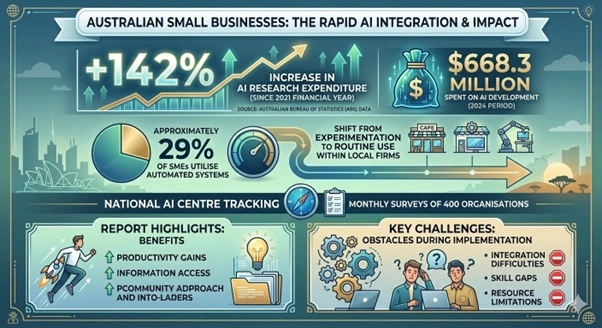
Rapid AI integration in small businesses across Australia
Data Integrity and Strategic Planning
Poor data management represents a primary cause of project failure in Australia. Algorithms require information to generate insights for business owners. Many firms feed unorganised datasets into these systems.
This practice leads to errors in forecasting and decision-making. A report from CSIRO indicates that 40 per cent of projects fail due to data issues. Managers must establish protocols for data governance before deployment.
- Organisations lack systems for structured data storage.
- Manual entry errors compromise the integrity of outputs.
- Audits help remove information that lacks utility.
Strategic misalignment further hinders the progress of local companies. Business leaders often purchase software without setting goals for the investment. This approach results in tools that sit idle within the organisation.
Companies must identify friction points within their workflows first. AI delivers the most value when it solves specific operational bottlenecks. Leaders should select areas where talent and data availability align with priorities.
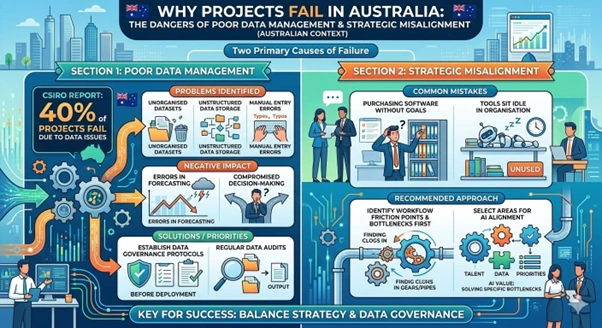
Why projects fail in Australia
Security Protocols and Staff Integration
Security breaches pose a threat to firms using generative platforms. Employees sometimes enter client details or trade secrets into public models. These platforms store inputs to train future versions of the software.
The Australian Cyber Security Centre warns against the sharing of sensitive data. Unauthorised disclosures increase the risk of phishing and identity theft. Firms require policies that define what information remains private.
- Public models retain data for further development purposes.
- Breaches create liabilities under the laws of Australia.
- Training serves as a defence against cyber risks.
Human oversight remains a requirement for the verification of content. Relying on automation without review leads to brand damage. Dr Sarah Mitchell of the Tech Innovation Institute notes the importance of this balance.
“AI should augment human intelligence rather than replace it entirely,” Mitchell says. Verification processes prevent the spread of hallucinations and factual errors. Teams must check outputs before these results reach the customer.
Financial Oversight and Future Scalability
Hidden costs often impact the budget of a small business. Expenses include subscription fees, maintenance, and the cost of computing power. Many owners overlook the energy requirements of advanced processing tasks.
Research from Deloitte Australia suggests that 35 per cent of firms underestimate costs. Scaling becomes difficult when software does not work with existing systems. Compatibility checks prevent technical issues during periods of growth.
- Maintenance expenses often exceed the purchase price over time.
- Modular platforms offer flexibility for expanding organisations.
- Assessments of return on investment help justify the spending.
The current market offers many tools with low entry costs. Platforms like Gemini and Copilot provide capabilities for a monthly fee. These tools allow small teams to compete with larger brands.
“The momentum we’re seeing in 2025 shows that AI has become more accessible and relevant,” says Kenny from BizCover. Accessibility allows firms to automate marketing and customer service tasks. This shift changes the economics of running a small enterprise.
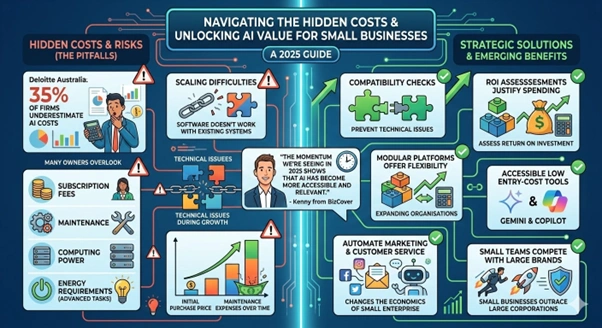
Hidden costs for a small business
Regulatory Compliance and Legal Risks
Legal risks increase when businesses use automation for professional advice. A lawyer in Australia faced a ban from practice after using AI. The technology generated false cases, which the lawyer submitted to the court.
Courts and regulators monitor the use of these tools for accuracy. The ACCC investigates instances of misleading conduct involving automated systems. Businesses bear the responsibility for the actions of their software.
- Accountability rests with the business owner for all outputs.
- False information leads to penalties from regulatory bodies.
- Documentation provides evidence of compliance during audits.
The government established four AI Adoption Centres to help SMEs. These centres provide training and support for the responsible use of technology. Expert guidance reduces the likelihood of legal or ethical lapses.
Clear communication with customers builds trust in the brand. Only 14 per cent of businesses tell clients how they use AI. Transparency helps organisations maintain a reputation for integrity.
Also Read: Why Investors Are Watching Australia’s Newest Consultancy
Workforce Evolution and Productivity Benchmarks
AI changes the requirements for skills within the Australian workforce. Many owners believe creativity and innovation remain the top priorities. However, data analytics and automation skills are gaining traction among staff.
Staff members report time savings of 40 to 60 minutes per day. These gains allow workers to focus on tasks with higher value. Productivity improves when teams use technology to handle repetitive work.
- Training programs bridge the gap in digital literacy.
- Automation handles data entry and document processing tasks.
- Workers spend more time on problem-solving and strategy.
Measuring the impact of technology remains a challenge for many. 46 per cent of SMEs do not measure the return on their investment. Without metrics, owners cannot determine the effectiveness of their strategy.
Successful firms use key performance indicators to track progress. Metrics include revenue per employee and the meeting of objectives. Data-driven assessments lead to better resource allocation in the future.
The landscape of artificial intelligence in Australia continues to evolve. Firms that prioritise data quality and security will likely lead the market. Success requires a commitment to learning and adaptation in a digital economy.