
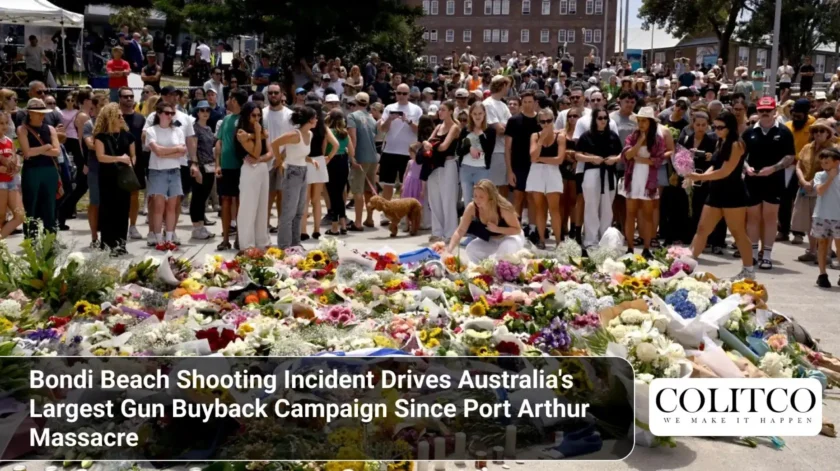
Australia has unveiled its most ambitious gun buyback initiative since the devastating Port Arthur tragedy in 1996. The announcement came following a horrific mass shooting at Sydney’s Bondi Beach, which claimed fifteen lives and injured over forty individuals. Prime Minister Anthony Albanese declared the incident an act of anti-semitic terrorism targeting Jewish Australians celebrating Hanukkah.
The federal government has introduced legislation for a comprehensive gun buyback scheme. States and territories will jointly fund this initiative with federal support. Authorities expect hundreds of thousands of firearms to surrender through the program. The government will collect and process these weapons whilst paying surrendered firearm owners according to established valuations.
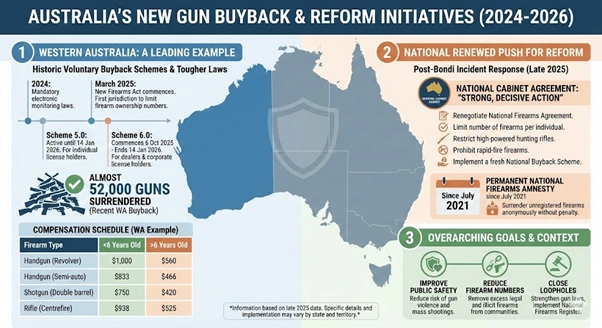
Australia’s new gun buyback & reform initiatives
The Bondi Beach Attack And Its Immediate Aftermath
The terror attack occurred on Sunday at Australia’s most iconic beach. A father and son opened fire at a Jewish Hanukkah celebration in a rampage that shocked the nation. Naveed Akram, aged twenty-four, faces fifty-nine criminal charges including fifteen counts of homicide and one charge related to conducting a terrorist act. His father, Sajid Akram, aged fifty, perished during the incident.
Law enforcement officials revealed that one attacker held a firearms licence and possessed six guns. Despite residing in the heart of Sydney’s suburbs, this individual maintained legal access to multiple weapons. Prime Minister Albanese highlighted this concerning detail at Friday’s press conference. He emphasised that no justification exists for someone in such circumstances to retain so many firearms.
Authorities have classified the shooting as driven by Islamic State ideology. Intelligence services had previously scrutinised the son due to his alleged connections with an Islamic State terrorism cell based in Sydney. Home Affairs Minister Tony Burke confirmed the son’s Australian citizenship status. The father had entered Australia on a visa in nineteen ninety-eight, which later converted to a partner visa in two thousand and one.
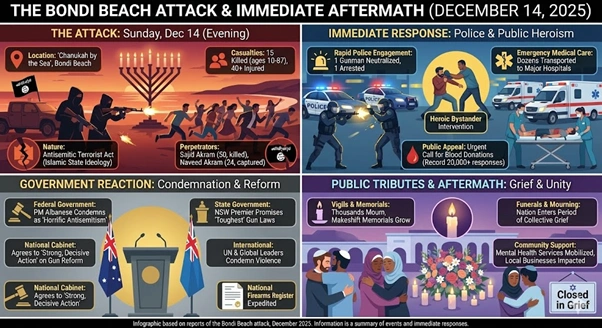
Attack on Bondi Beach
National Cabinet Response And Legislative Framework
The National Cabinet convened immediately following the attack. Representatives from the federal government and all state and territory leaders unanimously agreed to strengthen firearm regulations. This coordinated response demonstrates the gravity officials attributed to the situation. The government has committed to implementing measures that significantly exceed existing protections.
Prime Minister Albanese addressed the nation on Friday morning. He stated that the terrible events at Bondi demonstrated the necessity to remove more guns from Australian streets. The prime minister noted that Australia currently has over four million firearms in circulation. This figure surpasses the number present nearly thirty years ago when Port Arthur occurred.
https://www.youtube.com/live/o4p_0PQLTsI?si=FgzuW5g29w4wrgmA
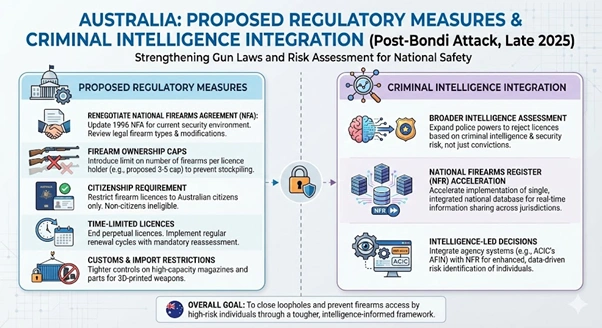
The government plans to revise the National Firearms Agreement established in nineteen ninety-six. Enhanced regulations will reinforce Australia’s existing gun control framework. Officials intend to accelerate the creation of a National Firearms Register, a concept introduced by the National Cabinet in two thousand and twenty-three. This comprehensive database will track firearm owners and their respective licences.
Proposed Regulatory Measures And Criminal Intelligence Integration
The new framework incorporates more criminal intelligence into the firearms licensing process. Authorities will restrict the number of firearms individuals can lawfully possess. Specific limitations on firearm types and modifications will also take effect. The government will ensure that only Australian citizens can obtain firearms licences.
Additional customs restrictions on firearms and associated equipment will commence. These measures may limit imports of items linked to three-dimensional printing technology or large-capacity ammunition accessories. The legislative changes represent the most stringent approach to firearm regulation Australia has undertaken since Port Arthur.
Proposed Regulatory Measures And Criminal Intelligence Integration
Historical Context And Port Arthur Legacy
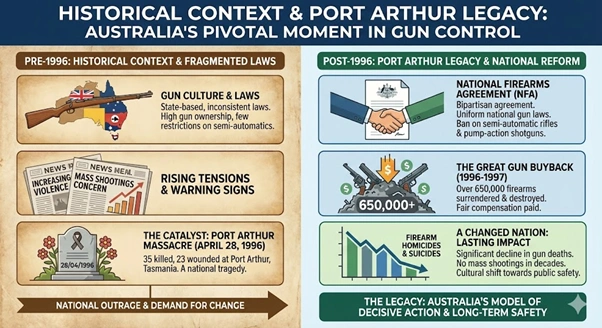
The Port Arthur massacre occurred in April nineteen ninety-six when a gunman killed thirty-five individuals. This tragedy fundamentally transformed Australia’s approach to firearm safety and regulation. The National Firearms Agreement followed within two weeks of that event.
Under the original buyback scheme, over six hundred and fifty thousand firearms were surrendered and destroyed. The program cost approximately three hundred and fifty million dollars, funded through a temporary Medicare levy increase. This historical precedent demonstrates Australia’s capability to remove significant numbers of weapons from circulation.
Western Australia has recently demonstrated the effectiveness of modern buyback approaches. Almost fifty-two thousand guns have been surrendered across three phases of their voluntary firearm buyback program. This represents the biggest removal of firearms anywhere in Australia since nineteen ninety-seven.
The Port Arthur massacre’s impact
Community Support And International Recognition
Public sentiment in Australia strongly favours stricter gun laws. Walter Mikac, patron of the Alannah Madeline Foundation named after his two daughters who perished in the Port Arthur shooting, released a statement of support. He emphasised that Australia made a collective commitment after Port Arthur to prioritise community safety. Mikac stated that this commitment remains as vital today as ever.
International observers have frequently referenced Australia’s gun control framework as a global benchmark. Former United States President Barack Obama cited Australia’s regulations when discussing effective firearm policy. Research indicates that Australia experienced no mass shootings throughout the two decades following the Port Arthur reforms.
The Bondi Beach attack has reignited Australia’s commitment to firearm safety. Government officials have demonstrated their determination to prevent similar tragedies. The national cabinet’s swift and unanimous response reflects widespread recognition that stronger measures are necessary. Prime Minister Albanese emphasised that Australia’s gun laws receive bipartisan parliamentary support and represent a proud moment of democratic reform.