
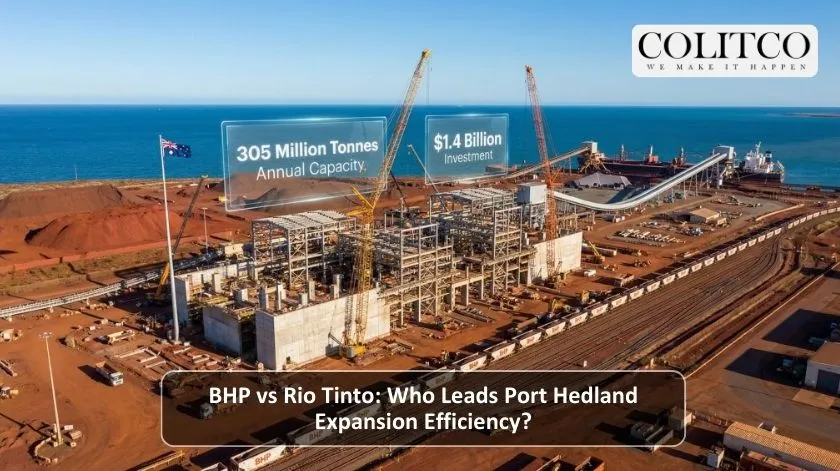
Australia’s iron ore industry runs on the rhythm of the Pilbara. And nowhere does that rhythm beat louder than Port Hedland, the world’s largest bulk export port by volume. As BHP doubles down on its port infrastructure with a landmark $1.4 billion investment, eyes are turning towards how the mining giant stacks up against rival Rio Tinto in the race to optimise Port Hedland’s port capacity.
The answer, it turns out, is more nuanced than a simple head-to-head.
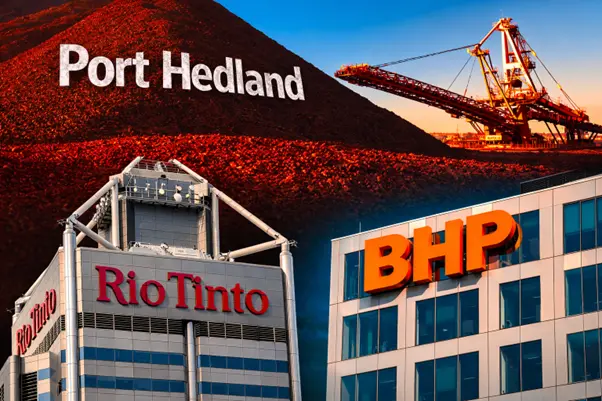
Figure 1: BHP’s $1.4B Port Hedland investment highlights competition with Rio Tinto to optimise Pilbara iron ore export capacity, though the comparison remains complex.
BHP Makes Its Move at Nelson Point
The Sixth Car Dumper That Changes Everything
BHP has officially broken ground on one of its largest-ever port infrastructure projects — the installation of a sixth car dumper (CD6) at its Nelson Point operations in Port Hedland.
The project forms the centrepiece of BHP’s Port Debottlenecking Project 2 (PDP2), a $1.4 billion commitment to strengthening the supply chain resilience of its Western Australian Iron Ore (WAIO) division.
BHP WAIO asset president Tim Day put it plainly at the 2025 Hedland Economic Forum: “The Pilbara is the engine room of the Australian economy, and this investment will ensure it keeps firing.”
Construction kicked off in December 2025, with the first ore expected to flow through CD6 by the fourth quarter of the 2027–28 financial year.
What CD6 Actually Does
Car dumpers at Port Hedland are industrial workhorses. Each one tips two 135-tonne rail cars simultaneously, unloading up to 16,000 tonnes of Pilbara iron ore every hour. The ore then travels roughly five kilometres of conveyor systems before reaching stockpiles or heading directly onto vessels for export.
BHP currently operates five car dumpers across its Nelson Point and Finucane Island facilities. Adding CD6 will dramatically shift the operational picture.
Currently, BHP runs five car dumpers at roughly 60 per cent availability. Once CD6 comes online, the port will run with at least five dumpers available more than 90 per cent of the time. That is not a marginal gain — it is a step-change in reliability.
The project also delivers:
- Enhanced ore blending and screening capabilities
- Greater supply chain resilience from mine to port
- Improved operational consistency during maintenance windows and cyclone season
- Local economic benefits through contracts awarded to Indigenous and Traditional Owner businesses
PDP2 follows the successful delivery of PDP1, which had already improved car dumper and ship loader performance across BHP’s Port Hedland operations. BHP’s WA iron ore operations recorded full-year production of 290 million tonnes in FY25, a record, alongside record shipments through Port Hedland. The medium-term target sits at 305 million tonnes per annum (mtpa).
Rio Tinto Plays a Different Game
A Port Strategy Built Around Dampier and Cape Lambert
While BHP centres its iron ore export operations on Port Hedland, Rio Tinto takes a geographically distributed approach. The bulk of Rio Tinto’s Pilbara iron ore exits through the ports of Dampier and Cape Lambert, not Port Hedland.
Cape Lambert alone handles approximately 80 million tonnes annually. Dampier adds another 140 million tonnes per year in capacity. Together, these two facilities carry the weight of Rio Tinto’s Pilbara export machine.
Rio Tinto’s presence at Port Hedland itself accounts for a relatively minor share, estimated at around 40 to 50 million tonnes annually. This is a fundamentally different footprint to BHP, which pushes the majority of its 290-plus million tonnes of iron ore through Port Hedland port capacity infrastructure.
Mine Replacement Over Port Expansion
Rio Tinto’s current strategy leans heavily on mine replacement rather than direct port capacity upgrades. The company is progressing multiple Pilbara brownfield projects designed to sustain and grow its system capacity of 345 to 360 mtpa over the medium term.
Active projects include:
- Western Range (25 Mtpa): Opened in June 2025 in partnership with China Baowu Group, on time and on budget at $2 billion
- Brockman Syncline 1 (34 Mtpa): Approved in October 2024, with planned first production in 2027
- Hope Downs 2 (31 Mtpa): Government approvals secured, main works construction now enabled, targeting first production in 2027
- West Angelas Sustaining (35 Mtpa): Approved August 2025, targeting production in 2027
Rio Tinto also committed $294 million in December 2025 to a full-scale feasibility study on Rhodes Ridge, one of the world’s great undeveloped iron ore deposits. Subject to approvals, first ore from Rhodes Ridge could arrive by 2030, leveraging existing rail, port and power infrastructure. The deposit carries a potential capacity of approximately 100 million tonnes per year of high-quality iron ore.
This mine-led strategy keeps Rio Tinto’s Pilbara throughput pipeline full without requiring a Port Hedland port capacity overhaul — at least for now.
Why the Timing of BHP’s Investment Matters
Ageing Infrastructure Meets Rising Demand
BHP’s CD6 decision did not come out of nowhere. It reflects the age and stress of existing port infrastructure, and the operational reality that five car dumpers running at 60 per cent availability creates genuine risk in a high-volume, weather-exposed supply chain.
Cyclones routinely disrupt Pilbara operations. The Category 4 Cyclone Zelia, which struck in early 2025, temporarily shut Port Hedland and removed ships from the shore. Having a sixth dumper available means maintenance can happen on one machine without throttling the entire export pipeline.
BHP’s PDP2 investment also signals confidence in iron ore demand, even against a backdrop of fluctuating global prices. The company is positioning itself to sustain 305 mtpa production through the late 2020s, a period of planned major maintenance in its WA operations.
The broader context is telling. Port Hedland handled 577.7 million tonnes of cargo in FY2025, the port’s best-ever result, with iron ore accounting for over 90 per cent of that volume. Both BHP and Fortescue drive the majority of that throughput. Investors watching the appointment of new leadership at emerging mining companies across Australia will recognise how critical infrastructure confidence is to long-term capital strategy.
How Each Company Measures Efficiency
Two Philosophies, One Port
The BHP vs Rio Tinto comparison at Port Hedland is not just about volume — it is about operational philosophy.
BHP is optimising a deeply embedded port-centric model. Almost all of its Pilbara production flows through Port Hedland, so every reliability improvement at Nelson Point compounds across the entire export chain. The CD6 investment is a concentrated bet on extracting more output from existing infrastructure.
Rio Tinto, by contrast, spreads its risk across multiple export points and prioritises upstream mine replacement to maintain throughput targets. It is a broader, more distributed strategy — and one that reduces single-port dependency.
Neither approach is wrong. Both companies are spending billions to maintain and grow their Pilbara capabilities. The difference lies in where they concentrate that investment.
It is worth noting that efficiency gains in the resources sector rarely stay siloed. Across the Pilbara, projects like St George Mining’s high-grade rare earths discoveries and porphyry copper expansions at Mt Cannindah are part of a broader resources sector that feeds off the same infrastructure networks, investor confidence, and regional workforce that BHP and Rio Tinto have spent decades building.
The Verdict on Port Hedland Port Capacity
At Port Hedland specifically, BHP leads on direct infrastructure investment. The $1.4 billion PDP2 project is the most significant single port capital commitment at Port Hedland in recent years, and CD6 will deliver measurable gains in availability, reliability, and throughput.
Rio Tinto, for its part, operates at Port Hedland on a smaller footprint and pursues its capacity growth through mine development and its own port terminals at Dampier and Cape Lambert.
If the question is who leads Port Hedland port capacity expansion efficiency right now, BHP holds that ground. But the broader contest, who is best positioned across the full Pilbara system, remains genuinely competitive.
Frequently Asked Questions (FAQs)
Q1: What is BHP doing to increase Port Hedland port capacity?
Ans: BHP is investing $1.4 billion in its Port Debottlenecking Project 2 (PDP2), which includes installing a sixth car dumper (CD6) at its Nelson Point operations. Once operational in FY2027–28, it will boost car dumper availability from roughly 60 per cent to over 90 per cent, significantly improving throughput reliability and export volumes.
Q2: Does Rio Tinto operate mainly through Port Hedland?
Ans: No. Rio Tinto’s primary iron ore export terminals are at Dampier and Cape Lambert, not Port Hedland. Its Port Hedland footprint handles an estimated 40 to 50 million tonnes annually — a fraction of BHP’s throughput at the same port. Rio Tinto focuses its growth strategy on mine replacement projects and its own dedicated port infrastructure across the Pilbara.
Q3: Why is Port Hedland port capacity so important to Australia’s economy?
Ans: Port Hedland is the world’s largest bulk export port by volume, handling 577.7 million tonnes of cargo in FY2025 alone — a record. Iron ore accounts for over 90 per cent of that figure. The port is a critical artery for Australia’s resources exports, directly influencing national trade revenues, regional employment, and the long-term competitiveness of major miners like BHP, Rio Tinto, and Fortescue on the global stage.
Sources
- Australian Mining
- Australian Resources & Investment
- Australian Mining Review
- Silverstone
- Rio Tinto SEC Filing
- Rio Tinto SEC Filing
- Rio Tinto Media Release
- The DCN
- Grokipedia
- Rio Tinto