

BHP Group Limited reclaimed the title of the largest company in Australia. This shift occurred on 27 January 2026. The mining giant overtook Commonwealth Bank of Australia during a rally in metals markets. BHP now holds a market value of over $253 billion.
Commonwealth Bank of Australia previously held the top position since October 2024. Its market capitalisation currently sits at approximately $251.5 billion. This transition reflects broader trends within the domestic share market. Investors shifted focus toward the resources sector from financial institutions.

BHP becomes the largest company in Australia, surpassing CBA
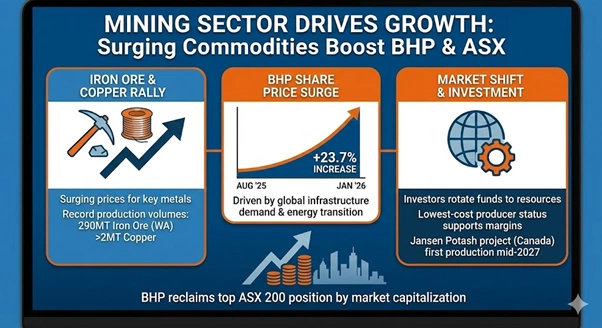
Mining Sector Drives Growth
Surging prices for iron ore and copper boosted the performance of BHP. The company reported record production volumes for several key commodities. Iron ore production reached 290 million tonnes at its Western Australia operations. Copper production exceeded 2 million tonnes for the first time.
BHP shares rose by 23.7 per cent over the last six months. This growth stems from infrastructure demand in China and India. Global interest in metals for the energy transition also supports these figures. The company maintains its position as the lowest-cost producer of iron ore.
Mining Sector Drives Growth
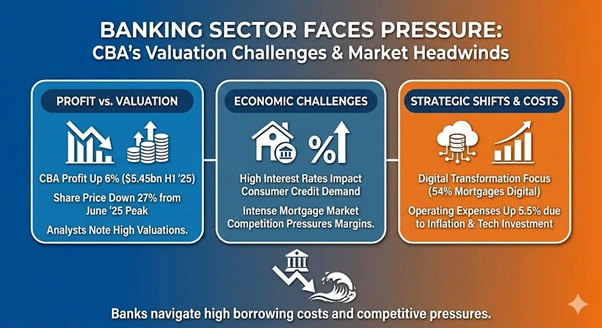
Banking Sector Faces Pressure
Commonwealth Bank of Australia encountered challenges despite reporting a profit. The bank posted a cash net profit of $5.45 billion for the first half of 2025. This result represents a 6 per cent increase from the previous period. However, the share price remains 27 per cent below its June 2025 peak.
Market analysts noted that bank valuations reached high levels in 2025. High interest rates now impact demand for credit among consumers. Competition in the mortgage market also puts pressure on margins. These factors contributed to the decline in the market weighting of the bank.
CBA’s Valuation Challenges
Performance Statistics Comparison
The following figures highlight the current financial standing of both entities:
- BHP Market Capitalisation: $253.3 billion.
- CBA Market Capitalisation: $251.4 billion.
- BHP Share Price Increase (6 months): 23.7 per cent.
- CBA Share Price Decline (from peak): 27 per cent.
- BHP EBITDA Margin: 53 per cent.
- CBA Interim Dividend: $2.35 per share.
BHP now accounts for 9.3 per cent of the S&P/ASX 200 index. CBA follows closely with a weighting just below this mark. This balance dictates the movement of the wider Australian index.
Executive Leadership Strategies
Chief Executive Officer Mike Henry led the restructuring of BHP since 2020. He oversaw the divestment of the petroleum business to Woodside Energy. Henry also directed the consolidation of the dual-listed company structure. This strategy focused the portfolio on commodities for the future.
Matt Comyn continues to lead Commonwealth Bank of Australia as Chief Executive Officer. He emphasised discipline in executing the strategy of the bank. Comyn prioritised investments in technology and artificial intelligence. The bank increased spending on technology by 10 per cent to $1.21 billion.

Chief Executive Officer Mike Henry
Dividend Distributions to Shareholders
BHP determined a final dividend of 60 US cents per share for shareholders. The company maintains a payout ratio of 55 per cent. This policy balances returns to investors with investments in growth. BHP generated a net operating cash flow of $18.7 billion.
Commonwealth Bank of Australia lifted its interim dividend to $2.35 per share. This payment is fully franked for domestic investors. The bank reported a dividend payout ratio of 74 per cent. Comyn stated the balance sheet remains resilient despite economic uncertainty.
Operational Milestones for BHP
The Jansen potash project in Canada represents a major investment for BHP. The company expects first production from this site by mid-2027. This project diversifies the earnings base beyond iron ore and copper. BHP plans to spend $11 billion on capital expenditure annually.
The company also achieved gender balance within its global workforce in 2025. Female representation reached 35 per cent across the organisation. Henry linked these outcomes to the operational excellence of the firm. BHP also reduced its net debt to $12.9 billion.
Also Read: Everything Sony Announced in The State of Play: February 2026
Digital Transformation at CBA
CBA focuses on maintaining its leadership in digital banking services. The bank reported that 54 per cent of mortgages originate through its proprietary channels. Digital capabilities help the bank manage risks and allocate capital. Comyn highlighted the importance of deposit funding for the institution.
Operating expenses for the bank rose by 5.5 per cent. Inflation and technology investments drove this increase in costs. CBA added resources to its lending and operations divisions. The bank aims to offset these costs through productivity initiatives.
Economic Outlook for Australia
The Reserve Bank of Australia maintains a focus on controlling inflation. Economic growth strengthened during the first half of the financial year. Consumer demand and infrastructure investment remain key drivers of activity. However, supply constraints continue to limit the potential of the economy.
Market strategists expect upward pressure on interest rates to continue. This environment creates different outcomes for miners and banks. Miners benefit from global demand and a weaker Australian dollar. Banks must navigate higher borrowing costs and potential loan defaults.
Future Leadership Succession
Reports suggest the tenure of Mike Henry may conclude in 2026. The board of BHP initiated a search for a successor in 2025. This process ensures a smooth transition for the leadership of the company. Internal candidates include executives from the Australian mining and finance divisions.
Matt Comyn has served as the head of CBA since 2018. He remains focused on the long-term prospects of the Australian economy. The stability of leadership at CBA provides confidence to institutional investors. Both companies now prepare for shifts in global trade policies.