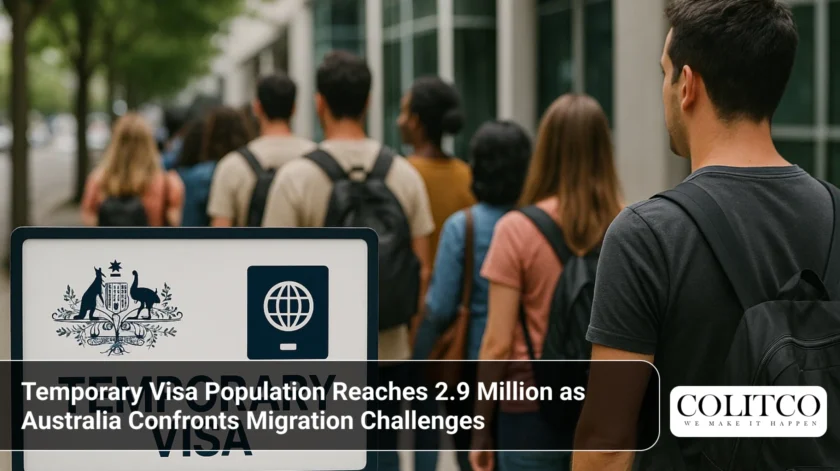
The Department of Home Affairs released updated migration data this month. Official figures show 2.9 million people currently live in Australia on temporary visas. This represents approximately 10 percent of the nation’s total population. The tally marks a significant increase of 70 percent since 2019 levels.
Breaking Down the Record Numbers
International students comprise the largest cohort within this temporary visa population. Student visa holders number 638,000 across the country. New Zealand citizens on Special Category visas represent the second-largest group at 731,000 people. The bridging visa category has expanded dramatically to 402,652 holders. Temporary skilled workers account for 238,322 visa holders currently in Australia. Working holiday makers total 226,962 individuals. An additional 360,214 tourists hold temporary documentation.
The Administrative Review Tribunal faces unprecedented pressure handling visa appeals. The tribunal maintains a backlog of 124,000 cases awaiting resolution. Student visa appeals account for 46,601 of these pending cases. Protection visa refusals constitute 40,427 additional matters before the tribunal. This administrative strain reflects systemic challenges within Australia’s visa processing infrastructure.
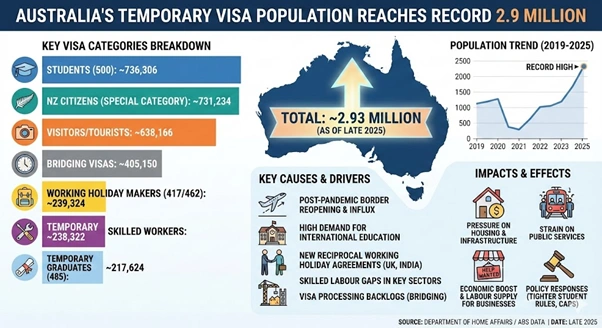
Breakdown of Australia’s temporary visa population
The Education and Labour Market Connection
Universities continue to attract international students despite recent policy tightening. Student visa applications experienced a 26 percent decline in lodgement numbers during 2024-25. Temporary graduate visa applications decreased by 31 percent in the same period. The government introduced higher English-language standards throughout 2025. Confirmation of Enrolment caps now restrict student numbers at educational institutions.
Hospitality, agriculture and aged care sectors depend heavily on temporary visa holders. These industries face workforce shortages that temporary migrants help address. Labour shortages persist in health care, engineering and construction occupations. Temporary skilled migration visa grants reached unprecedented levels in recent financial years. The Australian unemployment rate sits at 4.3 percent, demonstrating continued demand for workers.
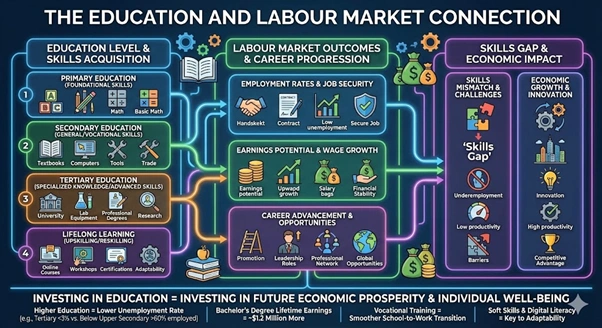
The education and labour market connection
Housing and Infrastructure Pressures
State governments warn that housing demand significantly outpaces available supply. The New South Wales Treasury estimates that every 100,000 temporary residents generate 40,000 additional housing demands within one year. Population growth driven by temporary migration creates infrastructure challenges across major cities. Public services face increased pressure accommodating the expanded population.
Australia’s total population reached 27.5 million in March 2025. Net overseas migration accounted for 315,900 people during the measured period. This exceeds natural population growth significantly. Permanent and long-term migrant arrivals reached a record 415,760 in the first three quarters of 2025. Updated migration forecasts will become available later this month.
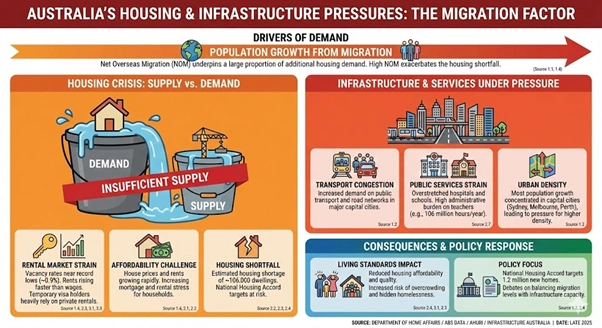
Australia’s Housing and Infrastructure Pressures
System Design Facing Fundamental Questions
Former deputy immigration secretary Dr Abul Rizvi made significant observations regarding Australia’s migration system. Dr Rizvi stated the system “has flipped from planned permanency to unmanaged temporariness”. He urges the government to lift permanent-migration caps by 50,000 places annually for three years. Dr Rizvi warns Australia will “sleep-walk into a two-tier society of permanent and perpetual temporary residents” otherwise.
The bridging visa category demonstrates systemic dysfunction most clearly. Originally designed for temporary applicants awaiting status decisions, bridging visas numbered 402,652 by October 2025. The system envisaged only a few thousand bridging visa holders at any given time. Visa applications lodged while applicants maintained valid visas generated administrative chaos.
Failed asylum seekers reached 101,976 individuals by 31 October 2025. An additional 26,298 asylum claims await decision processing. Deportation rates remain extremely low, averaging approximately twelve monthly during the last financial year. October 2025 recorded fewer than five deportations.
Also Read: Sophie Kinsella, Bestselling ‘Shopaholic’ Author, Dies Aged 55
Business and Union Concerns
The Australian Chamber of Commerce and Industry advocates for streamlined visa processing. Employers request a single digitised portal tracking applicants from lodgement through final status determination. Processing delays and inconsistent enforcement prevent effective workforce planning. Ad-hoc rule changes create operational uncertainty for businesses employing temporary migrants.
Trade unions insist better compliance represents the genuine solution. Wage theft and worker exploitation require stricter enforcement mechanisms. Unions have renewed calls for higher Temporary Skilled Migration Income Thresholds. An indexation review will determine threshold adjustments in December 2025.
Employers note that average visa expiry periods for casual workers have shortened. The period decreased from 18 months to 14 months. This compression requires more frequent work-rights verification processes. Sponsored workers must maintain occupational alignment with visa conditions.
Political Ramifications for 2026
Opposition parties accuse the Labour government of allowing migration to “run off the rails”. The government maintains it inherited a broken system and implements structural reforms. The federal government emphasises tightened English-language rules and enhanced student-visa integrity checks. Employer-sponsorship pathways face revised requirements.
A federal election looms in 2026. Housing affordability dominates public concern across Australia. Migration policy will sit prominently on the election campaign agenda. The visa population blow-out ensures this issue receives significant political attention throughout 2026.
The Department of Home Affairs has confirmed most bridging visa holders await substantive visa applications. These applications were lodged while applicants maintained valid visa documentation. Officials maintain that processing reforms will stabilise the system progressively.