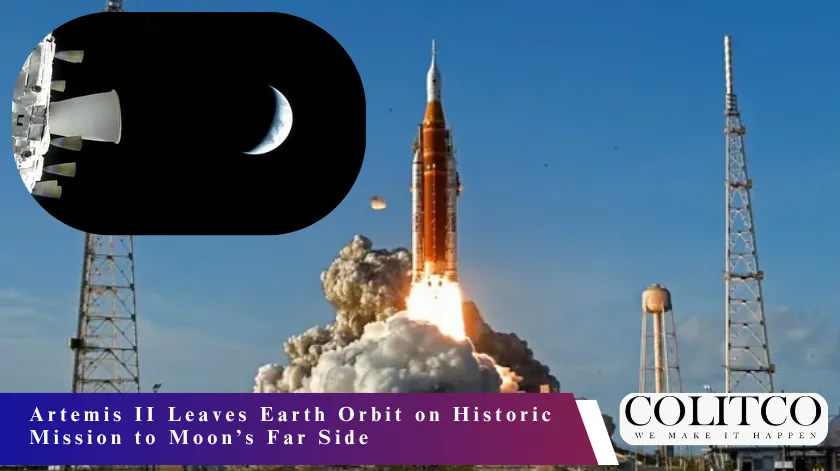
NASA’s Artemis II spacecraft has left Earth’s orbit and is now heading toward the Moon. Four astronauts aboard the Orion capsule completed a critical engine burn on April 2, 2026, sending them on the first crewed lunar trajectory in more than 53 years. The mission marks the most significant human deep-space event since Apollo 17 in December 1972.
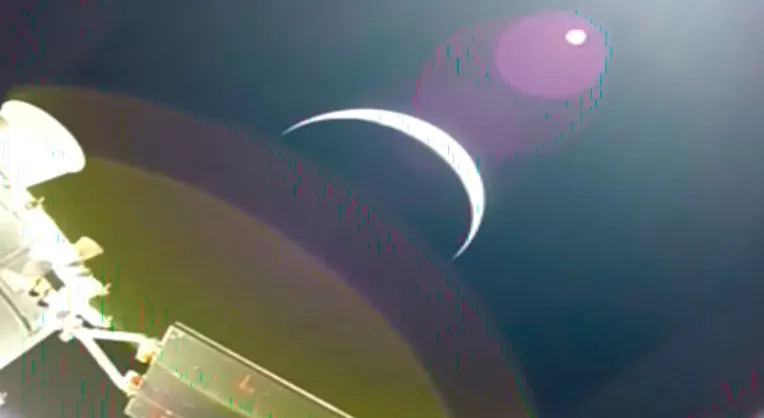
NASA’s Artemis II Orion spacecraft travels beyond Earth orbit toward the Moon on April 2, 2026.[NASA]
What Happened During the Artemis II Launch and Earth Orbit Departure?
NASA’s Space Launch System (SLS) rocket lifted off from Launch Pad 39B at Kennedy Space Center on April 1, 2026, at 6:35 p.m. EDT. Launch controllers cleared the flight on the first attempt, within the opening minutes of a two-hour window. The SLS carried the Orion spacecraft named Integrity by its crew into a high elliptical orbit around Earth.
On April 2, Orion fired its main service module engine for five minutes and 50 seconds. That burn, known as the translunar injection (TLI), consumed roughly 1,000 pounds of fuel. It changed the spacecraft’s velocity by 1,274 feet per second, breaking it free of Earth’s gravity and placing the crew on a direct path toward the Moon.
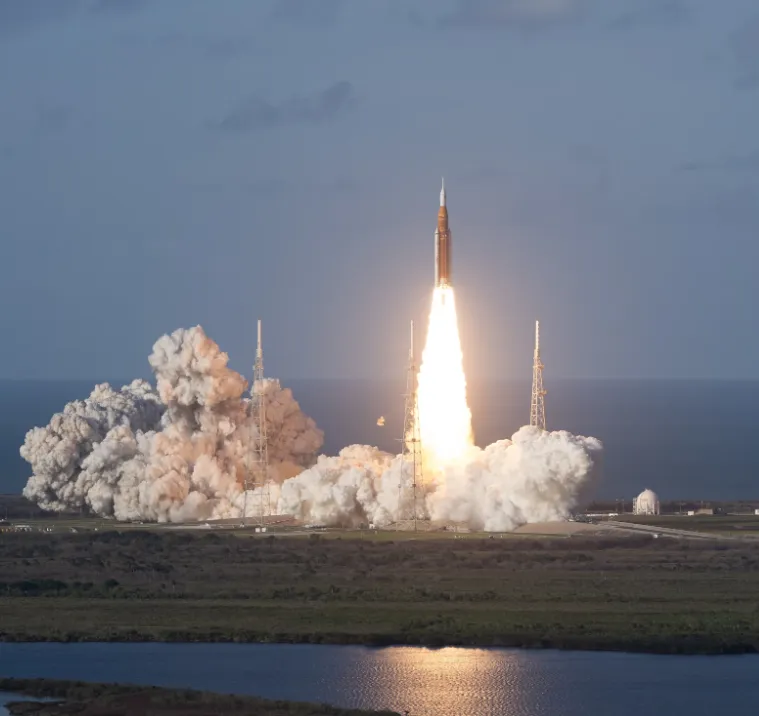
The Space Launch System rocket lifts off from Kennedy Space Center carrying Artemis II on April 1, 2026. [NASA]
Why Does the Artemis II Moon Mission Matter for Space Exploration?
Impact on the Space Industry and Science
Artemis II represents the first time NASA has sent humans beyond low Earth orbit since the final Apollo mission over five decades ago. The mission tests the full system, the SLS rocket, the Orion capsule, and all life-support and navigation systems under real deep-space conditions with a crew aboard.
Success or failure on this flight shapes the timeline for landing astronauts on the Moon and, eventually, sending humans to Mars.
Key Takeaways
- Artemis II is the first crewed deep-space flight since Apollo 17 in December 1972 — a 53-year gap in human lunar exploration.
- A successful mission clears the path for Artemis III, which targets a crewed lunar surface landing in 2027.
- The mission sets records for distance, crew size in deep space, and atmospheric reentry speed — all data critical for future Mars missions.
- Any system failures identified during this flight could push back the Artemis III landing timeline and affect broader NASA program funding.
Who Are the Astronauts Flying on the Artemis II Lunar Mission?
Primary Entity: The Artemis II Crew
Four astronauts make up the Artemis II crew. Commander Reid Wiseman leads the mission. He is a former NASA chief astronaut and U.S. Navy test pilot with 165 days of prior spaceflight experience. Pilot Victor Glover serves as the mission’s second-in-command. Glover previously spent six months aboard the International Space Station on the Crew-1 mission in 2020.
Mission Specialists Christina Koch and Jeremy Hansen complete the four-person team. Koch holds the record for the longest single spaceflight by a woman. Hansen, a Canadian Space Agency astronaut and former CF-18 fighter pilot, makes his first trip to space on this mission.

The Artemis II crew: Reid Wiseman, Victor Glover, Christina Koch, and Jeremy Hansen.[Reuters]
Together, the crew sets four historic firsts: Glover is the first person of color beyond low Earth orbit, Koch is the first woman, Hansen is the first Canadian and first non-American, and Wiseman is the oldest person to travel this far from Earth.
Secondary Stakeholders
- NASA — Mission operator and primary agency; responsible for the SLS rocket, Orion spacecraft, and mission control in Houston.
- Canadian Space Agency (CSA) — International partner providing Jeremy Hansen; participation secured under a 2020 U.S.-Canada treaty.
- European Space Agency (ESA) — Supplied Orion’s European Service Module, which houses the main engine and power systems.
Where Did the Artemis II Moon Mission Launch From and Where Is It Headed?
Geographic and Platform Context
The mission launched from Launch Complex 39B at NASA’s Kennedy Space Center in Cape Canaveral, Florida, the same facility that supported many Apollo launches.
The spacecraft currently travels through cislunar space, the region between Earth and the Moon. On April 6, 2026, Orion will fly around the far side of the Moon, reaching a maximum altitude of approximately 4,700 miles beyond the lunar surface.
Regional and Global Implications
Artemis II carries both national and international significance. The mission involves a Canadian astronaut under a bilateral space treaty, making it a multinational deep-space effort.
NASA views the mission as a foundation for a long-term human presence near the Moon, with implications for future scientific research, resource extraction, and deep-space infrastructure that affects the broader global space industry.
When Did Artemis II Launch and What Is the Mission Timeline?
Timeline of Key Dates
- 01 April 2026 — SLS rocket lifts off from Kennedy Space Center at 6:35 p.m. EDT. Orion enters high Earth orbit.
- 02 April 2026 — Translunar injection burn completed at 7:49 p.m. EDT. Orion departs Earth orbit and heads for the Moon.
- 06 April 2026 — Planned lunar flyby. Crew photographs the far side of the Moon; solar eclipse observed from Orion.
- ~11 April 2026 — Orion re-enters Earth’s atmosphere at ~25,000 mph. Splashdown in the Pacific Ocean off San Diego.
Historical Context
The last time humans traveled beyond low Earth orbit was December 1972, when Apollo 17 astronauts Eugene Cernan, Harrison Schmitt, and Ronald Evans completed the final Apollo mission.
The 53-year gap between Apollo 17 and Artemis II is the longest pause in human lunar exploration in the history of the space age. Artemis II also surpasses Apollo 13’s record distance of 248,655 miles from Earth, with a planned maximum distance of approximately 252,799 miles.
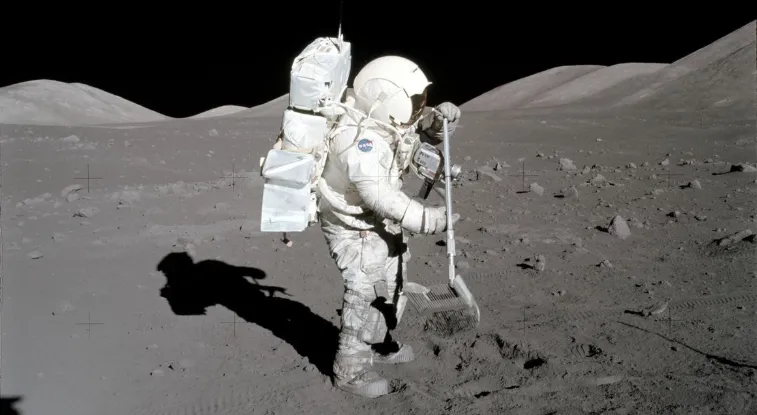
Apollo 17 astronauts on the Moon in 1972, the last crewed mission before Artemis II. [Space]
How Did Artemis II Reach the Moon’s Trajectory?
Mechanism and Process
After the initial ascent, Orion entered a high elliptical orbit with an apogee of roughly 1,200 nautical miles, nearly five times higher than the International Space Station.
The crew then performed a proximity operations demonstration, manually maneuvering Orion close to the spent ICPS upper stage using onboard navigation sensors and thrusters. Ground teams in Houston then conducted system checks before clearing the translunar injection burn.
The TLI burn itself lasted five minutes and 50 seconds. Orion’s service module engine, supplied by the European Space Agency, produced up to 6,000 pounds of thrust during the firing.
That burn placed the spacecraft on a free-return trajectory, meaning the Moon’s gravity will swing Orion around the far side, and gravity will naturally guide the capsule back toward Earth, requiring no further major engine firings.
How Will the Rest of the Artemis II Mission Play Out?
Forward-Looking Analysis
The crew approaches the Moon on April 6 for its closest encounter. During the flyby, the astronauts will photograph the far side in high resolution and observe a solar eclipse lasting nearly one hour. Lighting conditions will cast long shadows across the surface, revealing terrain features normally hidden under flat illumination.
NASA expects the imagery to contribute to site selection for future Artemis landing missions. Following the flyby, the crew will begin the return journey toward Earth, arriving at splashdown approximately five days later.
Risks and Counterarguments
Artemis II carries real technical risk. It marks the first time the Orion spacecraft has flown with a crew, meaning no human-rated flight data existed for the vehicle before this mission.
The Van Allen radiation belts pose an elevated exposure risk, as the crew travels through them longer than Apollo astronauts did due to a wider Earth orbit before departure. NASA has installed a real-time radiation monitor and an onboard shelter, but the cumulative exposure remains higher than on low Earth orbit missions.
Any major system failure, communications, life support, or propulsion could require emergency procedures on a trajectory already past Earth’s close reach.
Also Read: Hedge Funds Dump NVDA, TSLA & PLTR at 13-Year Record Pace
What Does Artemis II Mean for the Future of Space Exploration?
Artemis II is not a landing mission, but its outcome directly determines when humans next stand on the Moon. NASA’s Artemis III, targeting a crewed lunar surface landing in 2027, depends on the systems verified during this 10-day flight. Artemis IV, planned for 2028, will build on that foundation.
Every milestone Artemis II achieves, from the TLI burn to splashdown, moves the broader program one step closer to a sustained human presence on the Moon and, further ahead, to crewed Mars missions.
Follow continued coverage of the Artemis program for live mission updates as Orion approaches the Moon on April 6.
FAQS
Q1: What is the Artemis II mission?
A: Artemis II is a crewed mission by NASA that sends four astronauts around the Moon and back. It is the first human deep-space flight since 1972.
Q2: When did Artemis II leave Earth orbit?
A: The spacecraft departed Earth orbit on April 2, 2026, after completing a successful translunar injection burn that placed it on a trajectory toward the Moon.
Q3: Who are the astronauts on Artemis II?
A: The crew includes Reid Wiseman, Victor Glover, Christina Koch, and Jeremy Hansen.
Q4: Why is Artemis II important for space exploration?
A: Artemis II tests critical systems for future Moon landings and paves the way for Artemis III, which aims to return humans to the lunar surface.
Q5: How long will the Artemis II mission last?
A: The mission is expected to last about 10 days, including a flyby of the Moon and a return to Earth with splashdown in the Pacific Ocean.
Disclaimer
This article is published by Colitco and is intended for informational and educational purposes only. The information is based on publicly available data and official statements from NASA at the time of writing. While Colitco strives for accuracy, mission details may change as new updates emerge.
This content does not constitute scientific, technical, or investment advice. Readers should refer to official sources for the latest updates on the Artemis II mission and related developments.
Sources
https://www.cnn.com/2026/04/01/science/live-news/artemis-2-nasa-launch
https://en.wikipedia.org/wiki/Artemis_II
https://www.space.com/news/live/artemis-2-nasa-moon-mission-launch-updates-april-3-2026
Last modified: April 4, 2026