
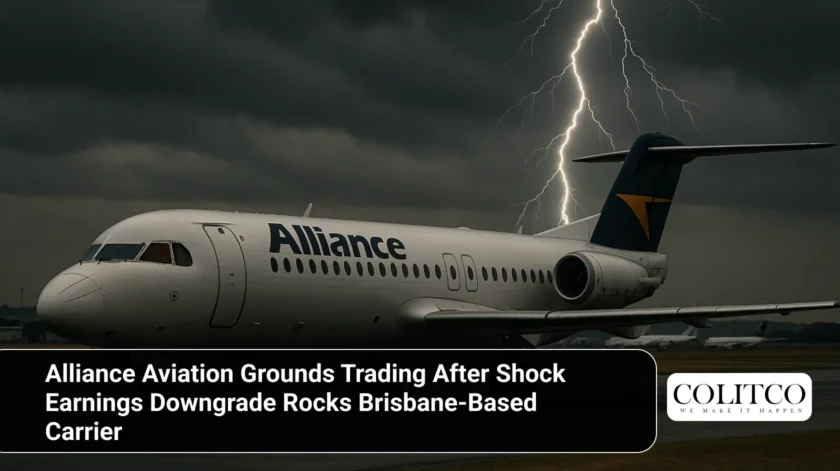
Alliance Aviation Services has pulled the emergency brake on its share trading this week after warning investors that full-year earnings will fall significantly short of analyst predictions.
The Brisbane-based airline requested an immediate voluntary suspension from the ASX on Tuesday, following a trading halt on Friday. The move comes just weeks after founder Scott McMillan announced his departure from the joint managing director role.
The timing couldn’t be worse for the carrier, which had been riding high on speculation about a potential takeover by private equity giant Pacific Equity Partners.
Maintenance Costs Spiral Out of Control
Alliance Aviation told shareholders the earnings shortfall stems from repairs, maintenance costs, and depreciation charges running higher than anticipated. The company needs until Friday morning to validate and verify the full financial impact before releasing a trading update.
“The voluntary suspension is necessary to assist Alliance in managing its continuous disclosure obligations,” the company stated in its ASX announcement.
The airline admitted FY26 earnings will be “materially lower” than analyst consensus estimates. This represents a sharp U-turn from August when joint Managing Director Stewart Tully described the company’s operating performance as “outstanding.”
Key concerns driving the downgrade include:
- Unexpected repairs and maintenance expenses
- Higher-than-forecast depreciation charges
- Need for thorough review of financial performance
- Impact on ongoing operational efficiency

Alliance Aviation operates a fleet of Fokker and Embraer aircraft across Australia.
Founder’s Exit Adds to Turbulence
Scott McMillan, who founded the company in 2002 as Alliance Airlines, announced in October that he would step down from his joint managing director position. The transition became effective at the company’s AGM on 27 November 2025.
McMillan will remain with Alliance in an executive capacity until his retirement in July 2026. During this period, he’ll focus on completing strategic projects to support the leadership transition.
Stewart Tully now serves as sole managing director, taking full control of the airline’s operations. The leadership change marks the end of a 12-month succession plan designed to ensure continuity.
Alliance chairman James Jackson praised McMillan’s contributions, noting he built one of Australia’s largest aviation companies servicing key industries and communities.
Takeover Speculation Complicates Picture
The earnings downgrade lands at an awkward moment. In mid-October, The Australian reported that Pacific Equity Partners was exploring a potential acquisition of Alliance Aviation.
The speculation sent shares soaring from $1.99 to $2.50 in a single session. Alliance declined to comment on the media reports, which investors interpreted as tacit confirmation of discussions.
Now, the earnings downgrade could hand Pacific Equity Partners significant negotiating leverage if talks are indeed underway. A lower earnings forecast typically translates to reduced valuations and acquisition prices.
Market watchers expect Alliance shares to drop sharply when trading resumes, regardless of what the company reveals in its update.
Qantas Stake Adds Strategic Weight
Qantas currently holds a 20 percent stake in Alliance Aviation, adding another layer of complexity to the situation. The partnership sees Alliance operate Embraer E190 jets for QantasLink on regional routes.
The relationship gives Qantas significant influence over Alliance’s strategic direction. Any potential takeover would require careful navigation of this existing partnership.
Industry observers note that Qantas attempted a full acquisition of Alliance in 2022, only to see the deal blocked by the Australian Competition and Consumer Commission.
Aviation Sector Faces Headwinds
Alliance Aviation’s troubles mirror broader challenges across Australia’s aviation sector. Flight Centre recently issued its own profit warning, citing inconsistent trading patterns and declining airline ticket prices.
The ASX 200 Airlines Index has struggled throughout 2025, underperforming the broader market. Rising operational costs, volatile passenger demand, and unpredictable fuel prices continue to pressure carriers.
Alliance provides contract, charter, and aviation services primarily to mining and energy companies. This fly-in, fly-out (FIFO) business model typically offers more stability than commercial passenger services.
However, even resource sector contracts can’t shield the carrier from spiraling maintenance costs and equipment depreciation.
What Happens Next
Alliance Aviation must release its trading update by Friday morning or trading will automatically resume at market open. Shareholders are bracing for significant downward revisions to FY26 earnings forecasts.
The company’s last traded price of $2.53 per share looks vulnerable to sharp declines once the suspension lifts. Analysts had been expecting continued growth based on the full-year Qantas wet lease operations ramping up in FY26.
Key questions investors want answered include:
- Specific FY26 earnings guidance figures
- Timeline for resolving maintenance cost issues
- Impact on debt-to-EBITDA ratios
- Strategy for returning to profitability
- Status of Pacific Equity Partners discussions
Alliance reported a cash position of approximately $24 million at the end of FY25, with net debt around $378 million. The company had targeted reducing its net debt-to-EBITDA ratio to 1.65-1.7x in FY26.
Whether these targets remain achievable now seems doubtful given the earnings downgrade.

Alliance Aviation shares last traded at $1.53 before the suspension.
Investor Outlook Turns Cautious
The combination of leadership transition, earnings downgrade, and trading suspension has created a perfect storm for Alliance Aviation shareholders. The 12-month rally driven by takeover speculation now looks premature.
Investors face considerable uncertainty until the company releases detailed guidance on Friday. Even then, questions will linger about the carrier’s medium-term profitability and strategic direction.
The aviation services market remains robust, particularly for resource sector contracts. Alliance’s underlying business model hasn’t fundamentally changed. However, execution issues around cost control have clearly emerged.
Also Read: Far East Gold Rigs Turn at Mount Clark West as Quest for Major Copper-Gold Discovery Begins
For now, shareholders can only wait for Friday’s announcement and hope the damage isn’t as severe as feared. The market’s reaction when trading resumes will provide the first real test of investor confidence.
Alliance Aviation’s turbulence serves as a reminder that even companies with strong market positions can hit unexpected air pockets. The question now is whether this is temporary turbulence or the start of a more concerning descent.



