
Young Australians are entering the national workforce without fundamental knowledge of their legal safety rights or access to mandatory training. New research from Unions NSW reveals a critical gap in workplace protection for the youngest demographic of employees.
Caitlin Malor began her second professional role at a prominent fast food chain immediately after finishing her high school education. She was 17 years old when she sustained a severe burn to her hand during a standard shift.
Malor sought medical assistance to dress the injury but faced immediate expectations to return to her duties. The workplace lacked basic first aid supplies and formal incident reporting mechanisms for staff members.
Managers at the facility were often only three years older than the entry-level employees they supervised. Malor describes the internal attitude toward health and safety protocols as the “wild west” during her tenure.
She frequently completed 50-hour work weeks and often managed the store alone without any formal safety inductions. This environment created significant pressure to ignore hazards and maintain high productivity levels at all times.
 Caitlin Malor
Malor represents a growing number of young Australians who do not understand their legislative protections when starting new jobs. Recent data confirms that her experience reflects a broader trend within the Australian labour market.
A comprehensive survey of 300 young workers by Unions NSW highlights a lack of institutional support for new hires. Nearly two in five respondents received zero workplace health and safety training upon commencing their employment.
Half of the participants reported that no one ever explained their basic safety rights to them. Only 29 per cent of young workers believe they received clear or useful training from their employers.
Statistics show that over one-third of young employees felt unsafe at work within the previous 12 months. This lack of preparation extends beyond the workplace and into the Australian educational system.
Approximately half of all young workers have never received safety education at school, TAFE, or university settings. Malor now serves as a campaigns officer for Unions NSW to address these systemic educational failures.
Young people in their first jobs often feel an intense desire to impress their supervisors. This drive frequently leads to a reluctance to speak up about dangerous conditions or missing equipment.
Legislative Inquiries Target Apprentice Vulnerability
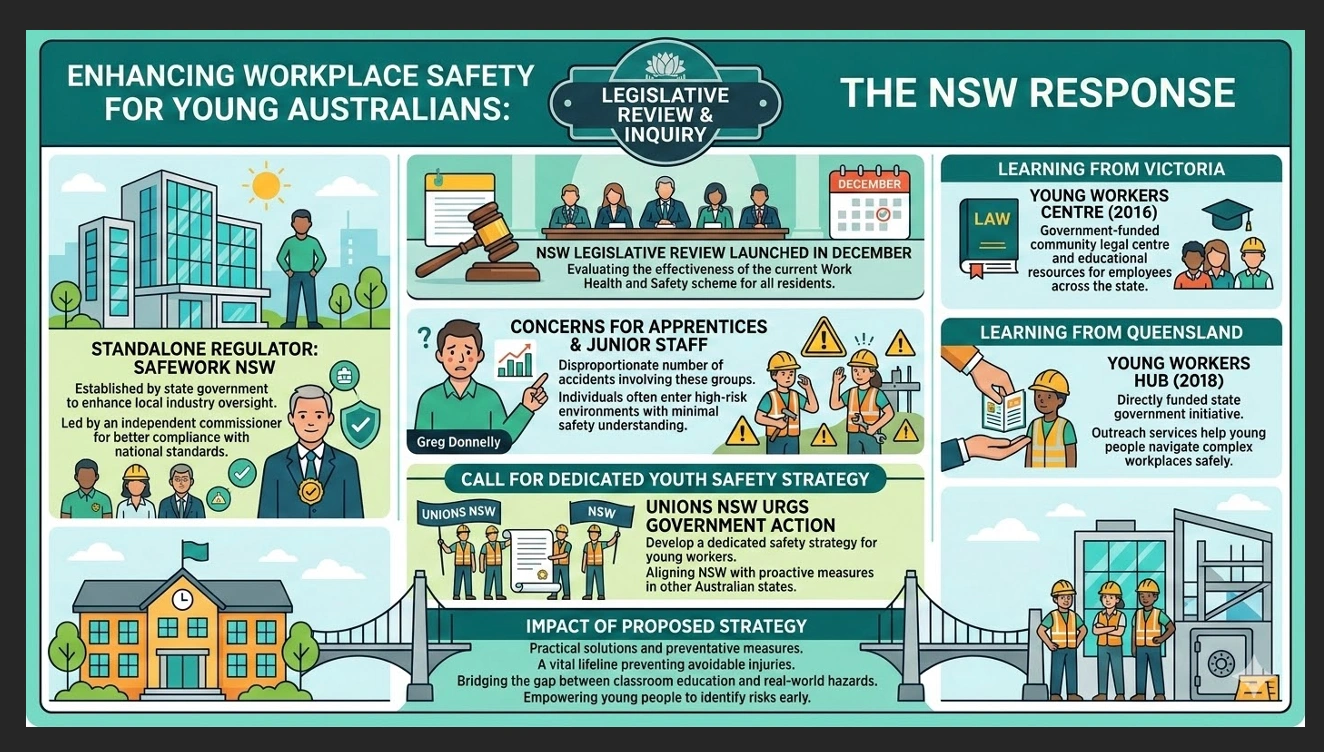
The Standing Committee of Law and Justice in New South Wales launched a formal review in December. This inquiry evaluates the effectiveness of the current Work Health and Safety scheme for all residents.
The state government recently established SafeWork NSW as a standalone regulator to enhance oversight of local industries. An independent commissioner now leads the organisation to ensure better compliance with national safety standards.
Committee Chair Greg Donnelly notes a disproportionate number of accidents involving apprentices and junior staff members. These individuals often enter high-risk environments with minimal understanding of healthy work practices.
Unions NSW calls for the state government to develop a dedicated safety strategy for young workers. Such a strategy would align New South Wales with proactive measures already active in other Australian states.
Victoria established the Young Workers Centre in 2016 to provide essential support for employees across the state. This government-funded initiative operates as a community legal centre and a primary source of educational resources.
Queensland launched the Young Workers Hub in 2018 with direct funding from the state government. This hub provides outreach services to help young people navigate complex workplace environments safely.
These programs offer practical solutions and preventative measures to protect vulnerable members of the workforce. They serve as a vital lifeline for individuals experiencing unsafe or exploitative conditions in their professional lives.
Malor advocates for these models as essential tools for preventing avoidable injuries among her peers. A coordinated national approach would ensure that every young Australian receives the same level of protection.
The proposed safety strategy aims to bridge the gap between classroom education and real-world workplace hazards. It focuses on empowering young people to identify risks before accidents occur on the job site.
 Enhancing workplace safety for young Australians
Mandatory Rights and Reporting Mechanisms for Employees
Australian health and safety laws guarantee several fundamental rights to every individual in the workforce. Workers possess the legal right to receive thorough instructions on how to perform their tasks safely.
Employers must provide all necessary safety equipment and personal protective gear at no cost to the employee. Every staff member maintains the right to voice concerns about their working conditions without fear of dismissal.
SafeWork NSW encourages any worker with safety concerns to contact their supervisor or health and safety representative immediately. These representatives act as the first line of defence against hazardous practices within a business.
Also Read: How the US-Israel-Iran War Is Hitting ASX, Wall Street & Oil Markets
The Speak Up platform provides a confidential channel for reporting dangerous workplace activities to the authorities. This tool allows employees to alert regulators when internal management ignores legitimate safety requests.
- Employees have the right to refuse work that poses an immediate risk to their health.
- Business owners must maintain a register of all workplace injuries and near-miss incidents.
- Training sessions must occur during paid work hours and cover specific site hazards.
- Workers can request an inspection from a government safety officer at any time.
The ongoing review by the Standing Committee will gather evidence from various stakeholders across the state. It aims to identify specific industries where young workers face the highest levels of physical risk.
 Safety First: A Comprehensive Guide to Your Fundamental Rights at Work
Legislators seek to implement stronger penalties for companies that fail to provide adequate safety inductions. These measures will reinforce the responsibility of employers to protect their most inexperienced staff members.
The final report will likely recommend new educational requirements for secondary schools and vocational training providers. Ensuring that students understand their rights before they sign an employment contract remains a top priority.
Malor continues to share her story to highlight the human cost of negligence in the fast-food and retail sectors. Her advocacy work focuses on changing the culture of silence that often surrounds workplace injuries.
Improving safety outcomes for Gen Z workers requires a combination of legislative reform and grassroots education. Australia moves closer to a standard where no young person has to choose between their job and their physical safety.


