
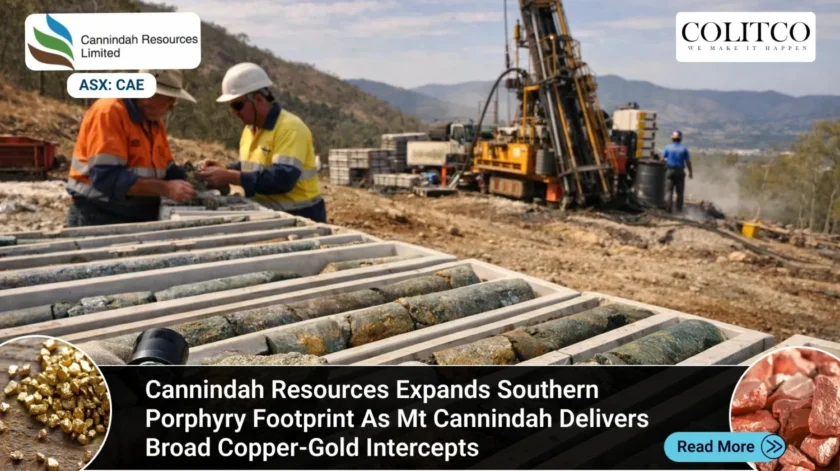
Cannindah Resources Limited (ASX: CAE) (“Cannindah” or the “Company”) has strengthened its claim over a potentially transformational copper-gold system at its Mt Cannindah Project in central Queensland, delivering significant drill results that confirm the scale and continuity of the Southern Porphyry Target.
Cannindah is currently at a critical juncture, with shares last trading at $0.045, a market capitalisation of $61.84 million, and a 52-week range of $0.017 to $0.098. The latest reconnaissance drilling results do not merely extend mineralisation, they reinforce the geological model of a large-scale, preserved porphyry copper-gold system with increasing grade vectors to the south.
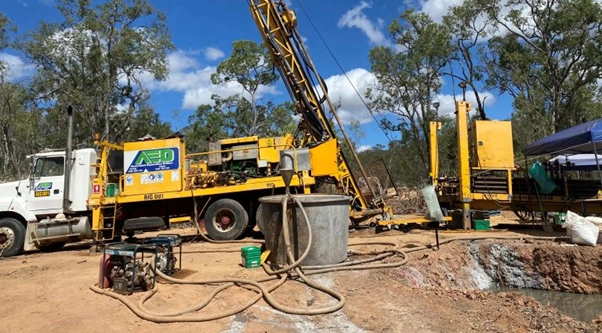
Figure 1: Drill rig in operation at the Mt Cannindah Project location [Cannindah Resources]
Broad Intercepts Confirm System Scale
The final assays from the 2025 reverse circulation scout drilling program confirm broad and continuous mineralisation across a 700-metre strike length.
Key intercepts include the following:
- 148m @ 0.27% CuEq from 112m in hole 25CRC015
- 172m @ 0.18% CuEq from 118m in hole 25CRC020
- 90m @ 0.33% CuEq from 184m in hole 25CRC013
- 28m @ 1.15% CuEq from 298m in hole 25CRC016 (ending in mineralisation)
Importantly, hole 25CRC016 returned high-grade intervals including:
- 2m @ 10.21% CuEq
- 2m @ 4.20% CuEq
These intersections are not isolated spikes. They sit within broader mineralised envelopes, which exploration geologists often interpret as positive indicators in porphyry systems.
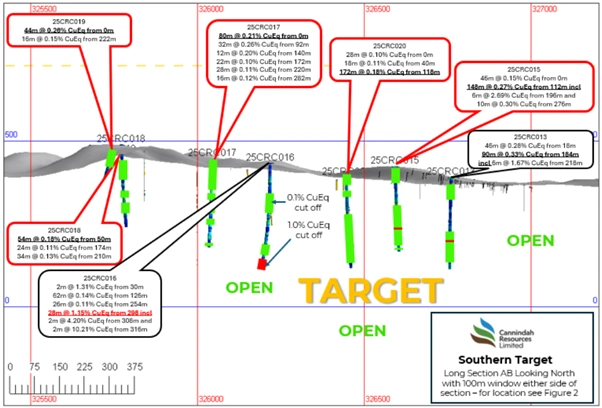
Figure 2: Long-section view facing north, displaying all 2025 drilling results. [Cannindah Resources]
Managing Director and CEO Mr Cameron Switzer underscored the importance of these wide zones: “Broad intervals such as described herein are typically positive indicators in the porphyry exploration toolbox.”
The width and continuity of mineralisation now define what the Company calls the Appletree Centre Target, which remains open to the south and east.

Figure 3: Map illustrating the Appletree Centre Target, including drill intercepts and cross-section lines. [Cannindah Resources]
Geological Vectors Point to a Fertile Intrusive Centre
Several geological features strengthen the case for a nearby porphyry core:
- Development of mineralised intrusive dykes
- Increasing grade and thickness southwards
- Metal ratio shift from Cu > Au on the periphery to Au > Cu toward the interpreted centre
- Hypogene chalcopyrite within stockwork veining
These are classic hallmarks of a zoned porphyry system.
Mr Switzer explained the broader geological implications: “Our mineralised intersections indicate extensive drilling is required and demonstrate a clear indication of a fertile intrusive centre. Critically, all geological indicators suggest we are testing a fully preserved system.”
Preservation matters. Many porphyry systems globally suffer from erosion or structural dislocation. A fully preserved system increases the probability of intact high-grade cores at depth.
The Southern Porphyry Target spans a surface footprint exceeding 2,000m by 800m and remains open laterally and at depth. The next phase of diamond drilling will test beyond 1,000 metres vertically.
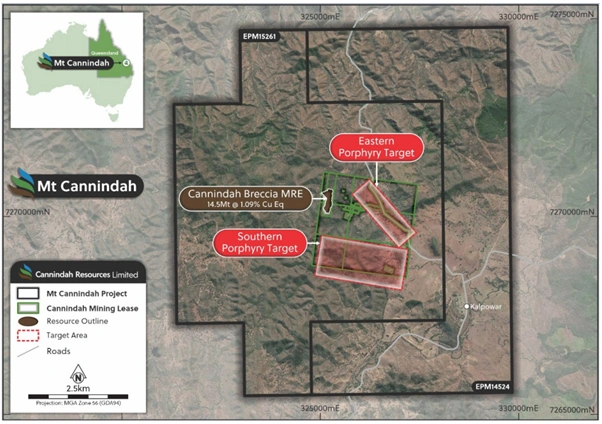
Figure 4: Location map showing the position of the Southern Target. [Cannindah Resources]
Resource Base Strengthened by Existing MRE
Beyond exploration upside, Cannindah already controls a defined Mineral Resource Estimate (MRE) at the Mt Cannindah Breccia.
The current MRE totals:
- 14.5Mt @ 0.72% Cu, 0.42g/t Au and 13.7g/t Ag
- 1.09% CuEq overall
- Containing:
- 104.8kt Cu
- 197.3koz Au
- 6.4Moz Ag
- 158.3kt CuEq
Seven of twelve planned resource expansion holes have been completed, with the first assay results expected in March. These results could further expand the existing inventory.
The presence of an established resource alongside an emerging porphyry system materially alters the Project’s scale potential.
Strong Funding Position Enables Aggressive Drilling
Exploration success requires capital discipline and adequate funding. Cannindah enters 2026 with approximately $17 million in cash, positioning the Company to aggressively test its targets without immediate financing pressure.
Mr Switzer emphasised management’s intent: “The Company will continue to aggressively explore and evaluate this asset with the appropriate deployment of in-ground drilling investment. 2026 is shaping up as an exciting year for Cannindah’s stakeholders.”
The planned program includes:
- Deep diamond drilling south and east of existing holes
- Continued MRE expansion drilling
- Ongoing metallurgical validation
- Systematic vector testing toward the interpreted porphyry core
Monument Exploration Target Adds Conceptual Upside
In addition to drilled resources, the Monument area hosts an Exploration Target of:
- 25–30Mt @ 0.2–0.3% Cu and 100–150ppm Mo
- For 64–114kt CuEq
While conceptual in nature, the Exploration Target demonstrates scale potential beyond current drilling limits.
The geological setting, a Triassic-age intrusive complex hosting skarns, breccias, stockworks and porphyry-related mineralisation, aligns with global analogues.
Cannindah itself notes that multiple intrusive centres commonly occur in major porphyry districts, referencing systems comparable in style to well-known global deposits.
Strategic Location in Central Queensland
The Mt Cannindah Project lies 90km southwest of Gladstone and comprises nine Mining Leases and two EPMs. The Project benefits from:
- Historical mining activity
- Established access agreements
- Existing tenure security
- Regional infrastructure proximity
The district hosts at least 17 significant Cu-Au-Mo occurrences, highlighting a fertile mineral province.

Figure 5: Mt Cannindah Project location in Central Queensland [Cannindah Resources]
What Makes This Announcement Significant?
This release matters for three reasons:
- Scale Confirmation – Broad mineralised intervals across 700m validate the Southern Porphyry model.
- Grade Indicators – High-grade intervals at depth suggest proximity to a potential core.
- Funding Strength – $17 million cash supports aggressive 2026 drilling without immediate dilution risk.
The shift from peripheral skarn mineralisation to porphyry-style vectors marks a potential step change in the exploration thesis.
Investors Outlook
Cannindah Resources sits at a defining moment.
At $0.045 per share and a $61.84 million market capitalisation, the Company trades well below its 52-week high of $0.098. Yet it now controls:
- An established copper-gold resource
- A large, open porphyry target with strengthening vectors
- A substantial exploration budget
- Imminent assay catalysts
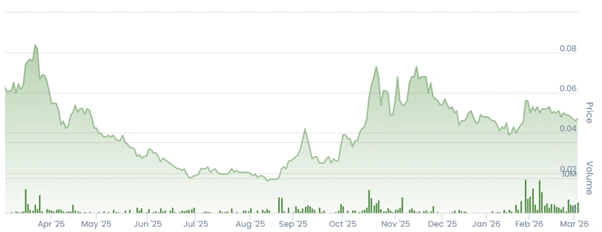
Figure 6: Share price performance of Cannindah Resources in the last 52 weeks [Cannindah Resources]
Porphyry discoveries rarely emerge from single spectacular holes. They build through systematic vectoring, precisely what Cannindah’s results now demonstrate.
For now, the geological indicators appear increasingly coherent. The metal ratio shifts, intrusive dyke development, grade thickening southwards and high-grade depth intercepts all align with a classic porphyry discovery pathway.
As Mr Switzer concluded, offering a note of optimism for investors: “2026 is shaping up as an exciting year for Cannindah’s stakeholders.”
For investors seeking exposure to copper and gold leverage in a Tier-1 jurisdiction, Cannindah Resources presents a high-risk, high-reward exploration story with tangible scale potential and funded momentum.
The drill rigs will ultimately determine the outcome, but the groundwork for a potentially significant porphyry system is now firmly in place.