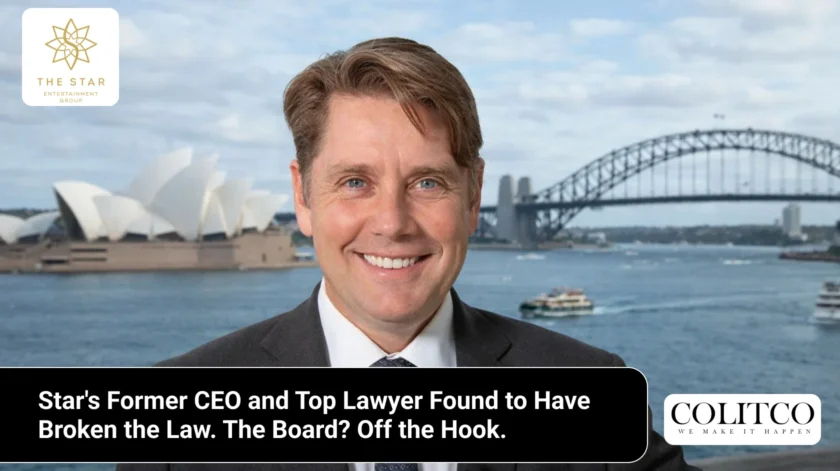
A Federal Court judge has found that Star Entertainment’s former chief executive Matt Bekier and former company secretary and group general counsel Paula Martin breached the Corporations Act – a watershed moment in Australia’s longest-running corporate governance saga.
Justice Michael Lee delivered the long-awaited judgment on 5 March 2026, capping a case that has cast a shadow over Australia’s casino industry for years. As a result that will surprise some, the board members named in the proceedings were not found to have breached their duties – only Bekier and Martin were held liable.
What the Judgment Found
The case, brought by the Australian Securities and Investments Commission (ASIC), centred on conduct at The Star Entertainment Group between 2017 and 2019. At the heart of it: a Chinese money laundering scheme involving Macau junket operator Suncity, and the fraudulent use of China UnionPay (CUP) cards at NAB ATMs inside Star’s casinos.
Martin and Theodore “knowingly permitted misleading statements” to be given to National Australia Bank regarding fraudulent use of the China UnionPay debit card, amounting to $900 million over six years, which was used to disguise gaming transactions as hospitality expenses.
Bekier, as CEO, was found to have known about the UnionPay deception and failed to disclose it to the board. Bekier extended a $50 million credit approval to a high-roller gambler named Qin Sixin within minutes of receiving a request, without seeking further information, despite Star having already filed concerns about Qin’s potential money laundering links with AUSTRAC in the prior month.
The court also found that Bekier and Martin failed to act on persistent red flags from Suncity. The three executives were aware of repeated suspicious conduct by Suncity personnel at the Sydney casino, including wads of cash delivered in a blue Esky and in paper bags to a private gambling room.

The Star Sydney casino, where Suncity’s Salon 95 private gambling room operated between 2018 and 2019. [Wikipedia]
The Board Escapes Liability
In a finding likely to generate debate in legal and corporate governance circles, the court did not find that the board directors had breached their duties. The case against Star Entertainment boiled down to whether the board and executives sufficiently focused on the well-known risks of money laundering and criminal associations in operating its casinos in Sydney and Queensland, and the answer was mixed.
Board members had argued they were not involved in the day-to-day management of operations and that executives had failed to keep them properly informed. For most directors, the court appears to have accepted that argument.
That outcome, however, raises uncomfortable questions. As one analyst noted during the trial: where there is no accountability, there is little incentive to ask hard questions.
How It Got Here
The full picture took years to emerge. Journalists uncovered the conduct in 2021, triggering the NSW Bell Inquiry the following year. Since 2021, Star Entertainment’s share price collapsed from $3.76 to a fraction of that, wiping billions in market value.
The Bell review resulted in mass resignations from The Star board, including former CEO Matt Bekier and former executive chairman John O’Neill, who both stepped down just prior to appearing at the ILGA review.
ASIC launched civil proceedings in December 2022, targeting 11 current and former directors and officers. By the time the trial concluded, some defendants had already settled:
- Former chief casino officer Greg Hawkins agreed to pay $180,000 and accepted an 18-month ban from managing ASX-listed companies after being found to have breached his director’s duties on two counts.
- Former CFO Harry Theodore also reached a settlement with ASIC ahead of the final hearing.
Bekier and Martin contested the proceedings. Today’s ruling settles the question of their liability – with penalties yet to be determined.
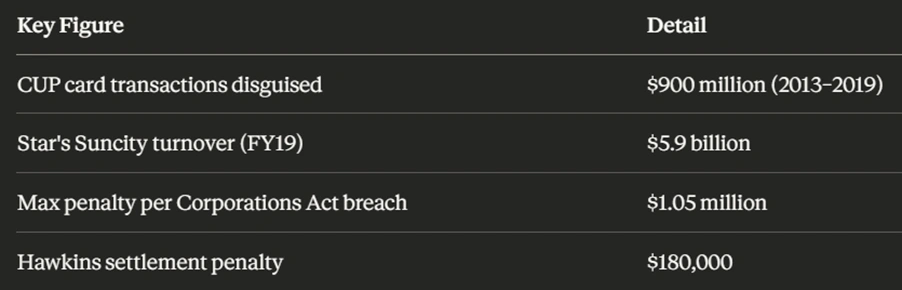
The scale of misconduct alleged, and now partly proven, is striking.
What Comes Next
Penalties for Bekier and Martin are yet to be handed down. Each breach of Section 180 of the Corporations Act carries a maximum civil penalty of $1.05 million per contravention. Disqualification from managing corporations is also on the table.
The judgment arrives as Star Entertainment continues to fight for survival. The company posted a $302 million half-year loss for the six months to December 2024 and has since accepted a rescue deal from American casino operator Bally’s Corporation. Its shares have been suspended from trading since March 3.
Whether today’s ruling will have a lasting effect on how Australian boards govern risk, particularly in industries with known exposure to organised crime, remains to be seen. The Crown Resorts scandal drew similar conclusions. So far, systemic change has been slow.
Also Read: The Lottery Corporation Just Rewired Its Entire Leadership Structure – Here’s What’s Changing
Frequently Asked Questions
Q: What did the Federal Court find against Matt Bekier?
A: Justice Lee found that former Star Entertainment CEO Matt Bekier breached the Corporations Act by failing to act on money laundering risks linked to junket operator Suncity and by failing to disclose the China UnionPay card deception to the board.
Q: Was the Star Entertainment board found liable?
A: No. The court found that the board members named in the ASIC proceedings did not breach their directors’ duties. Only Bekier and Martin were held liable.
Q: What is the China UnionPay money laundering case?
A: From 2013 to 2019, Star Entertainment customers used China UnionPay debit cards at NAB ATMs inside Star’s casinos to fund gambling — a practice prohibited by CUP. Star executives sent misleading letters to NAB claiming the transactions were for hotel expenses. The transactions totalled over $900 million.
Q: What penalties do Bekier and Martin face?
A: Penalties are yet to be determined by the court. Each breach of Section 180 of the Corporations Act carries a maximum civil penalty of $1.05 million. Disqualification orders are also being sought by ASIC.
Q: Who else was penalised in the Star ASIC case?
A: Former chief casino officer Greg Hawkins paid $180,000 and accepted an 18-month ban. Former CFO Harry Theodore also reached a settlement with ASIC before the final hearing concluded.


