
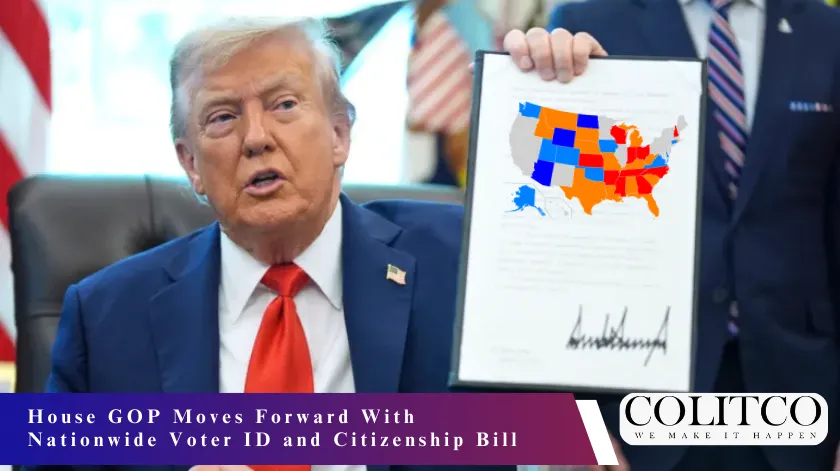
House Republicans have advanced legislation requiring voters in federal elections to present photo identification and proof of U.S. citizenship, setting up a floor vote that is expected to deepen partisan divisions over election law and voter access.
House Leadership Schedules Floor Vote
Republican leaders confirmed plans to bring the voter ID bill to the House floor this week. The proposal centers on creating uniform federal standards for voter identification in federal elections.
The legislation would require voters to present government-issued photo identification. In addition, voters would need to provide documentation proving U.S. citizenship before casting a ballot.
House Majority Leader Steve Scalise posted on X that the bill aims to ensure only American citizens vote in federal elections. His post described the measure as a priority for protecting election integrity.
🚨 BREAKING: @RepChipRoy‘s SAVE America Act is coming to the House floor next week.
Proof of citizenship. Photo ID to vote. Only Americans casting American ballots.
It’s not controversial.@HouseGOP is delivering secure elections.https://t.co/6AvcWYfbj1
— Steve Scalise (@SteveScalise) February 4, 2026
Republican sponsors said the vote reflects campaign commitments to address voter confidence concerns. They argued that national standards would remove inconsistencies among states.
Core Requirements of the Proposed Legislation
The bill mandates photo identification such as driver’s licenses, passports, or military IDs. It also requires proof of citizenship, including birth certificates or naturalization papers.
Under the proposal, states would need to verify citizenship status during voter registration for federal elections. Election officials would be required to reject incomplete documentation.
The legislation would override state-level rules for federal contests. States could maintain separate procedures for local elections if they choose.
Supporters said the measure creates clear expectations for voters nationwide. They described the approach as straightforward and enforceable.
Republican Arguments for Federal Standards
Republican lawmakers said the bill addresses concerns about non-citizen voting. They maintained that clear documentation requirements would strengthen public trust.
In a statement shared on X, a Republican committee account said the proposal protects “the sanctity of the ballot.” The message urged colleagues to support uniform voter ID standards.
🚨 @RepBrandonGill and 34 @RepublicanStudy members are calling on Senator Mitch McConnell to schedule an immediate markup of the SAVE Act.
Only American citizens should vote in American elections. Election integrity is nonnegotiable. PASS THE SAVE ACT NOW. pic.twitter.com/0yMCoHRM3T
— Republican Study Committee (@RepublicanStudy) February 3, 2026
Supporters also argued that federal elections require consistent safeguards. They said varying state requirements can cause confusion during national contests.
Several lawmakers stated that Americans widely support voter ID requirements. They referenced polling that shows strong backing for photo identification at the ballot box.
Democratic Lawmakers Push Back
Democratic members of the House criticized the legislation shortly after it was scheduled for debate. They argued that the bill could make voting harder for eligible citizens.
Some Democrats said many Americans lack ready access to citizenship documents. They cited seniors, students, and low-income residents as potentially affected groups.
House Minority Leader Hakeem Jeffries wrote on X that existing election systems already contain safeguards. His post called the proposal unnecessary and restrictive.
Instead of manufacturing a voting crisis that doesn’t exist.
Solve the affordability crisis crushing the American people.
Thank you for your attention to this matter. pic.twitter.com/eflSca2AwN
— Hakeem Jeffries (@RepJeffries) February 2, 2026
Other Democratic lawmakers warned that federal mandates could override state authority over elections. They said states have historically managed voter registration processes.
Public Debate and Advocacy Group Response
Voting rights organizations issued statements opposing the nationwide voter ID bill. They argued that additional documentation requirements could create administrative burdens.
Several advocacy groups posted messages on X urging constituents to contact lawmakers. They called for preserving voter access while maintaining election security.
Election integrity groups supported the House proposal. They said proof of citizenship requirements are a reasonable safeguard for federal elections.
Public discussion intensified online as the vote approached. Civic leaders encouraged peaceful debate and engagement through formal legislative channels.
Senate Prospects and Legislative Outlook
If the House passes the bill, it will move to the Senate for consideration. Senate Democrats currently control the chamber and have not signaled support.
Some senators suggested that any election reform proposal would require bipartisan negotiation. They emphasized balancing voter access with security measures.
The White House has not issued a formal position on the legislation. Administration officials are expected to review the bill if it clears Congress.
Observers expect the House vote to follow party lines. Attention will then shift to whether the Senate chooses to debate or amend the proposal.
Also Read: Israel’s President Seeks to Reset and Strengthen Ties During Australia Visit
State Election Systems and Administrative Changes
States currently follow different rules regarding voter identification. Some require photo ID, while others allow alternative verification methods.
If enacted, the federal bill would require adjustments in states without proof of citizenship mandates. Election officials would need to update registration systems.
State administrators may also need to revise training materials for poll workers. Public information campaigns would be necessary to inform voters of new requirements.
Lawmakers acknowledged that implementation timelines would depend on final passage and federal guidance. Further legislative steps could determine enforcement procedures.
As debate continues, the House prepares for a decisive vote on the nationwide voter ID bill. The outcome may shape federal election policy discussions in the months ahead.
FAQs
- What is the nationwide voter ID bill proposed by House Republicans?
The bill would require voters in federal elections to present government-issued photo identification and proof of U.S. citizenship before casting a ballot.
- What documents would count as proof of citizenship?
Acceptable documents would include a U.S. birth certificate, passport, or naturalization papers confirming American citizenship.
- Would the bill apply to state and local elections?
The legislation focuses on federal elections. States could maintain separate rules for state and local contests.
- Do all states currently require voter ID?
No. Voter ID laws vary by state. Some require photo identification, while others allow alternative verification methods.
- Why do supporters back the nationwide voter ID requirement?
Supporters say uniform federal standards would prevent non-citizen voting and strengthen public confidence in election integrity.
- Why do opponents oppose the bill?
Opponents argue that additional documentation requirements could make voting more difficult for certain eligible citizens.
- Has Congress attempted nationwide voter ID legislation before?
Yes. Similar proposals have been introduced in previous sessions of Congress but have not become law.
- What happens if the House passes the bill?
If approved in the House, the bill would move to the Senate for debate and consideration before potentially reaching the president’s desk.