

Atlassian reported stronger-than-expected results for the second quarter of fiscal 2026, with revenue and earnings surpassing market forecasts. However, the company’s shares declined following the announcement, as investors reacted cautiously amid broader technology sector weakness and ongoing debate around artificial intelligence spending.
Q2 Earnings and Revenue Surpass Forecasts
Atlassian posted quarterly revenue of about $1.59 billion for the period ended December 31, 2025. That figure represented growth of roughly 23 percent compared with the previous year. Adjusted earnings per share came in at $1.22, exceeding analyst expectations.

Atlassian reported stronger-than-expected Q2 2026 earnings despite a drop in share price after the announcement. [Market Beat]
Cloud revenue exceeded $1 billion for the first time in a single quarter. The company reported cloud growth of approximately 26 percent year over year. Remaining performance obligations also increased, reflecting contracted revenue yet to be recognized.
Management pointed to continued enterprise adoption of its collaboration and productivity tools. The results marked another quarter of expansion across its cloud-based offerings. Despite that performance, investor focus quickly shifted toward forward-looking growth trends.
Stock Decline Follows Broader Tech Weakness
Shares of Atlassian fell in extended trading after the earnings release. The decline occurred even though the company delivered a revenue and profit beat. Market participants appeared concerned about future growth momentum.
The drop also aligned with weakness across the technology sector. Software companies have faced valuation pressure in recent sessions. Investors have reassessed expectations for firms navigating increased artificial intelligence investment.
Over the past year, Atlassian’s share price has experienced volatility. The latest reaction reflects broader uncertainty rather than a single-quarter performance issue. As a result, market sentiment remains cautious toward high-growth software names.
CEO Addresses AI Strategy and Market Concerns
During the earnings call, Atlassian’s leadership addressed artificial intelligence directly. Chief executives stated that AI development remains a positive force for the company’s long-term strategy. They described ongoing investments in AI-powered collaboration tools.

Atlassian highlighted strong adoption of AI-powered tools, which contributed to user growth and engagement.
Executives said their AI platform initiatives are gaining traction among enterprise users. The company referenced growing adoption of AI features integrated into its workflow software. Management maintained that innovation will continue shaping product expansion.
Separately, commentary from the company’s leadership circulated on financial media platforms. Those remarks emphasized confidence in Atlassian’s direction despite near-term market fluctuations. The statements sought to clarify the company’s AI roadmap amid sector-wide debate.
Cloud Momentum Remains Central to Growth
Cloud services continued to drive Atlassian’s overall performance. The milestone of surpassing $1 billion in quarterly cloud revenue marked a key development. Enterprise migration from on-premise systems contributed to that expansion.
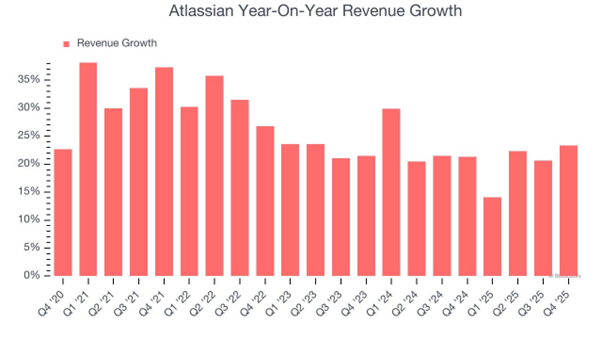
Cloud revenue exceeded $1 billion for the first time, driven by enterprise adoption of subscription-based services. [TradingView]
Atlassian has steadily transitioned customers toward subscription-based cloud products. This strategy aligns with broader trends across enterprise software markets. The recurring revenue model provides greater visibility into future earnings.
Remaining performance obligations rose compared with the prior year. That metric reflects contracted business not yet recorded as revenue. Therefore, management cited it as an indicator of sustained customer demand.
Investor Focus on Future Guidance
Although quarterly results exceeded expectations, investors concentrated on forward guidance. Market participants weighed projected cloud growth rates against elevated industry competition. Concerns about spending efficiency in the AI landscape influenced trading behavior.
Technology stocks have faced renewed scrutiny in recent weeks. Heavy investment in AI infrastructure across the sector has prompted debate about near-term profitability. Consequently, companies reporting earnings have encountered sharp market reactions.
Atlassian reaffirmed its medium-term growth strategy during the earnings discussion. Leadership reiterated commitment to product development and enterprise expansion. However, broader market dynamics continued influencing share performance.
Industry Context Shapes Market Sentiment
The technology sector has experienced volatility as investors reassess valuations. Software firms with exposure to artificial intelligence have drawn heightened attention. Some market participants question how rapidly AI initiatives will translate into revenue.
Atlassian’s results arrived during this period of adjustment. Even companies reporting solid quarterly numbers have seen stock price pressure. As a result, earnings beats have not always translated into positive share movement.
Public discussion across financial platforms included commentary on Atlassian’s performance. Market observers referenced the earnings beat while noting the stock’s decline. Those discussions reflected the broader shift in investor priorities.
Also Read: Binance Rejects Viral Insolvency Letter, Calls Document a Forgery
Outlook and Strategic Direction
Management stated that Atlassian remains focused on long-term operational goals. Continued cloud adoption and AI integration form part of its roadmap. Executives described steady enterprise demand for collaboration tools.
The company indicated that product innovation will remain central to expansion plans. Investment in AI capabilities aims to enhance workflow automation and team productivity. Leadership expressed confidence in maintaining growth momentum.
While the share price reaction drew attention, the underlying financial results showed expansion across major segments. Revenue growth, earnings strength, and rising contracted revenue formed the core of the quarterly update. Market conditions, however, continue to shape investor response across the technology industry.
FAQs
- What were Atlassian’s Q2 2026 financial results?
Atlassian reported revenue of about $1.59 billion for Q2 of fiscal 2026, beating analyst expectations. Adjusted earnings per share were $1.22, topping estimates, and cloud revenue exceeded $1 billion for the first time.
- Why did Atlassian’s stock fall after the earnings report?
Despite the positive financial results, Atlassian’s shares declined in after‑hours trading as investors reacted to concerns about a possible slowdown in cloud revenue growth and broader tech sector volatility.
- How much did Atlassian’s cloud revenue grow?
Cloud revenue grew about 26 % year over year and surpassed $1 billion for the first time in a quarter.
- What future revenue guidance did Atlassian provide?
For the next quarter, Atlassian forecasted revenue between roughly $1.689 billion and $1.697 billion, above market expectations.
- What are Atlassian’s remaining performance obligations?
Remaining performance obligations (future contracted revenue) rose 44 % year over year to about $3.8 billion, signaling strong future demand.
- Did Atlassian mention cloud customer growth?
Yes. Atlassian reported growth in its base of customers with cloud annualized recurring revenue over $10,000, indicating expanding enterprise adoption.
- What is the significance of Atlassian’s cloud milestone?
Crossing $1 billion in quarterly cloud revenue is a key milestone reflecting long‑term cloud demand and subscription growth.
- Were there any product adoption highlights reported?
Atlassian noted strong usage of its AI‑related tools, including Rovo, which had millions of monthly active users and contributed to customer expansion.


