
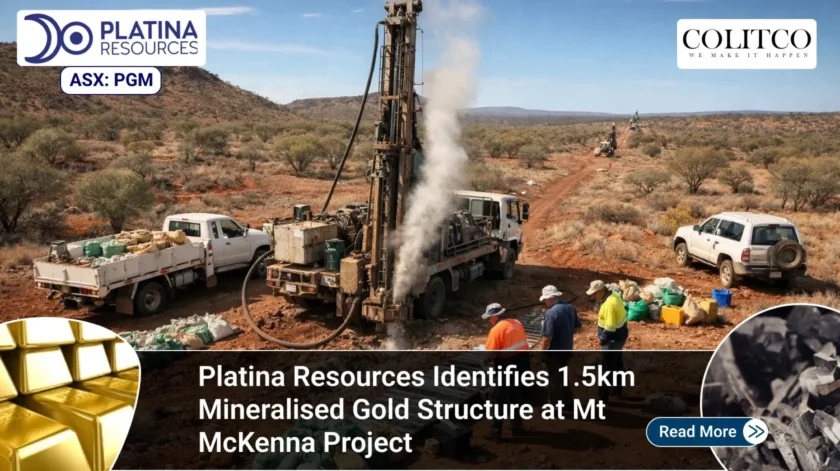
Platina Resources Limited (ASX: PGM) has identified multiple new gold targets from its maiden aircore drilling programme at the Mt McKenna Gold Project in Western Australia. The Company intersected a coherent 1.5 kilometre mineralised structure, with the majority of aircore holes along strike ending in gold mineralisation.
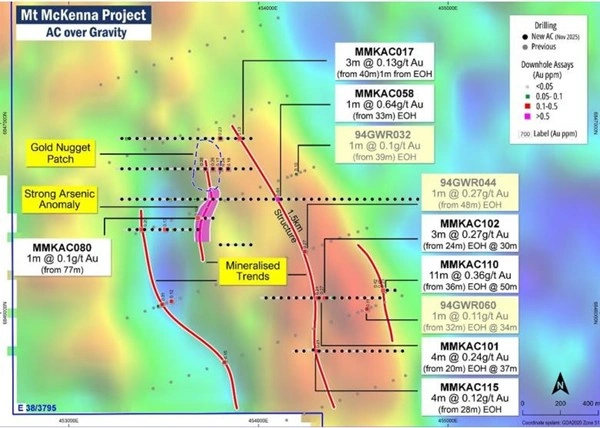
Figure 1: Map showing mineralised trends including the 1.5km mineralised structure identified from November 2025 aircore drilling at the Mt McKenna Gold Project, underlain by 2025 ground gravity data. [Platina Resources]
The Phase 1 programme was designed to delineate gold mineralisation concealed beneath transported cover. A total of 126 aircore holes for 6,056 metres were drilled across the northern portion of the Target 2 area.
Drilling Results Define 1.5km Mineralised Structure
The drilling defined multiple mineralised trends at the Mt McKenna Gold Project. The standout result is a coherent 1.5-kilometre mineralised structure where most aircore holes along strike ended in gold mineralisation.
Key intersections defining the 1.5km structure include:
- 1 metre @ 0.64 g/t Au from 33 metres (EOH in MMKAC058)
- 4 metres @ 0.24 g/t Au from 20 metres (EOH at 37 metres in MMKAC101)
- 3 metres @ 0.27 g/t Au from 24 metres (EOH at 30 metres in MMKAC102)
- 4 metres @ 0.12 g/t Au from 28 metres (EOH in MMKAC115)
- 3 metres @ 0.13 g/t Au from 40 metres (EOH at 41 metres in MMKAC017)
Additional anomalous intercepts included:
- 11 metres @ 0.36 g/t Au from 36 metres (EOH at 50 metres in MMKAC110)
- 4 metres @ 0.20 g/t Au from 32 metres (MMKAC072)
Strong Arsenic Anomaly Signals Potential Gold Zone
A second continuous structure of 250 metres strike length was intersected across four holes. This zone shows elevated arsenic concentrations up to 1,750 parts per million.
The strong arsenic anomaly is coincident with anomalous gold values at the end of MMKAC080. This zone lies immediately south of a known area hosting gold nuggets and remains completely open to the south.
Managing Director Comments on Systematic Approach
Platina Managing Director, Corey Nolan, commented on the results:
“The integration of geological mapping, surface sampling, magnetics, gravity and aircore drilling has proven effective in identifying gold-bearing structures at Mt McKenna. This systematic approach will continue across the remaining 20-kilometre strike of the tenement.”

Figure 2: Platina Resources Managing Director, Corey Nolan [Platina Resources]
He added: “This exploration approach is consistent with methods used to define other gold orebodies in the Laverton region, where surface expressions are commonly depleted.”
Building on Earlier Exploration Milestones
The latest drilling results represent the execution phase of Platina’s exploration strategy outlined in earlier announcements.
In November 2025, the Company completed geological mapping across Target 2 and a ground gravity survey covering almost one-third of the tenement in the north. These programmes outlined and differentiated key geological structures as well as rock types.

Figure 3: Location map of the Mt McKenna Gold Project near Laverton, Western Australia, showing aircore drilling areas, gold targets, and interpreted structures over GSWA magnetic imagery and recent gravity data. [Platina Resources]
The gravity data proved effective in geological mapping, structural architecture and target generation over the Project area. The Company also completed a cultural heritage area survey over Target 2 and received Programme of Works approval from the Department of Mines, Petroleum and Exploration to carry out aircore drilling.
In December 2025, Platina completed the Phase 1 drilling programme comprising 6,056 metres across 126 aircore holes by two rigs at the northern section of the Target 2 area. Assays were expected in January 2026. The Company also received US$1 million from the second tranche of a placement, completing a total capital raise of approximately A$2.15 million at A$0.03 per share to fund exploration activities at Mt McKenna.
Strategic Location in World-Class Laverton Gold District
The Mt McKenna Gold Project is located approximately 13 kilometres east of the town of Laverton in the Eastern Goldfields of Western Australia. The Project sits within the world- class Laverton gold district.
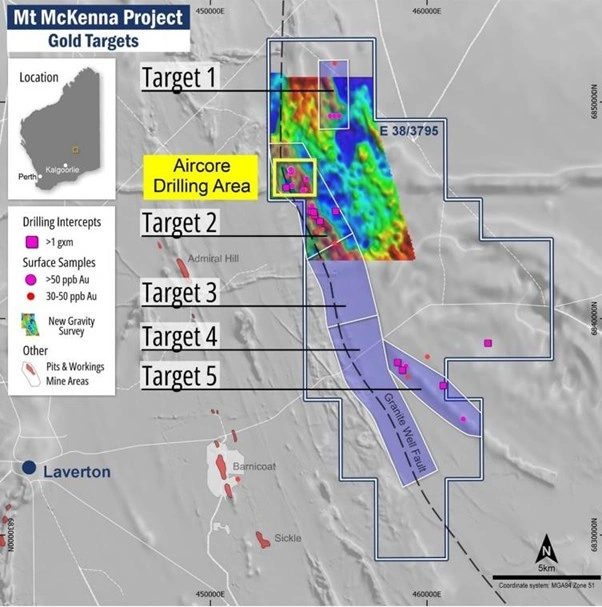
Figure 4: Gravity survey image of the Mt McKenna Project area highlighting interpreted faults, historical surface sampling, and target zones associated with gold mineralisation. [Platina Resources]
The region is in close proximity to several significant mines, including Genesis Minerals’ Laverton Project and Gold Fields’ Granny Smith Gold Mine. The Laverton gold district has demonstrated its capacity to host multi-million-ounce deposits.
In December 2025, Platina significantly expanded its landholding in Western Australia’s Laverton mineral district to more than 312 square kilometres after acquiring a 100 per cent interest in the Mt Morgans South Gold Project from Genesis Minerals Limited.
Geological Observations Support Mineralisation Model
The drilling intersected Laverton greenstone lithologies as expected in the Archean sequence of the Yilgarn craton. Basalts, High-Mg Basalts, Dolerites, Ultramafics, Komatiites, Talc- Carbonate Ultramafics, Quartz-Feldspar Dykes, Granites, Granodiorites and some Andesites were logged in drilling.
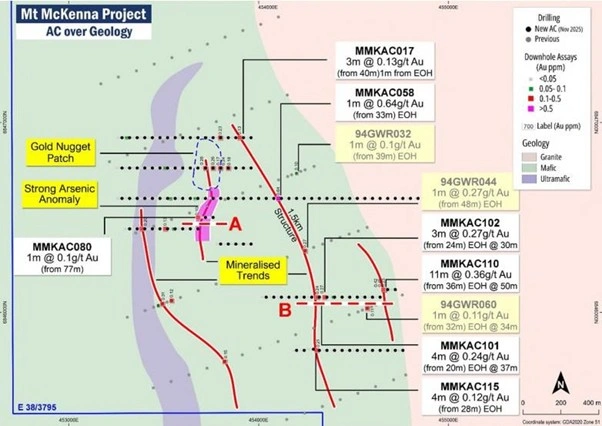
Figure 5: Interpreted geology map of the Mt McKenna Project displaying aircore drill locations, assay results, and identified mineralised trends. [Platina Resources]
Rocks are strongly weathered down to 40 metres with shallow transported cover from near the surface to 15 metres deep. Most holes ended in the top of fresh rock at varying depths.
Multiple zones of varying quartz veining have been logged along with minor amounts of sericite, chlorite and epidote alteration. Strong talc and carbonate alteration is noted in the Ultramafic schists, where holes were drilled down past 100 metres.
Varying levels of disseminated and blebby pyrite have been logged across the drilling. Hole MMKAC080, which has the strongest intersections of arsenic values up to 1,750 parts per million, is associated with laminated quartz veins up to 70 per cent.
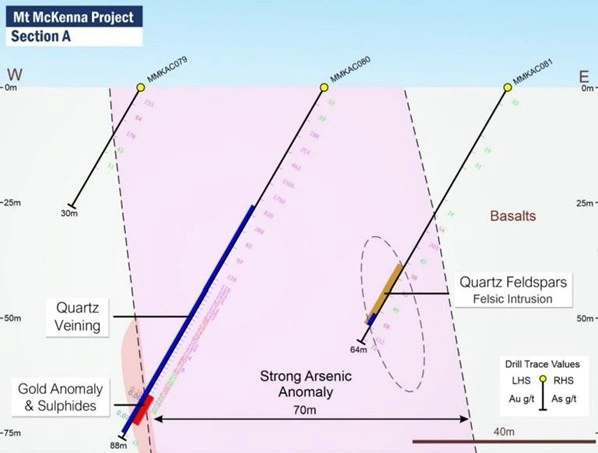
Figure 6: Cross-section showing aircore drill holes intersecting a continuous arsenic anomaly with associated anomalous gold values at the Mt McKenna Project. [Platina Resources]
Holes MMKAC049, MMKAC079-081 all have strong values of arsenic and define a zone of more than 250 metres along strike and up to 70 metres in width.
Next Steps: Deeper Drilling and Expanded Targets
The Company now plans to test these structures at depth using Reverse Circulation drilling. Work is underway on chemical analysis of rock samples from Target 2 to refine the geological model and identify the most promising zones.
Platina will focus first on drilling deeper into the mineralised corridor using either standard RC rigs or slimline RC equipment. This programme will test whether the arsenic-rich zone extends further south or continues down-dip.
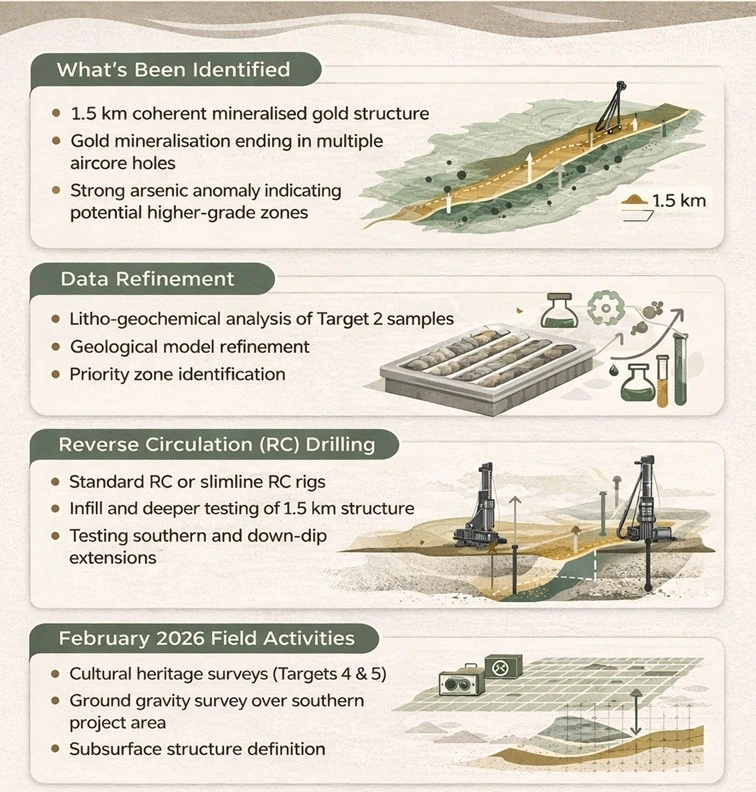
Figure 7: Summary infographic outlining Platina Resources’ planned next drilling steps at the Mt McKenna Gold Project
Meanwhile, heritage surveys will begin in February across Targets 4 and 5 in the southern part of the tenement. A gravity survey will run at the same time, helping to map buried structures that could host gold. Once new targets emerge, the Company plans to drill them all in a single, coordinated RC campaign. This approach will test multiple prospects more efficiently than drilling targets individually.
Global Gold Market Fundamentals Support Exploration
The global precious metal market demonstrates strong fundamentals that support gold exploration activities. The global precious metal market size was estimated at US$513,315.7 million in 2024 and is projected to reach US$865,324.6 million by 2030.
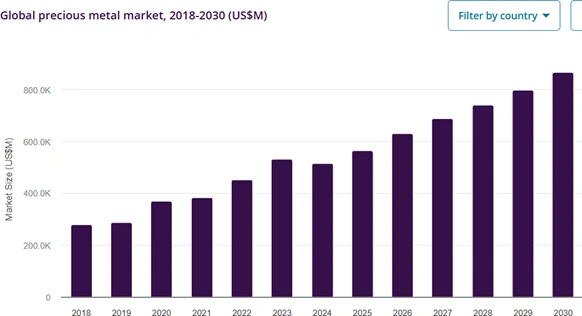
Figure 8: Global precious metals market size outlook from 2018 to 2030, illustrating projected growth in market value. [Grand View Research]
This represents a compound annual growth rate of 8.9 per cent from 2025 to 2030. North America accounted for 28.3 per cent of the global precious metal market in 2024.
Gold Price Performance:
- Current price: US$4,668.19 per ounce
- Today’s change: +US$71.85 (+1.56%)
- 30-day performance: +US$162.04 (+3.65%)
- 6-month performance: +US$1,204.11 (+35.50%)
- 1-year performance: +US$1,852.79 (+67.53%)

Figure 9: One-year gold price performance in US dollars per ounce through January 2026. [GoldPrice.org]
Share Price and Market Capitalisation
Platina Resources Limited (ASX: PGM) continues to generate interest as an emerging gold explorer in Western Australia’s strategic Laverton district.
Share price activity (as of 20 January 2026):
- Last price: $0.038 per share
- 52-week range: $0.018 to $0.045 per share
- Market capitalisation: $24.50 million
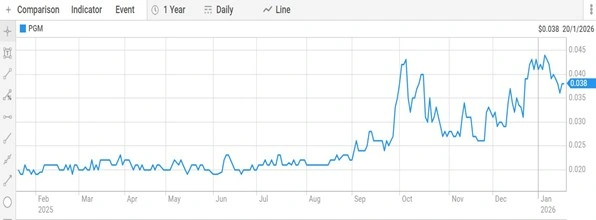
Figure 10: One-year share price performance of Platina Resources (ASX: PGM) through January 2026. [ASX]
Investor’s Outlook
The Company’s systematic approach to exploration at the Mt McKenna Gold Project, combined with the jurisdiction’s proven track record for hosting major gold deposits, supports further exploration work as drilling results are received.
The Company’s next catalysts include deeper RC drilling results from the 1.5 kilometre mineralised structure, assay results from expanded aircore drilling across Targets 4 and 5, and potential expansion of the exploration footprint across the broader 20 kilometre anomalous gold corridor.
With mineralisation confirmed along a coherent 1.5-kilometre structure and strong arsenic anomalies indicating potential for higher-grade zones, Platina Resources is building a compelling exploration story in an increasingly recognised Australian gold district.


