
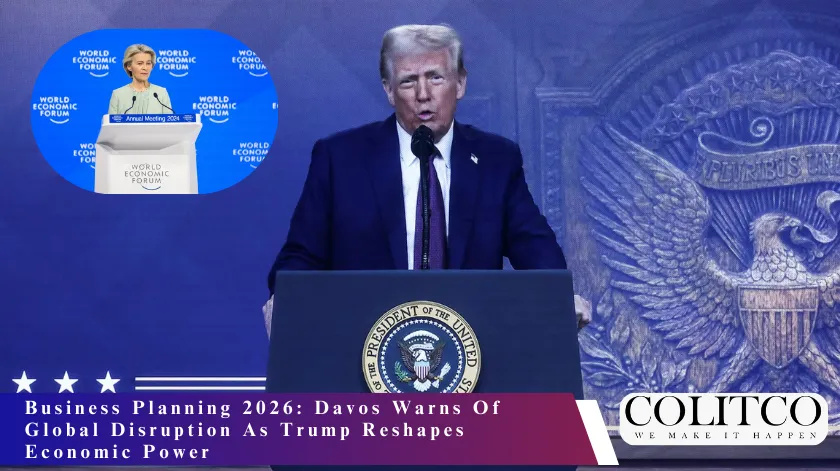
Davos was the place where global leaders and high-ranking officials met, as the world’s political tensions influenced the business climate and strategic planning in every corner of the planet.
The World Economic Forum became a hotspot for global economic issues when Donald Trump was about to speak to the biggest audience in the history of the event. His assertions of expansion and tariff threats drew back doubt across the continents of Europe and North America.
Business planning 2026 has now to deal with the consequences of trade policies, alliances that are not too strong, and leaders whose behaviour is hard to predict for the companies and their long-term expansion strategies, ready for investment in different areas.
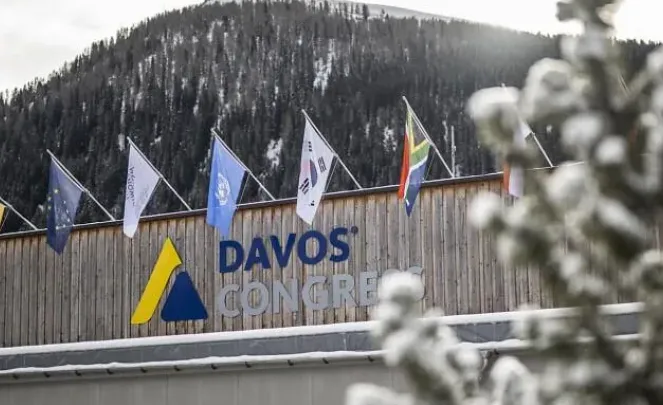
Davos gathered leaders as political tensions shaped business. [Business Report]
Why Is Business Planning 2026 Under Global Pressure?
The discussions were mainly about him, and the executives were taking a trip down memory lane to his last appearance at Davos when he urged the American manufacturers to either move their plants overseas or accept the tariffs.
He promised trillions of dollars from tariffs and still kept a provocative attitude toward the trade partners. The Europeans admitted that such a policy could lead to economic coercion, and the risks of trade might escalate.
Emerging from the situation, international business plans are becoming more complicated, especially for those firms that are operating in different markets and are trying to find the right balance between the risks of regulatory exposure, supply chain resilience, and political uncertainty.
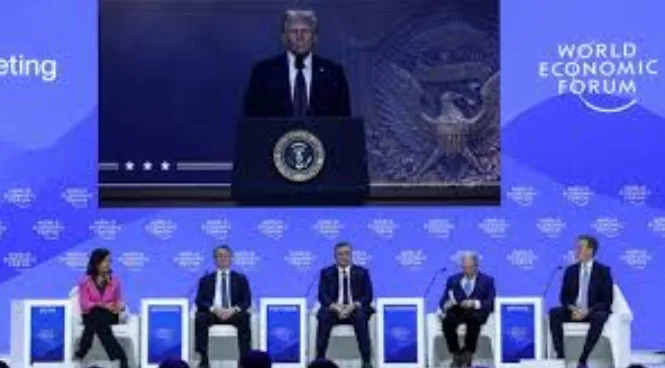
Executives weigh trade risks and policy volatility as Business Planning 2026 adapts to uncertain global conditions. [USA Today]
The Great Global Disruption Shapes Corporate Strategy
The World Economic Forum (WEF) organisers pointed out that geopolitical fragmentation, along with the issues of climate, technology, and borders, are the factors that are going to affect long-term investments.
The European delegates were already under the pressure of post-pandemic recovery when Trump’s Greenland dream further unsettled them. The global companies are now reevaluating their capital allocation, geopolitical exposure and compliance frameworks.
These changes will also be a source of Business risk insights for boardrooms that are trying to find stability in the midst of increasing regulatory intervention and changing trade alignments, which are affecting global manufacturing and energy supply chains.
How Do Leaders View Economic Power Shifts?
The forum was graced by more than 65 heads of state, 850 top executives, and many technology leaders. The President of Ukraine, Volodymyr Zelensky, was present along with the leaders of the G7 and high-ranking Chinese officials.
China took a position of a peacemaker, drawing attention to its status as the world’s second-largest economy and the largest car exporter. The delegates discerned that the rising multipolar competition was changing global economic news stories and was influencing the investment strategies of different countries.
Davos welcomed global leaders, executives, and technology pioneers. [Economic Times]
Davos Highlights Trade And Technology Rivalries
Davos discussions of the past have been predicting breakthroughs in artificial intelligence and quantum computing, indicating the speeding up of innovation cycles. It was last year when the Chinese battery technology went ahead of the Western manufacturers, thereby revealing the competitive fissures in the automotive markets.
The companies have to take these lessons as a reason and necessity to incorporate technology acceleration into Business planning for 2026. Thus, research investment, digital transformation, and operational agility must be the companies’ priorities to stay competitive in the rapidly changing markets.
Can Multilateral Cooperation Survive Political Tensions?
Davos supports dialogue and cooperation, but political rhetoric is increasingly difficult for multilateral institutions. The United States’ insistence on minimising climate agendas in favour of business priorities revealed the change in diplomatic priorities.
The leaders of Europe are still very careful in their approach to security implications arising from the disputes over territory. Business risk assessments are increasingly highlighting the unpredictability of regulators, changing of policies in trade, and the exposure to loss of reputation as the main threats to the operations of multinational corporations.

The US prioritised business over climate, signalling a diplomatic shift. [Trends Research & Advisory]
Strategic Lessons For Business Planning 2026
The executives are well aware that the uncertainty will last longer than the political cycles. They are focusing on the diversification of the supply chain, setting up manufacturing hubs in different regions, and increasing geopolitical monitoring as their top priorities.
The financial leaders are talking about the need for scenario planning to deal with the volatility of tariffs and fluctuations in currencies. The business planning for 2026 is now requiring a much closer alignment between operational resilience, regulatory intelligence, and emerging market opportunities that are shaping the world’s sustainable growth trajectories.
Also Read: Sendle Shutdown Shocks Small Businesses, Triggers Delivery Disruptions
FAQs
Q1: What is driving uncertainty in Business Planning 2026?
A1: Trade tensions, geopolitical disputes, regulatory shifts, and technology disruption continue to reshape global corporate strategies.
Q2: Why is Davos important for global economic news?
A2: Davos gathers global leaders and executives, offering insight into economic trends, investment sentiment, and policy direction.
Q3: How does Trump’s agenda affect business confidence?
A3: Tariff threats, territorial ambitions, and policy unpredictability increase risk exposure for multinational companies.
Q4: What are the key Business risk insights for companies?
A4: Firms should strengthen supply chains, diversify markets, enhance compliance readiness, and invest in innovation.


