
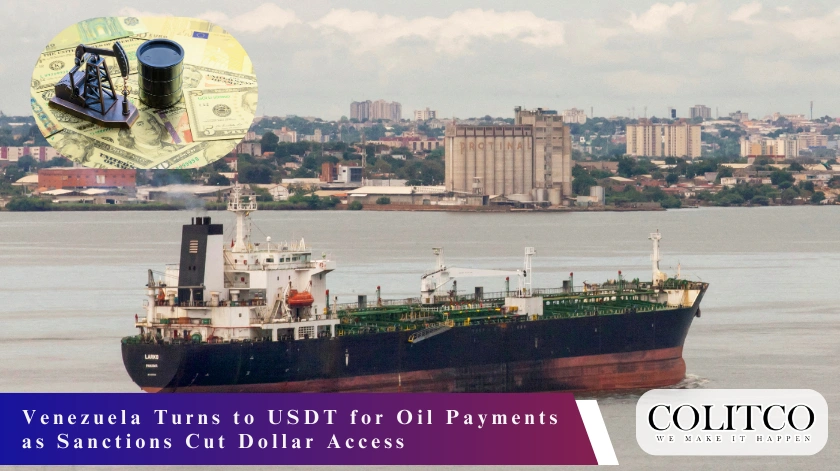
Venezuela’s state oil company, Petróleos de Venezuela SA (PDVSA), turned to the US dollar-pegged stablecoin USDT to settle crude exports after United States sanctions cut off its access to the global banking system, according to a new Wall Street Journal investigation.
The report said that from 2020 onwards, PDVSA required foreign oil buyers to hold cryptocurrency wallets and make payments in USDT, either directly or through intermediaries that converted cash into stablecoins, according to CryptoBreakNews on X.
Exploring Tether’s USDT Impact in Venezuela and Iran Reveals Stablecoin Duality
Recent geopolitical and economic crises in Venezuela and Iran have reignited debate over the dual roles of stablecoins, especially those backed by the US dollar, such as T…https://t.co/mSwAjSuGn5
— Crypto Breaking News (@CryptoBreakNews) January 12, 2026
This shift allowed Venezuela to bypass the SWIFT banking network, avoid payment seizures, and continue selling oil despite being locked out of dollar-clearing systems.
By late 2025, nearly 80 percent of Venezuela’s oil revenue was being settled through stablecoins, with USDT forming the backbone of those transactions, according to figures cited in the report.
Why USDT Replaced the Dollar
The United States has imposed sanctions on Venezuelan officials and state entities since 2005, with major restrictions introduced after 2017 targeting the Maduro government and PDVSA over alleged corruption, human rights abuses, and anti-democratic practices.
Those measures effectively blocked Venezuela from accessing international dollar settlement networks, freezing assets and cutting off correspondent banking relationships.
USDT filled the gap because it mirrors the US dollar while operating outside the regulated banking system. PDVSA could receive digital dollars in minutes rather than weeks, avoid bank compliance blocks, and store value in wallets that were harder to seize than traditional accounts.
According to the WSJ, PDVSA set up wallet systems for intermediaries and oil traders, allowing crude buyers to send USDT directly to addresses linked to the Venezuelan oil industry or to third parties who converted fiat proceeds into stablecoins.
Stablecoins Become Venezuela’s Parallel Currency
The same conditions that drove PDVSA to stablecoins also reshaped Venezuela’s domestic economy.
Years of hyperinflation have almost completely destroyed the bolivar, which has lost nearly all its value over the past decade. In response, Venezuelans turned to USDT as a store of value, a unit of account, and a medium of exchange.

Coltico reports Venezuelans increasingly use USDT for groceries, rent, and cross-border remittances amid hyperinflation. (Source: Reuters)
The WSJ reported that USDT is now widely used for grocery purchases, rent payments, professional services, and cross-border remittances. Estimates cited in the report suggest that by late 2025, around 10 percent of grocery transactions in the country will be settled in stablecoins.
Unlike Venezuela’s failed Petro token, which was launched in 2018 as a government-backed cryptocurrency, USDT carried global liquidity and trust because it was tied to the US dollar and accepted by international exchanges.
This made USDT a practical currency substitute rather than a political project.
Tether Responds With Compliance Warning
Following the publication of the WSJ report, Tether, the issuer of USDT, released a statement stressing that it operates under strict international sanctions and anti-money-laundering rules.
Tether said it cooperates closely with the US Treasury’s Office of Foreign Assets Control and has the technical ability to freeze wallet addresses linked to sanctioned entities or illegal activity.
The company confirmed that dozens of wallet addresses connected to Venezuelan oil trading and suspected money laundering have already been blacklisted.
While USDT moves on decentralised blockchains, Tether remains a centralised issuer that controls the ability to redeem and freeze tokens, making compliance enforcement possible even in crypto-based oil trade.
Oil Revenues Under Global Scrutiny
The Venezuelan case has attracted renewed attention following the arrest of President Nicolás Maduro in the United States on narcotrafficking charges. His detention has increased scrutiny over how Venezuelan state funds move through global financial systems.
Crypto intelligence firm Inca Digital said stablecoin use in Venezuela is likely to continue regardless of political developments, because inflation, capital controls, and weak institutions still drive demand for dollar-linked digital assets.
However, the same conditions that make USDT attractive to civilians also make it a tool for sanctions evasion, forcing regulators and stablecoin issuers into closer oversight.
Claims of a 600000 Bitcoin Reserve
Separate reports have also raised claims that Venezuela may hold as much as 600000 Bitcoin, allegedly accumulated through gold swaps and oil settlements between 2018 and 2025.
Based on current prices, such a stash would be worth more than 55 billion dollars, placing Venezuela among the largest Bitcoin holders globally. However, there is no independent verification of these claims, and no on-chain evidence has been publicly confirmed.
Analysts believe that any crypto holdings linked to PDVSA or the Maduro government would face heightened monitoring as international enforcement agencies tighten surveillance of blockchain-based commodity payments.
What It Means for Global Crypto Markets
Venezuela’s use of USDT for oil trading represents one of the clearest examples of stablecoins being used at a state-level scale to settle commodity flows outside the traditional financial system.
For global markets, it underscores how stablecoins have evolved into digital dollars that can function in both consumer economies and sovereign trade, even under sanctions.
At the same time, Tether’s enforcement actions highlight the limits of that freedom. Wallet freezing, blacklisting, and regulatory cooperation mean stablecoins are no longer neutral instruments but part of a global compliance framework.
As governments expand crypto regulations in 2026, the Venezuelan case is expected to shape how stablecoins are treated in energy markets, sanctions policy, and financial surveillance.
Also Read: Aristocrat Lands A$190 Million Win as Light & Wonder Bows Out of IP Dispute
Final Thoughts
The WSJ investigation shows that USDT has become a critical financial artery for Venezuela, supporting both its oil exports and its civilian economy. What began as a workaround for banking restrictions has evolved into a parallel monetary system built on stablecoins.
However, with Tether enforcing sanctions and global regulators watching closely, the future of crypto-based oil trade will depend not only on technology, but on geopolitics and compliance.
For now, Venezuela remains the most prominent example of how digital dollars can keep a sanctioned economy running when the traditional system shuts down.


