
Macquarie Securities (Australia) Limited has admitted to misleading conduct spanning more than 14 years after failing to correctly report millions of short sales to market operators. The Macquarie Securities unit will ask the NSW Supreme Court to impose a $35 million penalty to ASIC in what marks the regulator’s first short-sale reporting case.
The announcement caps off a tumultuous year for Macquarie Group, which now faces its fourth major regulatory action in just 12 months.
Staggering Scale of Misreporting Revealed
According to a statement of agreed facts filed with the NSW Supreme Court, Macquarie Securities admitted it failed to correctly report at least 73 million short sales between 11 December 2009 and 14 February 2024.
The actual figure could be far higher. ASIC estimates the misreporting of up to 1.5 billion short sales occurred during this period due to multiple systems-related failures that remained undetected for over a decade.
The inaccurate reporting affected at least 321 unique securities listed on the ASX and Cboe markets. For each impacted security, Macquarie’s misreporting inflated or deflated the published volume of short sales by an average of approximately 12 per cent. Some instances saw errors exceeding 50 per cent.
Multiple System Failures Went Undetected for Years
ASIC’s investigation revealed eight separate technical issues within Macquarie’s reporting systems. Many of these failures persisted for more than ten years before being identified.
The problems included:
- Duplicate “dummy fills” being counted as actual covered short sales
- Trade references being truncated, causing 53 million short sales to be misreported between December 2020 and October 2022
- Short sale reports failing to include trades completed after 5:00 PM
- Incorrect automatic adjustment processes in the IT portal
Macquarie had conducted a review of its short sale reporting processes in 2020, following weaknesses identified in 2015 and 2019. That review clearly failed to identify or resolve the systemic issues now exposed by ASIC.
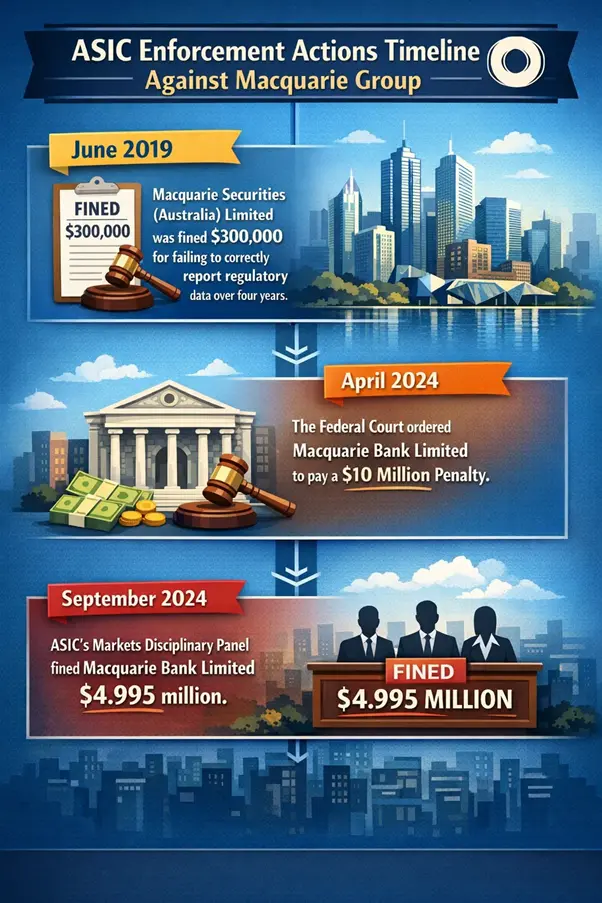
Timeline of ASIC enforcement actions against Macquarie Group entities
ASIC Chair’s Pointed Criticism
ASIC Chair Joe Longo did not mince words when addressing Macquarie’s failures.
“Accurate and reliable data underpins confidence in our financial markets,” Longo said. “ASIC and the market rely on short sale and regulatory reporting data – especially during periods of volatility – to understand market activity and make informed decisions.”
He added that without accurate data, market transparency is fundamentally undermined.
Longo’s comments referenced the company’s ongoing compliance problems: “Our actions reflect the ongoing and deep concerns we have with Macquarie Group and its weak remediation of long-standing issues.”
Why Short Sale Reporting Matters
Short sale reporting obligations were introduced in Australia in 2009, following the Global Financial Crisis. The requirements serve several critical functions:
Market Transparency: Short sale data informs investors, governments, regulators and financial market participants about market sentiment and potential risks.
Risk Detection: Aggregated short position data helps identify unusual trading patterns and potential market manipulation.
Investor Protection: Public disclosure enables investors to make informed decisions based on complete market information.
Market participants are required to report covered short sales to their executing broker, who then reports aggregate volumes to market operators like ASX or Cboe by 9am the following trading day. This data is then published in aggregated form for public access.
A Troubling Pattern of Compliance Failures
This latest penalty comes amid a disturbing pattern of regulatory breaches by Macquarie Group entities. The financial services giant has faced a series of enforcement actions:
September 2024: ASIC’s Markets Disciplinary Panel imposed a record $4.995 million fine on Macquarie Bank for failing to prevent suspicious orders in the electricity futures market. The bank allowed three clients to place 50 suspicious orders between January and September 2022, each displaying characteristics of attempts to “mark the close” and manipulate daily settlement prices.
May 2025: ASIC imposed additional licence conditions on Macquarie Bank following more than 10 years of compliance failures in its futures dealing business and over-the-counter derivatives trade reporting. The bank was required to prepare comprehensive remediation plans and appoint independent experts to review its systems.
April 2024: The Federal Court ordered Macquarie Bank to pay $10 million for failing to have effective controls to prevent unauthorised fee transactions on customer cash management accounts.
The pattern reveals systemic weaknesses in governance, compliance oversight and risk management across Macquarie’s operations.
This regulatory scrutiny mirrors broader enforcement trends as ASIC intensifies its crackdown on major financial institutions.
Admitted Breaches and Legal Consequences
In its agreed statement of facts, Macquarie Securities has admitted to multiple contraventions of the Corporations Act 2001 and ASIC Market Integrity Rules, including:
- Failing to have appropriate supervisory policies and procedures
- Failing to maintain necessary organisational and technical resources
- Failing to have adequate risk management systems
- Engaging in misleading or deceptive conduct related to financial products
The company also admitted to incorrectly reporting regulatory data for 633,680 orders submitted to the market operator between 16 November 2022 and 21 March 2023.
Beyond the $35 million penalty, ASIC is seeking court orders requiring Macquarie to undergo independent review and assurance of its regulatory reporting systems, controls and supervisory procedures.
Market Context and Broader Implications
The penalty against Macquarie Securities comes as Australian regulators are taking an increasingly hard line on compliance failures by major financial institutions.
Earlier this year, Cbus superannuation fund agreed to pay $23.5 million for systemic failures in insurance claims handling, while ANZ faces a proposed $240 million penalty for widespread misconduct.
For Macquarie Group, which recorded a net profit of $3.715 billion in its 2025 annual report, the $35 million penalty represents a material but manageable financial hit. The reputational damage and ongoing compliance costs may prove more significant.
The company’s shares were trading at $229.35 on the ASX as of 20 December 2025, with investors digesting the implications of yet another regulatory action.
What Happens Next
The proposed $35 million penalty and associated court orders now await consideration and approval by the NSW Supreme Court. While Macquarie Securities and ASIC have reached an agreement, the court is not bound to accept the proposed penalty.
Court proceedings of this nature typically take several months to resolve. The court will consider factors including the severity of the breaches, the company’s cooperation with the investigation, and the need for general deterrence when determining the final penalty amount.
Macquarie has stated publicly that it “seeks to uphold the highest standards” and is committed to implementing necessary improvements to its systems and controls. However, the pattern of repeated failures across multiple business units suggests significant cultural and governance challenges remain.

Industry-Wide Wake-Up Call
The case serves as a stark reminder to all market participants that regulatory reporting obligations must be taken seriously. ASIC Commissioner Simone Constant emphasised that market participants must ensure their systems, controls and governance arrangements are robust and fit for purpose.
The regulator’s message is clear: systemic failures that undermine market integrity will face significant consequences, regardless of the institution’s size or market position.
For investors and market participants, the Macquarie case highlights the critical importance of accurate short sale data in maintaining transparent, well-functioning markets. As global market volatility continues, the need for reliable data becomes even more pressing.
Also Read: St George Mining Delivers Thickest-Ever Drill Result at Araxá, Redefining Resource Scale
FAQs
Q: What is short selling?
A: Short selling is the practice of selling a financial product that the seller does not currently own, with the intention of repurchasing it later at a lower price to profit from the decline.
Q: How did Macquarie’s misreporting affect the market?
A: The misreporting inflated or deflated published short sale volumes by an average of 12%, with some instances exceeding 50%. This prevented investors, regulators and market participants from accurately assessing market sentiment and potential risks.
Q: Is this the largest penalty ASIC has sought against Macquarie?
A: No. ANZ currently faces a proposed $240 million penalty, the largest ever sought by ASIC against a single entity. However, the $35 million fine against Macquarie Securities is substantial and reflects the 14-year duration of the breaches.
Q: What other penalties has Macquarie Group faced recently?
A: Macquarie has faced four major regulatory actions in 12 months, including a record $4.995 million fine for electricity futures market failures and a $10 million penalty for unauthorised fee transactions on customer accounts.
Q: When will the penalty be finalised?
A: The NSW Supreme Court must consider and approve the proposed $35 million penalty and associated orders. The timeline for court approval typically spans several months.


