

Rio Tinto and its joint venture partners have approved a $191 million, multi-year feasibility study to advance early development of the Rhodes Ridge iron ore project in Western Australia, positioning the globally ranked deposit for potential first production by the end of the decade.
Study Approval Marks Major Step Forward
The Rhodes Ridge Joint Venture confirmed the approval of the feasibility study to assess phase one development of the long-awaited Pilbara project.
The study will examine plans for an operation producing between 40 and 50 million tonnes annually during its initial stage.
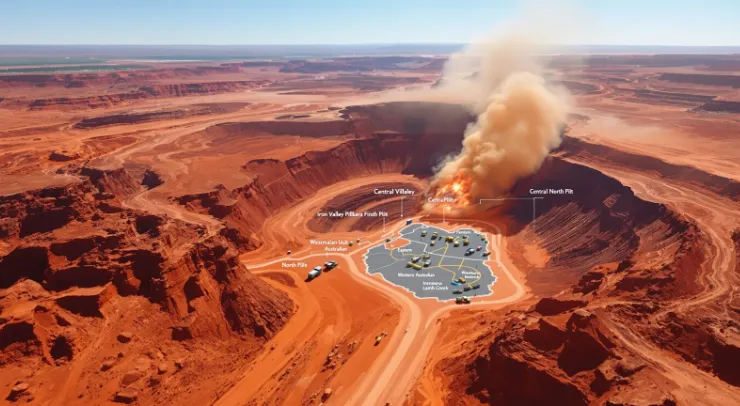
The work will run through 2029 and focus on technical design, infrastructure integration, and staged mine planning.
Rio Tinto will contribute $96 million toward the study, reflecting its 50 per cent ownership of the venture.
Partners Commit Additional Exploration Funding
Alongside the feasibility program, the joint venture will allocate $146 million for regional exploration between 2026 and 2028.
The spending aims to refine resource understanding and support later development phases.

The venture partners include Rio Tinto with 50 per cent, Mitsui & Co with 40 per cent, and AMB Holdings with 10 per cent.
Mitsui holds its interest through SPC Blue Pty Ltd, while AMB’s stake is managed via a Wright Prospecting subsidiary.
Production Scale and Long-Term Capacity
The feasibility study will evaluate infrastructure capable of supporting large-scale output from the outset.
Initial production targets place the project among the largest new iron ore developments globally.
Iron ore stockpiles at a Pilbara export terminal supplying global steel markets
Rhodes Ridge has an estimated resource of about 6.8 billion tonnes of high-grade ore.
At full build-out, the mine could support production of roughly 100 million tonnes per year.
Rio Tinto has stated that the project supports its goal of sustaining Pilbara exports between 345 and 360 million tonnes annually.
The Company expects the first ore from phase one by 2030, subject to regulatory approvals.
Use of Existing Pilbara Infrastructure
The project will be developed in stages, beginning with a northern hub.
That location allows access to Rio Tinto’s established rail, port, and power networks.
Using existing infrastructure reduces construction complexity and shortens development timelines.
It also supports lower surface disturbance during early project stages.

In a social media post following the announcement, Rio Tinto noted progress toward securing long-term supply continuity in the Pilbara.
The Company said coordinated planning across its asset base remains central to its regional strategy.
Engagement With Traditional Owners
The joint venture confirmed ongoing collaboration with the Nyiyaparli Traditional Owners.
Engagement will follow the framework set under an updated Native Title agreement.
Project planning includes measures to protect cultural heritage and manage environmental responsibilities.
Design choices aim to reduce land disturbance and limit long-term closure requirements.
Rio Tinto’s iron ore chief executive, Matthew Holcz, stated the deposit’s quality supports long-term operational planning.
His remarks were shared through Company communications during the project update.
Strategic Context for Rio Tinto
Rhodes Ridge is expected to support Rio Tinto’s Pilbara operations for decades.
The project follows recent investments in replacement mines and expansions across the region.
Earlier this year, Mitsui acquired its 40 per cent interest for $8.4 billion.
The transaction involved staged purchases from the Wright and Bennett family interests.
Rio Tinto continues parallel development at West Angelas and Hope Downs 2.
These projects are intended to maintain supply while Rhodes Ridge advances toward production.
Also Read: https://colitco.com/droneshield-european-military-contract-counter-drone/
Market Response and Project Outlook
Shares in Rio Tinto traded modestly higher following the announcement during Australian trading hours.
Investors have closely tracked the Company’s medium-term iron ore supply planning.
Rhodes Ridge is located about 40 kilometres northwest of Newman, within Western Australia’s Pilbara.
The mine is currently planned for a 25-year operational life, based on regulatory filings.
Company documents indicate the deposit could sustain production far beyond that timeframe.
The feasibility study results in 2029 will determine the final scope of the first development phase.
FAQs
- What is the Rhodes Ridge iron ore project?
Rhodes Ridge is a large undeveloped iron ore project located in Western Australia’s Pilbara region, and it is widely regarded as one of the most substantial remaining high-quality iron ore deposits yet to be developed globally. - Who owns the Rhodes Ridge project?
The project is held through a joint venture structure led by Rio Tinto with a 50 percent interest, alongside Japanese trading house Mitsui & Co with 40 percent and AMB Holdings retaining the remaining 10 percent stake. - What work has been approved for Rhodes Ridge?
The joint venture has approved a multi-year feasibility study designed to progress early development planning, covering mine design, infrastructure integration, environmental considerations, and the commercial framework for an initial operating phase. - How much will the feasibility study cost?
The feasibility study has been budgeted at $191 million, with Rio Tinto contributing $96 million in line with its ownership position, while the remaining costs will be shared proportionally by the other joint venture partners. - What production levels are being assessed?
The feasibility study will assess plans for an initial operation producing between 40 and 50 million tonnes of iron ore each year, with further stages expected to examine options for expanding output over the life of the project.


