
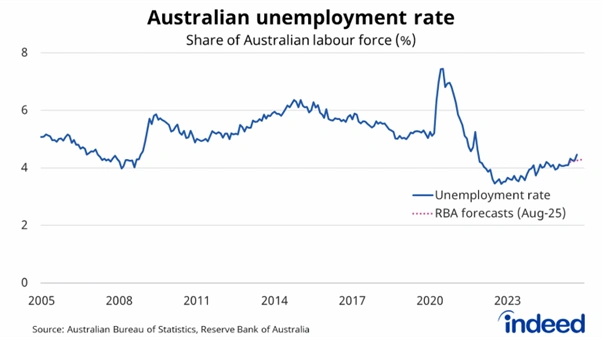
Australia’s labour market delivered a puzzling result in November. The unemployment rate held steady at 4.3% even as the economy shed 21,000 jobs.
The Australian Bureau of Statistics released figures on 11 December showing employment fell for the first time in nine months. Markets had expected 20,000 new positions.
Full-Time Jobs Take the Hit
The job losses came almost entirely from full-time work. These positions dropped by 56,500 in November.
Part-time employment rose by 35,200, partly offsetting the decline. Women gained 29,000 part-time roles while men added 6,000.
The participation rate fell to 66.7% from 66.9% in October. Fewer people actively seeking work kept the Australia unemployment rate from climbing.
Sean Crick, ABS head of labour statistics, noted both employed and unemployed people decreased in November. The unemployed fell by 2,000 while employed dropped by 21,000.
Market Reaction and RBA Implications
The unexpected decline in employment news caught economists off guard. Most analysts had forecast the jobless rate would rise to 4.4%.
Hours worked flatlined after a strong run in recent months. This signals weakening momentum in Australia’s labour market.
The underemployment rate jumped 0.4 percentage points to 6.2% in November. This measures workers who want more hours than they currently get.
The underutilisation rate, combining unemployment and underemployment, rose to 10.5%. That’s 0.5 percentage points higher than November 2024.
Key November 2025 Labour Force Statistics:
- Employment change: -21,300 (vs +20,000 expected)
- Full-time jobs: -56,500
- Part-time jobs: +35,200
- Unemployment rate: 4.3% (vs 4.4% forecast)
- Participation rate: 66.7% (down from 66.9%)
- Underemployment: 6.2% (up 0.4pp)
What This Means for Interest Rates
The Reserve Bank of Australia kept the cash rate at 3.60% at its December meeting. The central bank cited persistent inflation concerns despite three rate cuts earlier in 2025.
Recent inflation data showed CPI jumping to 3.8% in October. That’s the highest level since June 2024.
The RBA’s board minutes from November revealed limited scope for further rate cuts. Officials noted financial conditions remain “slightly restrictive” despite 75 basis points of easing this year.
CBA chief economist Luke Yeaman warns Australia is approaching its economic “speed limit.” The combination of resilient employment and rising inflation complicates the RBA’s path forward.
Labour Market Shows Mixed Signals
Roy Morgan’s alternative employment measures paint a different picture. Their November survey shows 3.34 million Australians either unemployed or underemployed.
That represents 20.9% of the workforce. The figure has stayed above 3 million for 12 straight months.
Roy Morgan CEO Michele Levine pointed to sluggish productivity stifling growth. “No net jobs created compared to a year ago” reveals deeper structural issues, she said.
The disconnect between official ABS figures and Roy Morgan data highlights measurement differences. ABS uses seasonal adjustment while Roy Morgan tracks actual responses.
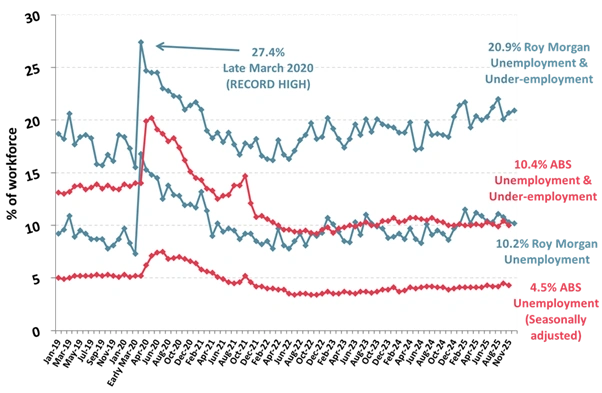
Roy Morgan Unemployment & Under-employment (2019-2025)
Broader Economic Context
Australia’s GDP growth forecasts hover around 1.6-1.7% for 2025. This represents the weakest expansion in years outside the pandemic.
Private demand has strengthened recently. But growth remains well below historical averages.
The housing market continues picking up steam. Investor demand and first-home buyer support drive prices higher in most capital cities.
Financial conditions have eased since early 2025. Yet money market rates and bond yields crept higher in recent weeks.
Business surveys show firms still struggle to find workers. This suggests the labour market remains tighter than headline unemployment numbers indicate.
Trend Data (November 2025):
- Trend unemployment: 4.3% (down from 4.4% in previous months)
- Trend employment growth: +21,000 (+0.1%)
- 12-month employment growth: 1.3%
- Employment-to-population ratio: 63.9%
Global Comparisons
Australia’s labour market performance diverges from major economies. The US Federal Reserve held rates steady after three cuts in late 2024.
The European Central Bank paused its easing cycle at 2% in June 2025. Euro area inflation nears the 2% target with unemployment at record lows.
New Zealand’s Reserve Bank has been more aggressive. It cut rates nine times since August 2024, bringing the cash rate to 2.25%.
Trade tensions and tariff uncertainty cloud the global outlook. The RBA flagged these risks in its recent statement.
What Economists Are Saying
Market reactions to the Australia job losses November data varied. Some economists see persistent labour market tightness supporting higher inflation.
Others point to declining participation as a warning sign. When people stop looking for work, it can mask underlying weakness.
The consensus view expects the RBA to hold rates through early 2026. Any further cuts depend on inflation returning sustainably to the 2-3% target band.
ANZ pushed its next rate cut forecast to the first half of 2026. CBA now expects no change through all of 2026.
NAB points to May 2026 as the earliest timing for the next move. Westpac shares this cautious view.
Looking Ahead
The December quarter CPI data will be crucial. Released in late January, it will shape the RBA’s first meeting of 2026.
The bank’s forecasts assume unemployment stays around 4.2% through June 2026. Recent data suggests this estimate may need revision.
Wage growth continues moderating. The Wage Price Index shows increases slowing from earlier peaks.
Yet real wages are finally rising after years of negative growth. This supports household spending power even as employment growth stalls.
Key Dates to Watch:
- 22 January 2026: December labour force data
- Late January 2026: Q4 CPI release
- 3-4 February 2026: First RBA meeting of 2026
- 18 March 2026: Next quarterly CPI update
The Bottom Line
Australia’s labour market delivered contradictory signals in November. Unemployment held steady despite significant job losses.
The participation rate decline explains why unemployment didn’t rise. But it raises questions about labour market health.
Policymakers face a delicate balancing act. Inflation remains too high to justify aggressive rate cuts. Yet growth is sluggish enough to warrant caution.
The next few months of data will determine whether November was a temporary blip or signals a meaningful shift. For now, the RBA maintains its patient, data-dependent approach.
Australian households and businesses should prepare for rates to stay higher for longer. The combination of sticky inflation and moderating employment growth limits the central bank’s flexibility.
Also Read: Qantas A380 Forced to Halt in LA After Wing Slat Breaks Mid-Flight
FAQs
Q: Why didn’t Australia’s unemployment rate rise when jobs fell?
A: The participation rate dropped to 66.7% from 66.9%. When fewer people actively seek work, it can keep unemployment steady even as employment declines.
Q: When will the RBA cut interest rates again?
A: Most economists now expect the next cut no earlier than May 2026. Some banks like CBA forecast no cuts through all of 2026.
Q: How does November’s job loss compare historically?
A: The 21,300 decline was the largest monthly fall in nine months. It reversed much of October’s 41,200 gain.
Q: What does underemployment mean?
A: Underemployment measures workers who have jobs but want more hours than they currently get. It rose to 6.2% in November.
Q: Is Australia’s labour market still tight?
A: Mixed signals persist. Unemployment is low at 4.3%, but job vacancies are declining and hours worked have flatlined. The RBA describes conditions as “a little tight.”


