

Rio Tinto has thrown down the gauntlet. The world’s second-largest miner unveiled an aggressive restructure at its 2025 Capital Markets Day that promises to reshape the company’s trajectory for the next decade.
Chief Executive Simon Trott, barely five months into the top job, didn’t hold back. His blueprint targets productivity gains, tighter capital spending and a major portfolio shake-up.
The market responded with guarded optimism. Rio’s London-listed shares climbed more than 2% in early trading on 4 December 2025.
The Numbers That Matter: $650 Million and Counting
Rio Tinto has already banked $370 million in productivity gains during the first three months of the restructure. The remaining $280 million will land by March 2026.
The savings come from simplified organisational structures and sharper focus on core operations. Job cuts are part of the equation, though Trott declined to specify headcount reductions.
“We are delivering strong early productivity benefits and cost savings with more to come,” Trott stated during the London presentation.

Simon Trott, Chief Executive, Rio Tinto
The company projects a 4% reduction in unit costs between 2024 and 2030. This cost discipline forms the foundation for Rio’s earnings growth ambitions.
Copper Takes Centre Stage
Rio substantially upgraded its 2025 copper production forecast. The miner now expects output between 860,000 and 875,000 tonnes on a consolidated basis.
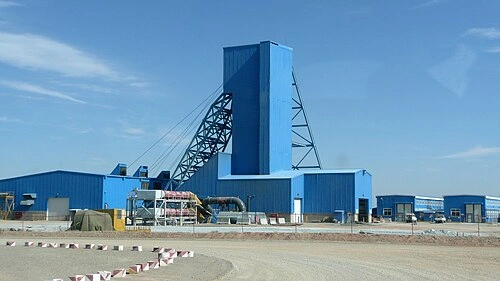
That marks a significant jump from the previous guidance range of 780,000 to 850,000 tonnes. The upgrade reflects the ramp-up at Mongolia’s Oyu Tolgoi mine.
Copper output from Oyu Tolgoi is set to surge more than 50% in 2025. Production should increase another 15% in 2026.
The strategic shift toward copper mirrors broader industry trends. Rio aims to produce 1 million tonnes annually by 2030.
Unit cost guidance for copper also improved. Rio now forecasts 80-100 cents per pound, down from the previous 110-130 cents per pound range.
Capital Discipline Gets Serious
Rio mapped out clear capital expenditure targets. The miner will invest approximately $11 billion in both 2025 and 2026.
From 2028 onwards, annual capex drops below $10 billion. The reduction reflects completion of major replacement projects.
The mid-term guidance signals tighter control over capital allocation. Rio plans to scrutinise every project against strict return thresholds.
“Across each of our three product groups: copper, aluminium, lithium, and iron ore, we’ve got really good growth projects and they need to compete for capital,” Trott explained.
The company also slashed decarbonisation capital estimates. The revised target of $1-2 billion through 2030 replaces the previous $5-6 billion projection.
Three Core Businesses, One Streamlined Strategy
Rio formally consolidated operations into three divisions. The new structure focuses on Iron Ore, Copper, and Aluminium & Lithium.
This simplification eliminates a fourth business unit. The change reflects Rio’s strategic decision to concentrate resources on the highest-return assets.
Iron ore still generates over 80% of underlying earnings. However, Rio is working to diversify revenue streams and reduce dependence on a single commodity.
The streamlined approach should accelerate decision-making and improve operational efficiency across the portfolio.
$5-10 Billion Asset Release Programme
Rio identified opportunities to release $5-10 billion from its existing asset base. The company will seek third-party funding where costs fall below Rio’s capital requirements.
Strategic reviews of iron and titanium operations are progressing. The borates business also faces potential divestment or partnership arrangements.
“Rio Tinto has undertaken a thorough review of its global assets and identified some that it does not need to own,” Trott told media.
The next phase focuses on testing market appetite for these assets. Proceeds will strengthen the balance sheet while maintaining shareholder returns.
Rio’s 40-60% dividend payout policy remains unchanged. The company has maintained this commitment for nine consecutive years.
Production Guidance: Mixed Signals Across Commodities
Bauxite production guidance received an upgrade. Rio now expects output to exceed the previous 59-61 million tonne range.
Aluminium production should hit the upper end of the 3.25-3.45 million tonne guidance range. These upgrades reflect operational improvements.
However, Iron Ore Company of Canada (IOC) production guidance dropped to 9.0-9.5 million tonnes. The previous forecast ranged from 9.7-11.4 million tonnes.
For 2026, Rio provided comprehensive guidance across all commodities. Total iron ore sales should reach 343-366 million tonnes on a 100% basis.
This includes Pilbara output of 323-338 million tonnes. Guinea’s Simandou project should contribute 5-10 million tonnes.
Lithium production guidance stands at 61-64 kilotonnes for 2026. Rio plans to reach approximately 200 kilotonnes per annum capacity by 2028.
EBITDA Growth: The 40-50% Ambition
Rio projects potential EBITDA growth of 40-50% by 2030. The forecast assumes long-run consensus commodity prices.
Three factors drive this ambitious target:
- 20% growth in copper-equivalent production
- 4% annual unit cost reduction
- Disciplined capital allocation
The earnings diversification strategy reduces reliance on iron ore. Copper and aluminium contributions will grow significantly by decade’s end.
Rio’s growth plan depends heavily on project execution. The Oyu Tolgoi expansion, Simandou ramp-up, and lithium operations must deliver on schedule.
Analyst Perspectives: Decent but Not Dazzling
RBC Capital Markets called the update “decent” but noted it wasn’t expecting a strong market reaction. The firm viewed the announcements as largely anticipated.
Goldman Sachs analysts estimate a 10-day strike could cost Rio up to $250 million in earnings at operations like Escondida. Extended disruptions pose significant financial risks.
Barclays analyst Amos Fletcher highlighted that cost-cutting targets could substantially boost 2030 consensus EBITDA. The 4% annual unit cost reduction represents a meaningful driver.
However, Fletcher also noted that near-term production guidance for 2026 fell 3% below consensus estimates. The Simandou ramp-up appears slower than some investors anticipated.
Industry Context: A Pivotal Moment for Mining
Rio’s restructure comes amid shifting commodity demand patterns. Copper demand continues surging on electrification trends and renewable energy infrastructure buildouts.
Meanwhile, iron ore faces uncertain long-term prospects as China’s economic growth slows. The property sector slump directly impacts steel demand.
Global miners are responding with portfolio reshaping. Anglo American and Teck Resources recently proposed a $53 billion merger.
Rio itself held preliminary discussions with Glencore about a potential combination earlier this year. Trott dismissed further large-scale consolidation unless it delivers clear synergies.
The competitive landscape favours companies with exposure to energy transition metals. Rio’s push into copper and lithium positions it for this shift.
What This Means for Investors
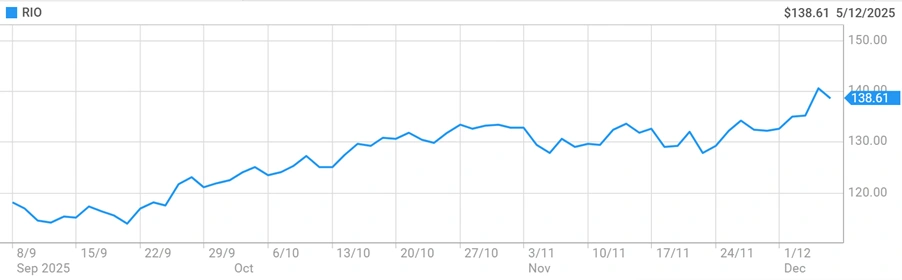
Rio Tinto shares (ASX: RIO) traded at $119.85 as of 5 December 2025. The stock sits within a 52-week range of $105.11 to $136.82.
Market capitalisation stands at approximately $143 billion. The company maintains a conservative net debt position despite heavy capital investment plans.
Investors should monitor several key milestones:
- Quarterly production reports tracking copper ramp-up progress
- Updates on strategic asset reviews and potential divestments
- Cost reduction achievement against the $650 million target
- Simandou iron ore project development timeline
- Lithium market conditions and pricing trends
The restructure timeline extends through the end of the decade. Near-term financial performance may face pressure as transition costs hit earnings.
However, successful execution could position Rio as the “most valued” miner globally by 2030, matching Trott’s stated ambition.
Challenges Ahead
Rio faces multiple execution risks. The productivity programme requires cultural change across a 57,000-person global workforce.
Labour relations remain sensitive following the Juukan Gorge destruction controversy. Union resistance to restructuring could complicate cost-cutting efforts.
Commodity price volatility poses another challenge. Iron ore prices around $95 per tonne support current margins but could weaken further.
Geopolitical tensions affect several key operations. The Oyu Tolgoi mine in Mongolia requires careful stakeholder management.
Guinea’s Simandou project depends on political stability in West Africa. Infrastructure constraints could delay the production ramp-up.
The Bottom Line
Rio Tinto’s 2025 Capital Markets Day outlined a comprehensive strategy for the next phase of growth. The plan combines aggressive cost reduction with selective capital investment.
Trott’s approach reflects lessons from industry cycles. Disciplined capital allocation and operational excellence form the strategic core.
The market’s initial response suggests cautious optimism. Investors want to see execution before rewarding the strategy with higher valuations.
Rio’s track record of project delivery will face scrutiny. The Oyu Tolgoi expansion must meet revised targets after years of delays and budget overruns.
For now, the mining giant has set a clear direction. Whether it reaches the destination depends on flawless execution over the next five years.
Also Read: Provaris Energy Sets New Benchmark with Robotics Facility for Next-Generation H2 and CO₂ Tanks
FAQs
Q: What are the main goals of Rio Tinto’s restructure?
A: Rio Tinto aims to achieve $650 million in productivity gains, reduce unit costs by 4%, boost copper production 13%, and release $5-10 billion from asset sales while maintaining strong shareholder returns.
Q: Why is Rio Tinto focusing more on copper production?
A: Copper demand is surging due to electrification trends, electric vehicle production requiring 80-100kg per vehicle, and renewable energy infrastructure buildouts. Rio aims to produce 1 million tonnes annually by 2030.
Q: How much will Rio Tinto invest in capital expenditure?
A: Rio will invest approximately $11 billion annually in 2025 and 2026, then reduce spending to below $10 billion per year from 2028 onwards as major projects reach completion.
Q: What assets is Rio Tinto considering selling?
A: Strategic reviews are underway for iron and titanium operations plus borates businesses. The company seeks to release $5-10 billion through partnerships, divestments or third-party funding arrangements.
Q: How is Rio Tinto’s new CEO Simon Trott different from his predecessor?
A: Trott brings operational mining experience and focuses on “stronger, sharper, simpler” operations with tighter capital discipline. His predecessor Jakob Stausholm emphasised cultural change following the Juukan Gorge incident.


