
Westpac Banking Corporation (ASX: WBC) has issued its WBC sustainability update for 2025, outlining new climate transition measures, portfolio targets, and sustainable finance growth. The announcement includes the bank’s latest Climate Transition Plan, released in November, alongside refined sector requirements and updated emissions data. The update forms a core element of the Westpac sustainability 2025 program, which strengthens the bank’s long-term ESG strategy.
Westpac has released its 2025 Sustainability Update, outlining new climate and finance commitments
The update covers the bank’s national and regional activities, including lending policies, climate-risk governance, emissions pathways, and progress on Westpac’s environmental commitments. Westpac remains Australia’s largest financier of renewable projects, with no exposure to thermal coal mining at the corporate level.
Key Findings and Performance Metrics
Westpac reported strong progress across its sustainability pillars. The WBC sustainability update highlights improved emission profiles, expanded customer engagement, and increased capital allocation to sustainable finance.
Key findings include:
- Zero exposure to thermal coal mining as of 30 September 2025.
- More than 70% of financed emissions sector targets now show a lower emissions profile.
- A 37% increase in sustainable finance lending year on year.
- A 40% rise in sustainable bond facilitation activities.
- Over 130 engagements with institutional customers on climate transition plans.
- Westpac ranked #1 in Australian renewable project financing in FY25.
These results position the bank ahead of many global peers, particularly on coal exit policies and renewable lending exposure.
Climate and Economic Implications
The release of the new Climate Transition Plan reflects changing global demand for low-carbon investment. Rising international requirements for ESG transparency continue to influence bank lending and institutional decision-making. Westpac’s targets align with the well-below-2°C Paris Agreement goal.

Chief Sustainability Officer Dr Fiona Wild
Chief Sustainability Officer Dr Fiona Wild said the strategy aims to provide clarity for customers navigating transition pathways.
“We are supporting our customers to decarbonise while ensuring operational resilience across the bank,” she said.
“Our updated plan delivers a pragmatic approach, backed by firm targets and customer engagement.”
Sustainable finance commitments remain a major economic driver. The bank has pledged $55 billion in sustainable lending and $40 billion in sustainable bond facilitation by 2030. Current progress shows steady momentum towards these goals, supported by strong renewable infrastructure investment and increased customer demand for green financial products.
Resource, Data and Portfolio Updates
The WBC sustainability update includes detailed reporting on operational and financed emissions.
Key data points:
- A 76% targeted reduction in Scope 1 and 2 emissions by 2030, based on a 2021 baseline.
- A 50% targeted reduction in upstream Scope 3 emissions by 2030.
- FY24 financed emissions measured at 31.6 MtCO₂-e.
- 89% of electricity-sector lending is directed to renewables.
- Sustainable lending exposure reached $39.4 billion as of September 2025.
The update also outlines sector-level financed emissions progress, with significant reductions recorded in thermal coal mining, power generation, aviation, and commercial real estate. Some agricultural sectors showed marginal increases due to production variability, but all sectors remain aligned to long-term 2030 reduction pathways.
Westpac continues to refine methodologies to match evolving global standards, with full details provided in the bank’s 2025 Annual Report and Sustainability Report.
Market and Strategic Context
The sustainability update reflects increasing industry pressure to address climate-related risks. Global forecasts show strong growth in renewable energy, electric vehicles, electrification infrastructure, and sustainable agriculture.
Westpac’s strategy positions it competitively against regional and global banks, many of which continue to face regulatory scrutiny and supply-chain constraints. Australia’s stable regulatory environment and large renewable-resource base remain a jurisdictional advantage for the bank.
Institutional customers are now required to demonstrate credible climate transition plans for new or renewed facilities. Of those assessed:
- 55% received an A rating.
- 36% received a B rating.
- 9% received a D rating and may decline financing.
This signals a tightening of lending standards that aligns with broader shifts in global sustainable finance.
Investor Outlook
Westpac Banking Corporation’s WBCPK securities last traded at $104.99, down 0.26% for the day. Trading volume reached 13,487, with a bid–offer range of $104.82 to $104.99.
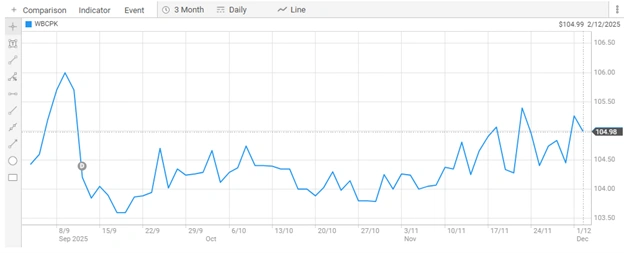
Westpac Banking Corporation Share Price
Market performance for WBCPK has remained stable despite broader financial-sector volatility. Investors continue to monitor Westpac’s sustainability strategy, capital allocation trends, and progress on its transition targets. Analysts note that demand for ESG-aligned securities remains resilient, supported by strong institutional interest and the bank’s long-term positioning under the WBC sustainability update and broader Westpac sustainability 2025 agenda.
Sentiment remains balanced, with sustainability-linked performance expected to play a growing role in future credit and equity valuations.
Also Read: Government Finally Releases Damning Report on Appointments Process After Two-Year Delay
Conclusion
The WBC sustainability update reinforces Westpac’s commitment to leading the transition toward a lower-carbon economy. The new Climate Transition Plan, strengthened emissions targets, and expanded customer engagement position the bank to play a central role in Australia’s future energy and sustainability landscape.
For investors and industry analysts, the update provides clear visibility into Westpac’s climate-aligned strategy, capital allocation, and long-term growth positioning within global supply chains.